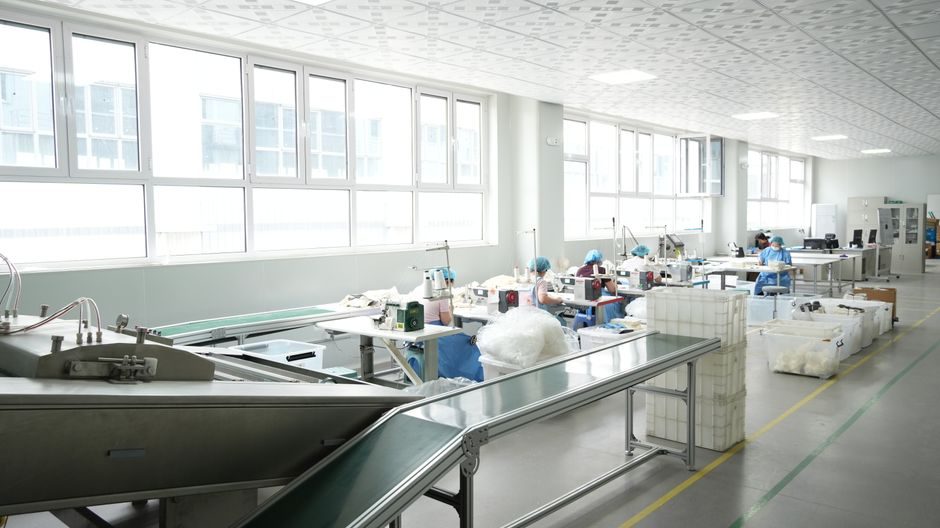
For PCB, SMT tray, and cleanroom subassembly lines, mesh belt conveyors are commonly specified as 304 stainless steel balanced weave or polyester monofilament mesh, with edge finish, opening size, and belt tracking tolerance — the same ≤3 mm roller-to-belt centerline limit used in general conveyor maintenance [S1] — as the dominant selection criteria.
Electronics handling differs from bulk-material conveying in three measurable ways: part weight per unit area is low (typically under 5 kg/m of belt width), contamination tolerance is tight (often ISO Class 7 cleanroom or better), and ESD sensitivity rules out carbon-black-loaded rubber covers, pushing designs toward stainless or thermoplastic monofilament meshes [S3][S5].
Material and weave selection: 304 SS balanced weave vs polyester monofilament
304 stainless steel balanced weave belts, with the mesh and cross rod in T304 stainless and side chains in carbon steel, are the default choice when line temperature exceeds the polyester limit or when the belt must survive wash-down [S3]. Polyester plain-weave monofilament mesh — also called linear screen cloth or polyester mesh conveyor belt — is supplied in 2-shed and 3-shed patterns with selectable mesh count, caliper, GSM, and air permeability, and is the lighter, non-contaminating option for tray and component transfer [S5]. A 304 SS balanced weave typically outlasts polyester by a factor of 3-5 in hot-air solder reflow or wave-solder preheat zones, but adds 4-8× the mass per square meter, which raises the required belt tensioner take-up force and the drive motor kW rating.
Belt deviation control: 3 mm roller alignment is the field-tested limit
Belt deviation is the most frequently reported mesh belt failure mode, and the published field procedure fixes the transverse-vs-longitudinal centerline non-coincidence of the idler rollers at ≤3 mm before adjustment is required; if the offset exceeds 3 mm the elongated mounting holes on the roller frame must be used to shift the roller group forward or backward in the direction of the drift [S1]. A second tolerance — ≤1 mm parallelism between the head-drum and tail-drum bearing-seat planes — applies directly to the conveyor frame, and exceeding it produces the same drift on a mesh belt conveyor as on a conventional rubber belt, with the additional risk that a drifting woven metal edge can snag SMT component leads [S1].
Contamination, ESD, and cleanroom envelope

Electronics lines reject the particulate shedding and carbon-black residue of fabric-plied rubber belts, and metal wire mesh or polyester monofilament are the two widely used alternatives because both can be specified without organic fibres in the contact zone [S3][S5]. Where ESD-sensitive components are handled, a stainless mesh is usually paired with a dissipative earthing brush on the tail pulley rather than a conductive belt compound; the alternative — antistatic polyester — is available in the same monofilament product family but with surface resistivity in the 10⁹-10¹¹ Ω range, a value that should be confirmed against the line's ESD programme (ANSI/ESD S20.20) rather than assumed.
Drive and tension: matching motor kW to mesh weight and width
Mesh belt conveyors are mechanically a subset of belt conveyor design, and the published general-conveyor envelope — inclination up to 30-90°, small footprint, large transport volume, and smooth horizontal-to-incline transition — applies to mesh lines as well, but with the additional constraint that the moving mass is dominated by the belt itself [S1]. As a rule of thumb used by Chinese conveyor OEMs, a 600 mm wide 304 SS balanced-weave mesh at 1 m/s needs roughly 0.55-0.75 kW on a 5 m horizontal run, while the same line in polyester monofilament drops to 0.18-0.25 kW; these are planning values, not selection outputs, and the final motor must be sized from the supplier's actual belt weight per m² plus product load.
Width, opening size, and component-geometry fit
Mesh opening is the spec most often mis-sized on electronics lines: a 4×4 mm opening is fine for tray bottom support but will let a 5 mm wide QFN lead pass through, while a 2×2 mm opening can trap solder paste balls on a return run. Polyester monofilament mesh is available across a wide range of mesh counts and air-permeability values, which lets the designer trade off support flatness against drainage or suction-box under-belt vacuum [S5]. For woven stainless, Shuke's product line lists T304 stainless as the standard mesh and cross-rod material, with carbon-steel side chains — a combination that the supplier cites as suitable for foodstuff, chemical, and furnace applications, and that translates well into wave-solder and reflow preheat zones on an electronics line [S3].
Who a mesh belt conveyor is — and is not — for
A mesh belt conveyor is the right answer when the product is rigid, flat-bottomed, and small-to-medium in mass, when the line requires wash-down or operates above 150 °C, and when the surrounding air must stay low-shed — SMT magazines, PCB inspection, wave-solder, reflow, and battery-cell stacking are the canonical fits. It is the wrong answer for finished-carton palletising (use a flat-belt or roller conveyor), for OHT-compatible long-run interbay transport (where a ribbed belt or power-roller line dominates), and for any application that demands a hermetic seal between belt and frame, because every woven mesh is by design an open structure. For a deep dive on the heavier-duty end of the same belt family, the spec map for chemical-shipping mesh belt conveyors lays out the same selection logic against a more aggressive corrosion and temperature envelope. [S1]
Common failure modes and field signals to track

Three failure signatures cover most mesh-belt service calls on electronics lines: (1) edge wire fatigue or unravelling, which traces back to roller misalignment above the 3 mm threshold or to a missing steel mesh edge reinforcement; (2) product marking, usually caused by a worn cross-rod or a broken spiral pressing into the component, and corrected by section replacement rather than full-belt scrap; (3) tracking drift that reappears within a shift, which almost always points back to the 1 mm head-to-tail bearing-seat parallelism rather than to the belt itself [S1]. When a Chinese-side parts logistics line is being compared with an electronics line, the automotive-parts mesh belt spec map shows where the same woven-mesh platform is pushed to higher unit loads and where the electronics envelope diverges.
Two trackable signals for the next procurement cycle: published price-per-metre for T304 balanced-weave mesh in 600-1200 mm widths, and the revision status of any supplier datasheet that still lists carbon-steel side chains for cleanroom or ESD-sensitive zones — both are concrete values a spec engineer can re-quote in 90 days rather than vague market chatter.