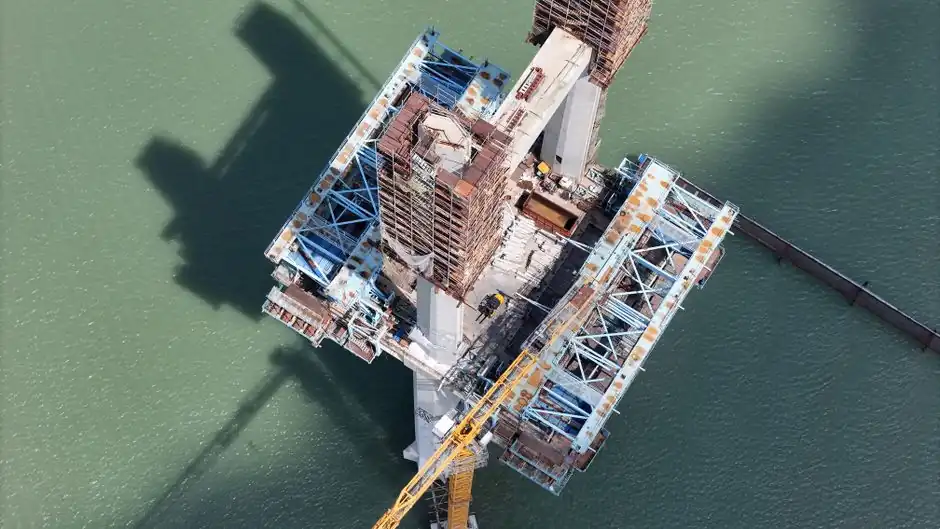
Bridge pylon construction above 60 m almost always routes through a crane-lifted jump form or a hydraulic self-climbing (SCL) formwork system, with the dividing line driven by repetition count, crane time, and shaft geometry [S1][S3]. Below that height, cantilever climbing formwork remains the cost default for low-pier and box-girder projects where cycle counts stay under 20 pours [S4].
Bridge steel formwork for piers, bent caps, T-beams, U-beams, and box girders sits in a separate category from climbing formwork and is selected for reusability across spans, not for vertical repetition [S5]. Selecting the wrong family is the single most expensive mistake on a multi-span bridge program, since retrofitting a self-climbing system mid-cure cycle is impractical.
Crane-Lifted Jump Form Versus Hydraulic Self-Climbing
Crane-lifted jump form systems, including the JB-240 pattern, move full wall-formwork assemblies upward in stages by tower-crane pick after each pour reaches stripping strength, and they remain the workhorse for high-rise cores, shear walls, bridge pylons, silos, and similar vertical concrete structures [S1]. Hydraulic self-climbing systems decouple the lift from the crane entirely, climbing on integrated hydraulic rams through anchor cones left in the previous lift, which preserves crane capacity for rebar, steel, and mechanical hoists [S3].
The crossover sits around 60-80 m of pylon height: below it, the capex premium of a self-climber rarely pays back within a single structure; above it, the saved crane hooks, the schedule stability in Level 5 winds (operating envelope specified for modern hydraulic climbers), and the ability to keep climbing through crane-bottlenecked windows usually justify the investment [S3]. A direct comparison on four decision criteria clarifies the choice:
Decision criterion: Crane dependency. Crane-lifted jump form relies on tower-crane availability to lift the formwork assembly upward between concrete pours. Hydraulic self-climbing: zero crane hooks for the formwork lift itself, freeing the crane for rebar and structural steel [S3].
Decision criterion: Wind tolerance. Crane-lifted jump form: limited to safe rigging conditions, typically stopped at Beaufort 3-4. Hydraulic self-climbing: rated to operate up to Beaufort 5 (Level 5 wind) on modern OEM systems, with the structure itself tied to the host concrete at all times [S3].
Decision criterion: Repetition economy. Crane-lifted jump form: cost-effective from 5 to 30 pours, where crane time is cheap and the geometry is stable. Hydraulic self-climbing: cost-effective from roughly 20 pours upward, where the upfront assembly premium amortizes across repeated identical cycles [S3].
Decision criterion: Shaft geometry. Crane-lifted jump form: needs a swing radius for the panel set. Hydraulic self-climbing: accommodates narrow-shaft and variable cross-section pylons through integrated rollback carriages and synchronised multi-cylinder lifting [S3].
Where Climbing Formwork Beats Cantilever and Timber
Cantilever climbing formwork, widely applied in high-rise buildings, bridge pylons, core walls, and large-scale infrastructure projects, is the third option and the one to pick when pylon heights stay under 60 m and cycle counts are low [S4]. It is essentially a one-sided formwork anchored to the previously cast lift, with no hydraulic rams and no crane pick per cycle. Compared with timber formwork, a properly designed steel climbing system delivers higher strength, better dimensional accuracy, longer service life, and greater reusability, which matters on bridge piers where consistent concrete cover and plumbness are spec-driven [S5].
Bridge piers, T-beams, U-beams, and balanced-cantilever segments are commonly built with custom steel formwork rather than climbing rigs, since the geometry is not vertical-repetitive in the same sense as a pylon [S5]. The selection logic splits cleanly: climbing systems solve vertical repetition, steel bridge formwork solves horizontal-span repetition.
Cleaning, Maintenance, and Throughput on the Pylon Face
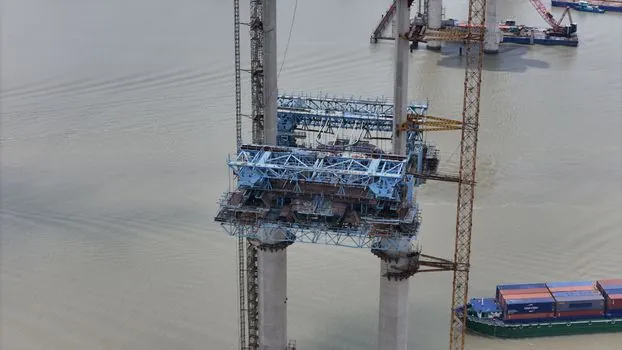
Cleaning of the climbing formwork face is a hidden cycle-time sink, and a 2026 prototype automatic cleaning system for cast-in-place concrete bridge tower wooden formwork has been demonstrated at 1 m^2/min, a 60% efficiency improvement over manual cleaning, with effective operation on vertical surfaces from 0 to 6 m [S2]. The system is designed to cut the manual high-altitude exposure that has historically driven the labour-intensity and safety record on tall pylon pours, and it is sized for the same 0-6 m vertical face that a single climbing lift presents [S2].
Throughput-wise, the cleaning system matters because every minute spent on face prep is a minute the climbing rig is not climbing, and a self-climber on a 100 m pylon typically needs 30-45 min per lift including anchor setting, rollback, and re-engagement. Reducing the cleaning step from a manual rope-access team to a 1 m^2/min automated pass can compress the cleaning share of that cycle from roughly 90 min to under 30 min on a typical 6 m lift [S2].
Bridge Steel Formwork for Piers, Caps, and Girders
Bridge steel formwork systems cover pier shafts, bent caps, cofferdams, guardrails, T-beams, U-beams, balanced-cantilever segments, box girders, and section girders, and are engineered for high concrete pressure, complex geometry, and tight schedules on highway, railway, municipal, viaduct, and overpass bridges [S5]. They are usually selected on bridge design complexity, load requirements, construction schedule, reusability needs, project budget, and supplier engineering capability, with most projects requiring custom solutions rather than catalogue panels [S5].
For pier and bent-cap work the formwork is almost always a vertical or near-vertical steel panel system re-used across many piers in a corridor, which is functionally a horizontal analogue of climbing formwork in that the same rig walks from pier to pier [S5]. For T-beam, U-beam, and box-girder segments the rig becomes a self-supporting casting cell with internal soffit form, side form, and end bulkhead, sized to the segment length and tendon profile.
Selection Decision Map for Bridge Scope

For a bridge project the selection tree runs: (1) identify the structural element: pylon, pier, cap, or girder. (2) For pylons above 60 m with high repetition, default to hydraulic self-climbing. (3) For pylons under 60 m with low repetition, default to crane-lifted jump form or cantilever climbing. (4) For piers, bent caps, and girders, default to custom steel bridge formwork re-used across the corridor. (5) For pylon-face cleaning, fold in an automatic cleaning pass rated to the 0-6 m vertical face at roughly 1 m^2/min to recover the 60% efficiency delta over manual cleaning [S2][S3][S4][S5].
The capital gate is repetition count: self-climbing pays back above roughly 20 pours, jump form in the 5-30 pour band, and cantilever climbing below 20 pours where the geometry is stable [S3]. Wind tolerance is the secondary gate on coastal or valley-crossing bridges, where Level 5-rated hydraulic climbers keep the cycle running when crane-lifted rigging would be grounded [S3].
For broader equipment context across the site, see the spec map for climbing formwork selection for electrical installation scopes and the industrial coating selection for construction reference, both of which feed the same selection tree at the pylon-face and corrosion-protection boundaries. The climbing formwork page on this site covers the definition and core mechanism of climbing formwork for readers new to the category.
Trackable signals to watch over the next 6-12 months: published cycle-time data from automatic cleaning system retrofits on operating pylon sites, OEM disclosures of Level 5 wind-rated hydraulic climber envelopes, and the next round of bridge steel formwork projects releasing repetition-count and re-use data. Reference the bridge formwork overview for the wider equipment context.
For the relevant spec sheets and selection criteria, see overhead bridge crane.