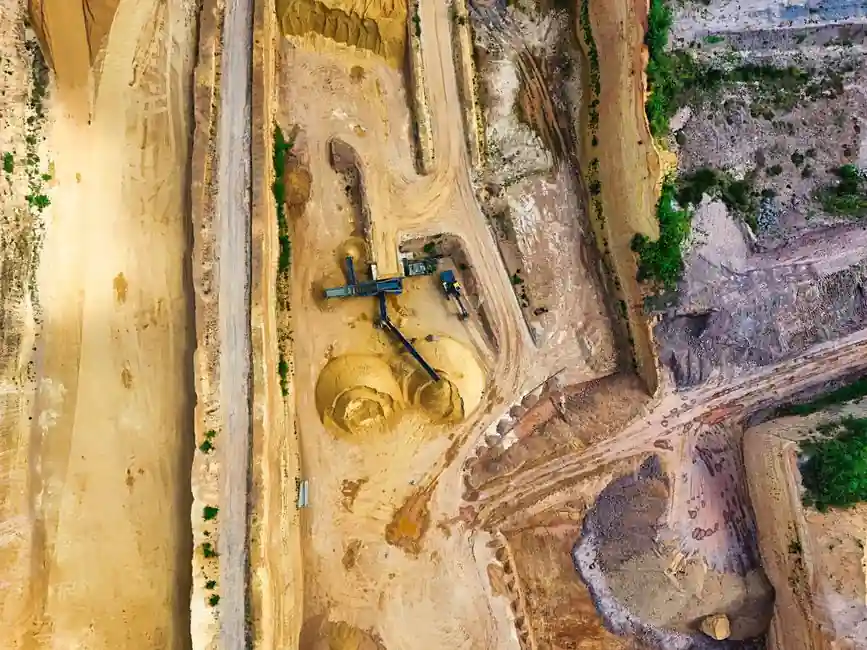
For rotary drill masts, roof bolters, and crusher booms on mining rigs in 2026, worm-gear slewing drives are the default pick because their self-locking geometry (reduction ratios above 30:1) holds the load when hydraulic pressure drops, eliminating the runaway risk on inclined surfaces [S5].
Planetary and hydraulic slewing drives are reserved for continuous-rotation duty such as conveyor stacker-reclaimers and large 360° hydraulic excavators, where the self-lock penalty is not needed and higher duty cycles justify the added cost and complexity [S5]. This split is now consistent across both Asian OEM catalogues and North-American end-user guidance published between May and August 2026 [S5][S7].
Mining Load Profile and Why 3–5× Dynamic Factor Matters
A mining-grade slew drive must handle simultaneous axial, radial, and tilting-moment loads, and on a blasthole drill the static tilting moment frequently exceeds 100 kNm before any rock-strike event is added [S5]. The real design driver, however, is the dynamic shock: when a drill bit fractures rock or an excavator bucket hits a boulder, instantaneous load can spike to 3–5× the steady operating value, and a standard industrial slew drive typically fails within weeks in this regime [S5]. To absorb that shock, mining-grade units use through-hardened gears, induction-hardened raceways, and high-grade bearing steels such as 42CrMo4, which resist plastic deformation at the impact peak [S5].
Open-pit sites also impose a -30°C to +50°C ambient swing, persistent silicate-dust abrasion, and acidic underground water, so the sealing system has to clear at least IP66 with multi-lip or labyrinth geometry, and exterior coatings should be zinc-nickel, epoxy primer, or stainless fasteners to protect bolt retention and raceway surfaces [S5]. Skipping the dynamic factor is the single most common cause of premature slew-drive failure on production drill rigs, in the field data cited by Lyra Drive's 2026 mining application note [S5].
Worm-Gear vs Planetary Slewing Drive: Selection Matrix
For a rotary blasthole drill mast or an underground roof bolter, the self-locking worm gear is a safety requirement, not a convenience, because the geometry alone prevents back-driving when the hydraulic motor is de-energised [S5]. The same logic applies to a mobile crusher feed boom, where vibration and a hanging load make hold-position behaviour more important than continuous slewing speed [S5]. A worm unit with a reduction ratio above roughly 30:1 has a lead angle below the friction angle, which is the geometric condition that guarantees self-locking [S5].
For conveyor stacker-reclaimers and large 360° hydraulic excavators, planetary or fully hydraulic swing drives win because they deliver higher continuous torque density, faster indexing, and no self-lock penalty during normal cycling [S5][S8]. Above 40 tonnes of excavator operating weight, hydraulic swing drives dominate on torque density, overload tolerance, and integration with the machine's existing hydraulic circuit, while electric swing drives are only viable on new-energy machines or in well-ventilated underground faces with strict diesel-emission limits [S8].
SE-Series 21" Slewing Drive: The Mining Benchmark Size
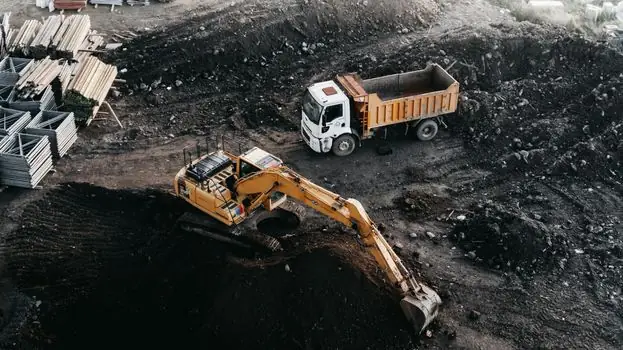
The 21-inch frame size is the de-facto benchmark for mid-to-large mining machinery, and the SE21 spec line is widely published: 15 kNm output torque, 135.6 kNm tilting-moment torque, 72.3 kNm holding torque, 970 kN static axial load rating, 390 kN static radial load rating, with a 150:1 gear ratio, 40% mechanical efficiency, IP66 enclosure, and a hydraulic-motor input [S3][S4]. Smaller SE3 through SE17 frames cover the rest of the duty range, scaling from 0.4 kNm output at SE3 up to 10 kNm at SE17, with axial ratings rising from 30 kN to 970 kN across the same span [S4]. The full SE3 to SE25 line lets a buyer right-size the slew drive to the host machine instead of over-spec'ing the bearing diameter.
Beyond the SE worm line, the spur-worm SP-H "Heavy Duty" configuration, with spur gear architecture inside a fully enclosed cast-iron housing, targets combined axial, radial, and overturning-moment loading, and is rated for severe outdoor environments including high-dust and high-shock mining and material-handling duty [S1]. For a U.S. heliostat-style solar field adjacent to a mining site, the SP-H-0455-40/1008 has been shipped to less than 0.08° rotational accuracy to meet utility-scale solar positioning requirements, with self-locking for wind loads and a low-maintenance sealed package for remote desert installs [S1].
Hydraulic vs Electric Swing Drive for Mining Excavators
Hydraulic swing drives remain the default above 40-tonne excavator class because they deliver higher torque density, better short-term overload tolerance, and a simpler mechanical interface with the carrier machine's existing hydraulic system [S8]. Electric swing drives are not yet a direct swap-in for that class; they fit mainly new-energy construction platforms, machines tethered to mine-site electric reticulation, or underground LHDs and drills where ventilation requirements cap diesel particulate and make electric swing economically attractive [S8].
For an electric retrofit or a BEV excavator, the integration cost is the gating factor: the swing drive must match the machine's DC bus voltage, regen-braking strategy, and thermal envelope, and most suppliers in mid-2026 are still pairing electric swing with permanent-magnet motors in the 30–90 kW class rather than offering a full drop-in kit [S8]. On a 100-tonne-class rope shovel or hydraulic excavator, the same operating-weight rule still applies: hydraulic swing unless there is a specific mine-wide electrification mandate driving the choice [S8].
Spec Gates and Acceptance Criteria Before You Order
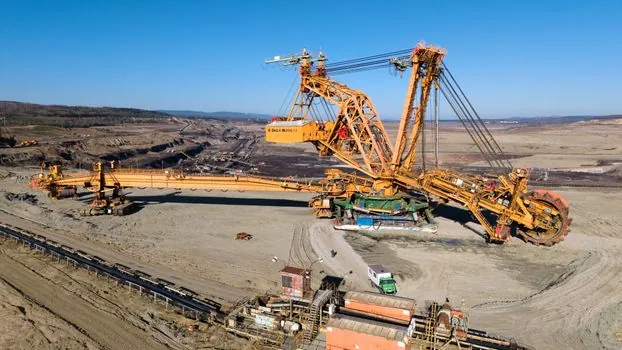
Every mining slew-drive order should be checked against five numeric gates before sign-off: (1) output torque at the worst-case load with a 1.5× minimum service factor, (2) tilting-moment torque with the 3–5× dynamic factor applied to the steady moment, (3) static axial and radial ratings above the host structure's peak reaction loads, (4) gear ratio above 30:1 if self-locking is required for safety on inclined masts or hanging loads, and (5) IP66 or IP67 sealing matched to dust, water, and chemical exposure on site [S5][S4]. The slewing drive envelope and how it integrates with the host's slewing ring bearing and slewing bearing should be reviewed together, since the bearing raceway and the gear set share the same load path.
Confirm also that the input interface matches the machine: a hydraulic-motor input with the right mount flange, or a matched electric servo or drive-motor package sized for the start-stop duty cycle, and verify the certifications expected by the end customer (CE and ISO 9001 are typical for Asian OEM exports, with country-specific marks such as MSHA expectations on U.S. underground equipment layered on top) [S3][S4]. For a related haul-fleet spec that often pairs with slew-drive choices, see Mining Dump Truck Selection for Quarrying on the matching duty cycle, and a VFD selection map for the conveyor side of a stacker-reclaimer. The SE21 21-inch worm-gear slewing drive with 150:1 ratio, 40% efficiency, IP66 sealing, and a 2000-piece-per-month production capacity remains the default mid-2026 export SKU from major Chinese OEM lines for truck cranes, crawler cranes, ship cranes, and mining machinery [S3].