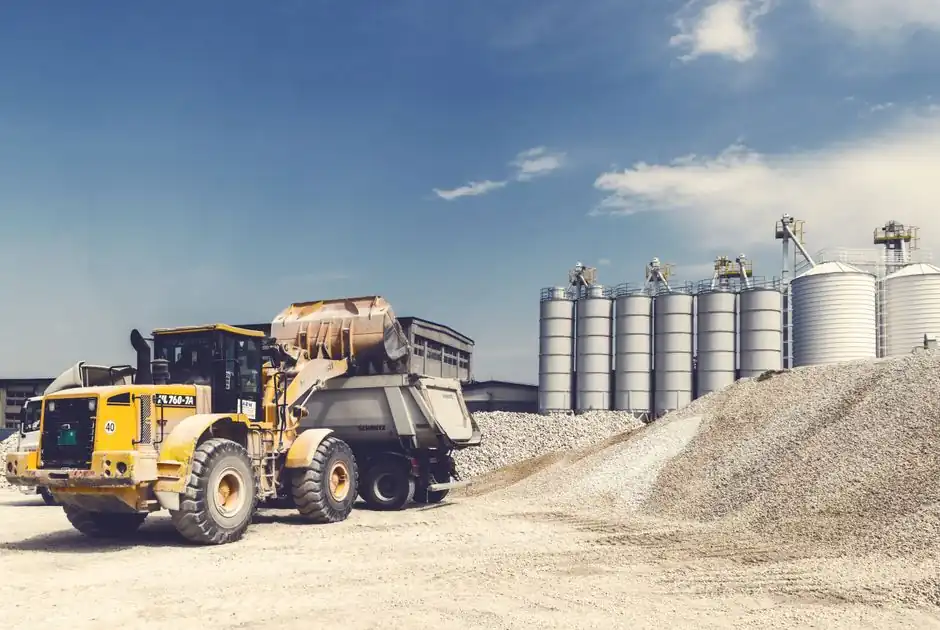
Open-pit mining operations use four main truck classes, and the wrong choice is paid for in tyre wear, fuel, and lost cycles: rigid haul trucks (90 to over 400 t payload, engines above 1,500 hp), articulated dump trucks (20 to 60 t, 6×6 drive, oscillating hitch), rear-dump trucks (medium distances, gradients up to 12%), and bottom-dump trucks (flat hauls, gradients under 5%) [S3][S4].
The selection pivot is not brand, it is haul-road quality and cycle distance: rigid trucks repay their capital only on well-maintained, firm roads, whereas ADTs absorb poor ground but cap payload and top speed, a trade-off the mining dump truck category makes explicit when comparing machine classes.
Rigid Haul Trucks: High Payload, High Road Tax
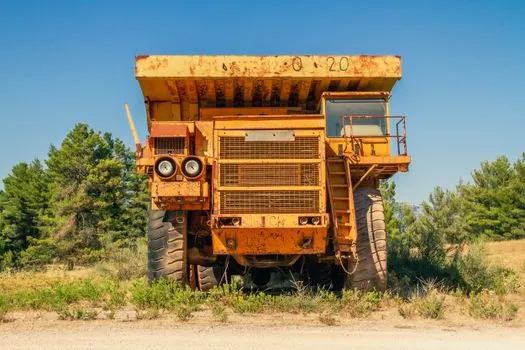
Rigid dump trucks run a single fixed frame with rear-wheel drive and payload ratings from roughly 40 t up to nearly 700 t on the largest mechanical-drive mining trucks, with heaped body volumes that scale with class [S2]. Engines above 1,500 hp move those loads on grades, and on firm, well-maintained haul roads the cost-per-ton is the lowest in the fleet, which is why they remain the default for large open-pit metal mines and quarries [S4][S5].
The hidden cost is infrastructure: rigid haulers need stable, meticulously maintained haul roads, and severe weather (thick mud, heavy rain) can ground them entirely, creating downtime windows an operation must budget for [S5]. For sites that cannot guarantee that road standard, the productivity advantage disappears, and an ADT or rented fleet becomes the rational pick.
Articulated Dump Trucks: Six-Wheel Drive for Soft Ground
ADTs connect a tractor unit to a rear hauler with a pivot joint, and a hydraulic oscillation bearing isolates the cab from trailer roll, which is the headline safety feature versus a rigid chassis on uneven ground [S1]. Permanent all-wheel drive plus wider tyres keep all six wheels on the ground across mud, soft sub-soils, and switchbacks, which is why ADTs are the standard pick for restoration sites, landfill work, quarrying in fractured rock, and short-haul overburden removal [S1][S5].
The trade-off is hard: rear-tip ADTs are generally limited to 20 to 60 t payload, and rear-ejector bodies to 30 to 40 t, far below a rigid frame, and the extra pivot, hydraulic rams, and 6×6 driveline add maintenance complexity and a higher capital cost per tonne of capacity [S1][S3]. Top speed is also lower on good ground, so on a long, flat, well-built haul road an ADT will be out-produced by a rigid truck of similar class; the dump truck family reference lays out this payload-versus-maneuverability split across the whole category.
Selection Criteria: Road, Gradient, Material, Cycle Distance
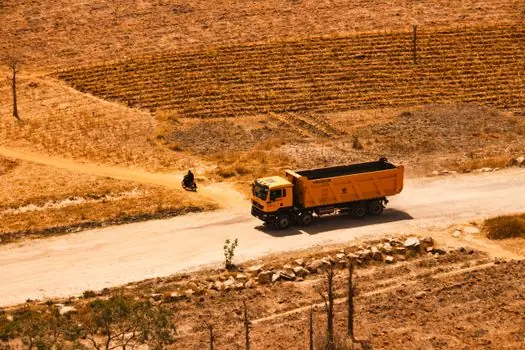
The decision matrix in published mine-haulage guidance lines up as follows: rear-dump trucks suit medium transport distances on gradients up to 12% but need well-maintained roads; bottom-dump trucks are fastest on flat hauls under 5% gradient and are best limited to light, fine materials such as coal or bauxite because the trailer and doors are comparatively light; ADTs take rough, boggy, or uneven ground plus steep gradients but carry a sideways-tip risk and higher maintenance burden; rigid trucks win on tonnage-per-cycle but only where road quality and pit layout justify the haul-road capex [S3][S5].
Concretely, the four criteria to weigh in order are: (1) required payload per cycle, (2) maximum sustained gradient, (3) haul-road quality you can guarantee year-round, and (4) material abrasiveness and lump size. A useful shorthand is that if the answer to (1) is above 60 t and (3) is firm, spec a rigid; if (3) fails in wet season, spec an ADT; if (2) is under 5% and the material is fine and free-flowing, a bottom-dump will out-cycle both on flat ground [S3].
Operating Economics: Ownership, Rental, and Electric
Third-party ADT rental is common for seasonal overburden work because it removes the capex of new machines, the maintenance burden, and the staffing load, with the trade-off being loss of direct control over operator skill and equipment condition [S5]. Published US rental benchmarks put an ADT at roughly $1,600 per day, $4,500 per week, or $12,600 per month, against a rigid dump truck at around $25,000 per month, with the rigid premium reflecting payload and rebuild cost [S2].
Electric-drive mining dump trucks are entering the catalogue as a new energy-saving class, with lower pollutant emissions, reduced energy cost per tonne, and simpler drivetrains, though charging infrastructure and continuous-duty energy supply at remote pits are still the gating constraints, which is why the class sits alongside diesel rigid and diesel ADT rather than replacing them on most sites today [S4]. Maintenance simplicity is the silent third axis: standard on-road dump trucks share chassis and parts with highway trucks, so spares are easier to source and repairs cheaper, an advantage that disappears once you step into a 400-t mechanical-drive rigid [S6].
Use Cases and Failure Modes
ADTs are the right call for restoration sites, landfill cells, and small-to-medium quarries where ground is soft or weather shuts down a rigid truck, and for overburden removal where the pit access road cannot be engineered to rigid-truck standard [S1][S5]. Rigid haulers remain the right call for large open-pit metal mines with long cycles, firm in-pit roads, and high annual tonnage, where the cost-per-ton advantage compounds over millions of tonnes.
Common failure modes to spec against: sideways tip on ADTs when the articulation joint is pushed on a side slope near the rated gradient; rigid-truck tyre damage and frame fatigue on poorly maintained roads; bottom-dump door wear and carry-back when fed oversize rock outside its light-material design window; and standard on-road dump trucks being misapplied to off-pit haul roads where ground pressure and traction exceed their chassis design [S1][S3][S6]. Choosing within the broader construction machinery and equipment landscape also matters, because the right excavator-to-truck match sets the cycle time the truck has to support.
Trackable signals worth monitoring over the next planning cycle: electric-drive rigid truck fleet deployment at major copper and iron-ore operations, ADT payload creep above the current 60 t ceiling, and stricter mine-site diesel-emission rules that re-rank the electric class on total cost of ownership. Related fleet decisions on motor grader selection for haul-road maintenance often decide whether a rigid-truck road programme is even feasible.