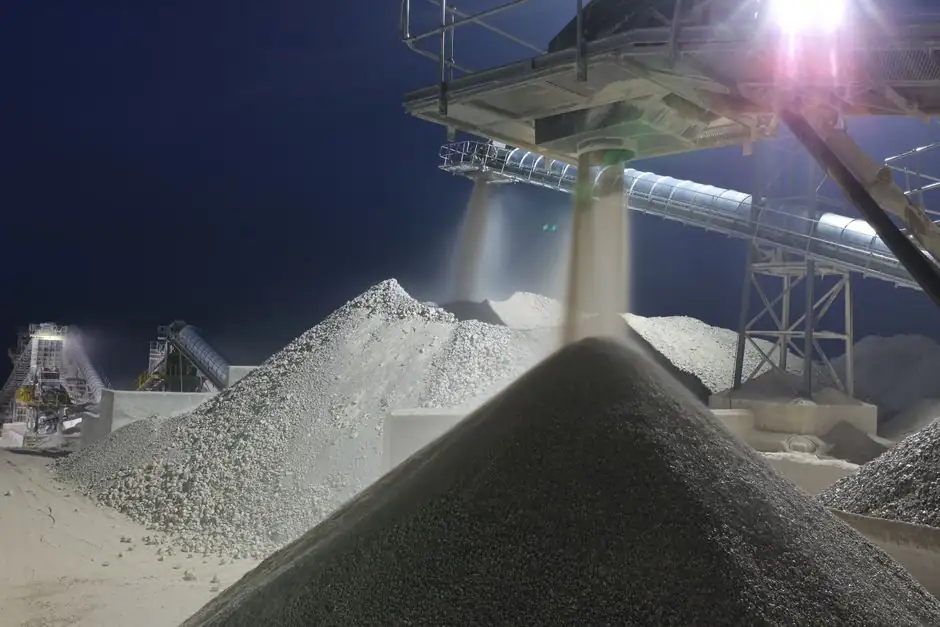
Modern mining equipment production lines integrate primary jaw crushers, secondary cone or impact units, ball/SAG mills, vibrating screens, magnetic separators, flotation cells, thickeners, and rotary dryers, with throughput packages commonly quoted between 40 and 1000 t/h depending on ore body and stage [S1][S2].
Designers working on tin, copper, bauxite, limestone, or granite flows in 2026 start by locking three numbers: ore Mohs hardness, feed top size, and target product size, because each metric gates the crusher class, the mill type, and the screening aperture downstream [S1][S6].
Scope and Definition of a Mining Equipment Production Line
A mining equipment production line is a configured sequence of comminution, classification, separation, and dewatering machines that turns run-of-mine (ROM) ore into a saleable concentrate or aggregate, with each stage sized to a defined mass balance rather than a single machine rating [S2][S6]. Reference designs from Henan Jiaozuo Heavy Mining Machinery (JHM) frame the scope as covering technical consulting, line design and customization, machine manufacturing, equipment procurement, and mine materials procurement under one contract [S6].
For a tin operation, the canonical chain reads ROM feed, jaw crusher, transfer station, cone crusher, vibrating screen, belt conveyor, ball mill, classifier, magnetic separator, flotation machine, thickener, and rotary dryer, with each unit sized against the production rate [S1]. SBM's published tin line claims a 40-1000 t/h envelope, with cone crushers delivering a product around 0-40 mm adjustable to customer specification [S1].
For an underground hard-rock mine, the parallel equipment class is mobile: scooptram (LHD), underground truck, jumbo drill, and rock support installation gear, where the line is sized by drift cross-section and haulage cycle rather than by t/h [S4]. Tuoxing Machinery, a 30-year Chinese underground specialist with a 25,000 m² plant, builds integrated underground production lines and ships to China Gold Group, Shandong Gold, and overseas customers in Russia, Peru, the Philippines, and Central Asia [S4].
Selection Criteria: Ore Hardness, Feed Size, and Throughput
Tin ore registers Mohs 3.75, sits below the 320 MPa compressive strength that bounds standard jaw crusher applicability, and is therefore a textbook cone-crusher feed for the medium-fine stage [S1]. For harder bodies, primary gyratory or single-toggle jaw units are specified, and the mid-stage shifts to short-head cone or vertical shaft impact (VSI) to manage wear and shape [S2].
AF Minerals Equipment, a Rowland Heights, CA engineering shop, packages its mining lines around hydraulic cone crusher, VSI, jaw crusher, feeder, vibrating screen, and sand washer, with the company positioning turnkey installation, commissioning, operational support, and training as part of the deliverable [S2]. A practical selection filter is: jaw for primary and high-compressive-strength feeds, cone for medium hardness where shape and reduction ratio matter, and VSI for shaping of manufactured sand or fine aggregate where the ore is below Mohs 6 [S2][S9].
Three decision variables drive the rest of the line: (1) ore Mohs hardness, which gates crusher class; (2) moisture and clay content, which determines whether a wet screens or a rotary dryer is needed upstream of storage; and (3) downstream use, which sets the closing screen aperture and the classifier cut point [S1][S6][S8]. Buyers sourcing from Made-in-China catalog listings see rotary drum dryers quoted at roughly US$8,000-15,000 per set at 1-set MOQ for sand and slag applications, with smaller drum dryers at US$4,800-6,000 per set, useful as a sanity-check on dryer line-item cost [S8].
Comparison of Main Comminution Options
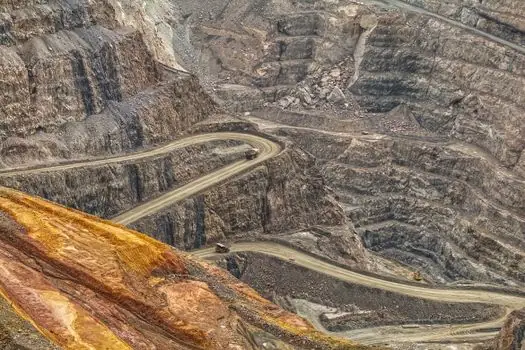
The three dominant comminution routes line up against decision criteria as follows. (1) Jaw plus cone: lowest unit cost for medium-hardness ore, capacity 40-1000 t/h, but limited shape control on the final product [S1][S2]. (2) Jaw plus VSI: better aggregate shape and higher reduction ratio for manufactured sand, but higher wear-media cost on the VSI rotors for abrasive feeds above Mohs 6 [S2]. (3) Gyratory primary with SAG/ball milling: standard for high-tonnage hard-rock copper-gold operations, but the SAG option is overkill below ~5,000 t/d and inflates capex [S6].
For grinding, ball mill remains the most widely specified unit for tin and similar flows because of its predictable throughput and liner wear pattern, while Raymond and trapezium mills are reserved for finer industrial powder duties where top size is already below 10 mm [S1]. When the line is processing a clay-bearing bauxite or refractory feed, calcination via rotary kiln is added downstream of milling, and a typical Chinese refractory plant such as Shanxi Jinlong is sized at 150,000 t/y of refractory material output to absorb that kind of feed [S5].
Buyers should weigh four practical criteria: (a) matched wear-part inventory, since jaw dies, cone mantles, and VSI tip sets have different service intervals; (b) energy per tonne, which on a ball mill typically sits in the 8-20 kWh/t range for medium-hardness ore; (c) footprint and foundation, where gyratory and SAG mills need significantly more civil works than jaw-cone lines; and (d) the ability to integrate crushing with later mining dump truck haulage, since the surge pile between primary crusher and mill sets the live storage that decouples face cycles from mill ramp-up.
Who This Line Is For, and Who It Is Not
A turnkey jaw-cone-ball-flotation line is the right fit for small-to-mid tin, copper, lead-zinc, or similar base-metal operations in the 40-1000 t/h band, and for aggregate producers crushing granite, basalt, or limestone down to 0-40 mm [S1][S2]. It is also the right fit for a greenfield quarry operator who needs one supplier for design, manufacturing, commissioning, and after-sales [S2][S6].
It is the wrong fit for an underground hard-rock mine that needs mobile load-haul-dump (LHD) and truck fleets, rock drills, and ground support rather than a fixed surface crushing line, where the procurement package looks more like Tuoxing's underground machinery catalog than SBM's surface tin line [S4]. It is also the wrong fit for ultra-high-tonnage copper-moly or iron-ore operations above ~50,000 t/d, where gyratory primaries and SAG mills are the default, and for flotation reagent-heavy flows where the molding line analogy in mine planning (stages of casting/comminution) gives way to dedicated reagent and tailings management design.
Real Use Cases from 2026 Sourcing Data
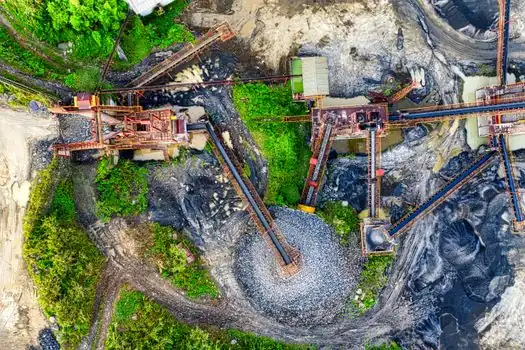
A typical 2026 tin flowsheet sourced from Chinese engineering vendors runs: ROM tippler, grizzly, primary jaw (e.g. PE 600 x 900 class), transfer conveyor, secondary cone, vibrating screen (typically 2- or 3-deck), oversize return, ball mill (overflow type), spiral classifier, magnetic separator, flotation cells (mechanical or column), thickener, and rotary dryer, with moisture targets commonly 8-12% going onto the stockpile [S1][S6]. For a quarry or aggregate operation, the same vendor pool substitutes a VSI for the ball mill and skips flotation, with the line ending at the sand washing stage and a finished stockpile [S2].
JHM's published one-stop service explicitly covers technical consulting, line customization, manufacturing, equipment procurement, and materials procurement for stone crushing, industrial powder making, mineral calcination and drying, and ore beneficiation, which is the most concrete end-to-end package documented in the 2026 vendor set [S6]. For buyers with floatation reagent needs, a Yantai Junbang-type reagent supplier can be bolted on, since that firm uses DCS automatic control across its xanthate, dithiophosphate, and sulfate reagent lines, which is the kind of instrumentation that ties into a modern mining process control backbone [S7].
Underground mines in 2026 are a parallel track: Tuoxing reports 30+ years building LHDs and underground trucks on a 25,000 m² plant, and that vertical integration is what allows the same vendor to hold the line design, not just the individual machines [S4]. For surface plants feeding port or rail logistics, the downstream of the production line interfaces with rail-mounted gantry cranes at the loadout, so the surge pile and reclaim design must match crane span and duty.
Limitations, Failure Modes, and Standards Discipline
Common failure modes in mining lines are liner wear in cone and VSI, screen blinding on clay-bearing feeds, ball mill over-grinding when classifier cut point drifts, and dryer back-pressure when feed moisture exceeds design, all of which should be engineered with redundant screens and bypass conveyors rather than solved in commissioning [S1][S8]. Wet feeds above roughly 15% moisture will defeat a standard rotary drum dryer without pre-dewatering, which is why thickener or filter press capacity must be specified against the mill discharge, not against nominal concentrate tonnage [S8].
On standards, buyers should anchor equipment selection to documented mechanical and electrical codes (e.g. ISO 12100 for machinery safety, IEC 60079 for explosive atmospheres in dusty mills, and IEC 60204 for electrical equipment of machines), and to local electrical and dust codes applicable at the mine site, without claiming a specific revision date that is not in the vendor documentation [S2][S6]. For flameproof or dust-ignition protection on mills, screens, and dryers handling combustible dust, IEC 60079-series enclosures and ATEX category alignment remain the typical reference, but the exact zone and EPL assignment must be set by the site hazard classification study, not by the line vendor's catalog copy. NDT on pressure-bearing or weld-critical mill components should follow NDT equipment practice suited to the component and material, and lighting in underground production galleries should be specified against lighting equipment and electric lamps suitable for the zone.
Trackable signals worth monitoring in 2026: vendor-published 2026 throughput and energy figures for jaw-cone-ball packages, additional Chinese refractory and dryer listings entering export channels (Shanxi Jinlong at 150,000 t/y output is a useful benchmark [S5]), and updates to automatic molding line style commissioning protocols being adapted from foundry practice into greenfield mine plants.