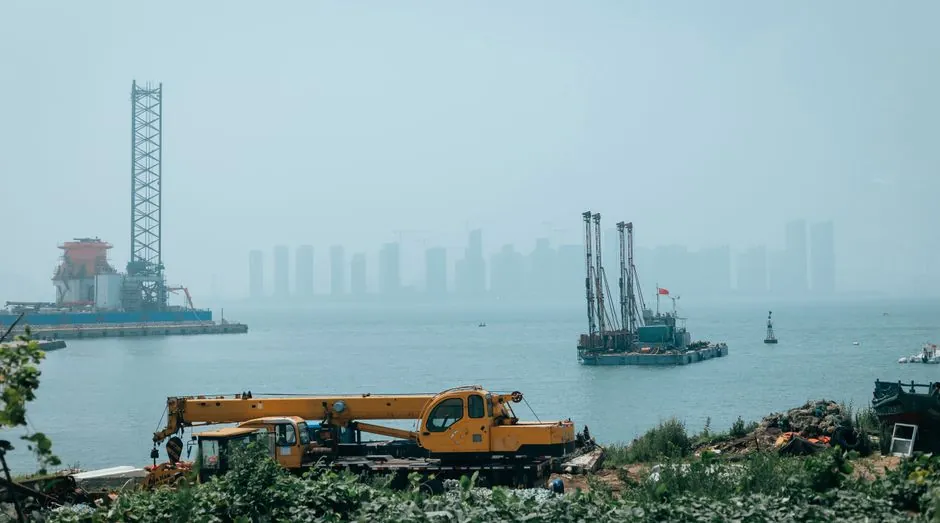
A mining-yard gantry crane purchase in 2026-08 defaults to a rail-mounted, double-girder, full-gantry unit rated 50-500 t SWL, sized against the heaviest single-piece haul-truck tray, crusher liner, or mill liner that the maintenance plan must clear [S2][S4].
The four functional classes defined in the standard reference list are: ordinary gantry (up to 100 t, span 4-35 m), hydropower gate gantry (80-500 t, span 8-16 m), shipbuilding gantry (100-1500 t, span up to 185 m), and container gantry (lifting weight 20-30 t for 20-40 ft boxes, span up to 60 m, stack 3-4 high and 6 wide) [S2]. A mining haul-truck or shovel-maintenance yard sits closer to the first two: heavy single lifts, moderate span, infrequent but high-utilisation cycles.
Duty class and FEM/CMAA mapping, the gate that drives steel weight
Selection of the crane's working class (FEM 1Am-5m, ISO 4301, CMAA A-F, or FEM 9.341) must come from the heaviest combined motion at the mine site, not from the nameplate tonnage alone; under-classing the duty in a 24/7 crusher-relining bay burns the bridge within 5-7 years [S2][S5].
For a haul-truck engine-change bay running two shifts, FEM 2m (CMAA D) is the realistic floor; a mill liner bay with grab or magnet work and a 6 m/min hoist creep moves up to FEM 3m-4m [S2]. Dafang's published range confirms 0.5 t-550 t overhead and gantry coverage, with FEM/ISO/EX-certified lines that mine EPCs typically accept on a 110-country export spec sheet [S4][S5].
Span, leg configuration, and skew-control design for rail-mounted units
When span exceeds 30 m, the standard guidance is one rigid leg plus one flexible (ball-hinge) leg so the gantry frame becomes a statically determinate system, absorbing thermal expansion of the bridge and avoiding thrust-induced secondary stress under lateral wind or skew travel [S2].
For a mining stockpile or truck-dump bay, expect spans of 18-35 m with double cantilever of 5-8 m each end to extend the working envelope without moving the rails; this is also the geometry shipped as standard by most Tier-1 Chinese builders [S2][S4]. Skew protection is mandatory: separate drive on each leg, limit-switch on the rail gauge, and a master/slave PLC tie; in gantry-crane practice, an undetected 50 mm skew on a 30 m span can add 20-30% to drive-motor current before any visible damage appears [S2][S3].
Hoist, brake, and motor protection gates
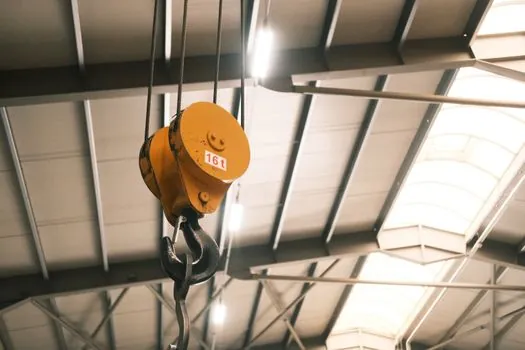
Hoist speed on heavy-duty mining gantries stays in the 1-5 m/min creep band (with 0.1-0.5 m/min micro-speeds for rotor or mill liner placement) while main hook on lighter service lifts 8-10 m/min, so a VFD on the hoist with closed-loop encoder feedback is now the baseline [S2].
For outdoor fixed-rail gantries, the 2026 reference for motor enclosure is IP55 as the dust-and-water default with IP65 specified for crushers, wash bays, or any location within 10 m of a dust curtain where wash-down or dust-laden air is normal [S8]. Brake-drift after stop is the single most common hoist failure in service: causes are pad wear, air-gap creep, VFD brake-release timing mis-set, and contactor sequencing faults, all of which are diagnosable on the no-load test before each shift [S8].
Wind, rail clamp, and outdoor duty interlocks
A gantry has a large wind-affected area, so the standard reference requires a wind gauge interlocked with rail clamps (or storm pins) and the long-travel drive, with operating instructions to set the rail clamp, raise the hook to the upper limit, close cab doors, and cut power above Beaufort 6 (≈49 km/h sustained) [S2][S3].
For tropical cyclone or Highveld thunderstorm regions, the rail-clamp set must be rated for both uplift and lateral; a 200 t class crane on 35 m span with full double-cantilever presents roughly 200-300 m² of projected wind area, and a 35 m/s gust generates uplift that parked clamps must anchor against [S2]. Operators should also drop the empty hook to within 2 m of ground only when traversing, never leave a loaded hook at mid-travel, and never operate above the 6 Beaufort ceiling [S3].
Comparison: full gantry vs semi-gantry vs rubber-tyre mobile for mining

On a fixed three-position decision matrix, the comparison reads: full rail-mounted gantry wins on cycle life, lifting capacity up to 550 t, and 24/7 duty, with a higher civil cost for the two parallel rails; semi-gantry (one rail on a high platform, the other on a floor rail) is a fit when one side of the bay is against a mill building and you cannot set a ground rail; rubber-tyre mobile units (port-style RTG or straddle carriers) are restricted to lighter container-class lifts of 20-30 t with spans to 60 m and stack heights of 3-4 over 6 wide, so they suit ROM stockpile hoppers, not mill bays [S2][S4][S7].
For a haul-truck maintenance shed with a 35 m clear span, a container-class mobile crane is structurally wrong and a single-girder unit caps out near 20 t; the correct answer is a double-girder rail-mounted full gantry, and most suppliers in the 0.5-550 t band ship a FEM/ISO/EX-traceable package in that configuration [S4][S5]. On procurement cost, indicative FOB pricing for mid-size 40 t-100 t container-class gantries sits in the US$ 300,000-500,000 per set, with heavy mining 200 t+ units quoted on application [S6].
Selection gates, constraints, and the items that fail inspection
The hard selection gates for a 2026-08 mining gantry purchase are: (1) FEM/CMAA duty matching the real cycle count, (2) span and leg-rigidity per the 30 m rule, (3) IP55 or IP65 motor enclosure matched to dust and wash environment, (4) VFD hoist with encoder and brake-release timing, (5) wind gauge interlocked to rail clamps, (6) rail-base straightness and levelness verified before erection, and (7) operator competency on the 15-point site rule set, including 3 m minimum track spacing for two cranes on the same rail, 75% combined-capacity cap for dual-crane lifts, and 50% capacity cap with any luffing motion [S2][S3][S8].
Common failure modes that should be written into the inspection plan: skewed travel on long spans, wire-rope weekly inspection records, brake-drift on stop, VFD over-voltage on regenerative lowers, and storm pins not re-set after maintenance [S3][S8]. Where the bay is a mill-liner or anode-handling room, the gantry crane duty class is the controlling spec; where the bay is a ROM stockpile with truck feed, the crawler crane or mobile crane becomes the competing asset and the trade-off turns on cycle count vs mobility. Two-crane lifts must not exceed 75% of the combined rated capacity, and a 3 m minimum spacing is mandatory for two cranes on the same track [S3].
Standards, sourcing, and what to verify on the data sheet

Traceable sourcing remains the procurement bottleneck: Yuantai's 1984-vintage catalogue lists FEM/ISO/CE/EX marks across 1-550 t overhead and gantry lines with 3,000+ project references; Dafang's 2026 line card states 70,000 cranes/year capacity across 850,000 m², with 31,500+ exported across 110+ countries, and notes a 200 t ladle overhead crane with integrated proportional valves and displacement sensors for millimetre-level synchronisation of five motions [S4][S5].
On the data sheet, the mining buyer should require: FEM classification stamped, ISO 4301 cross-reference, motor IP code, hoist VFD model, brake type and release-time spec, wind-gauge interlock schematic, and a documented weekly wire-rope inspection log per the 15-point operating rule [S2][S3][S8]. Container-class telescopic spreaders that lift 20 ft, 40 ft, and 45 ft ISO boxes are an available add-on from Donhao-class builders and let a single gantry service a truck-receive bay as well as a stockpile, which can reduce the stacker crane count in a mixed bulk yard [S7]. For a related site-envelope and duty-class workflow on container terminals, the port terminal tower crane selection map carries the same duty-gate logic and is a useful cross-check on classification calls. Also relevant to a mill bay that handles large steel segments: a rebar coupler spec map reads the same way on duty class and traceability.