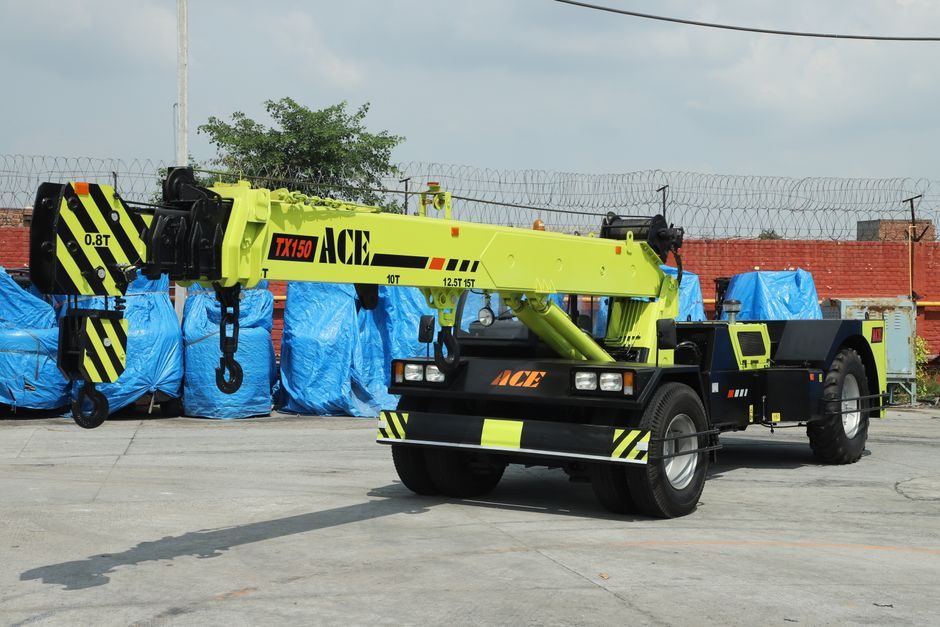
Mobile cranes and stacker cranes share the lifting function but are engineered for opposite environments — one for variable, road-going or rough-terrain duty and one for fixed-aisle warehouse automation [S1][S4].
Mobile cranes (e.g., the Gruniverpal MINIDREL 30B) typically offer 1–3,000 kg capacities with telescopic booms reaching 5.5 m standard / 7.0 m optional, on a 1,850 mm wheelbase at 1,900 kg total mass [S1]. Stacker cranes are rail- or aisle-guided, with masts commonly 6–40 m, designed for pallet or container throughput inside AS/RS or miniload systems — a duty class a wheeled mobile crane cannot match.
Definition and Operating Scope
BS EN 13000:2010 defines a mobile crane as a self-propelled, operator-controlled crane capable of on-site travel and equipped with outriggers, slew, and hoisting systems governed by sections 5xx (machine marking, information, warning, and graphic symbols) [S4]. The standard applies across the wheeled all-terrain class, including machines like the 60 t Liebherr LTM 1060-3.1 with its 48 m main boom and 9.5–16 m bi-fold swingaway [S2].
A stacker crane is a rail-guided, aisle-fixed lift typically integrated with warehouse storage racks; it is not classed under BS EN 13000 and instead follows AS/RS machinery practice and FEM/ISO 4301 duty classifications. Both classes may use a crane scale to verify load, but the surrounding safety architecture is fundamentally different.
Selection Criteria: Capacity, Envelope, Footprint
Three spec gates separate the two in any pre-purchase checklist:
1. Capacity envelope. The MINIDREL 30B lifts 3,000 kg max with 1,000 kg at full 1,500 mm telescopic extension, dropping to 100 kg at 5,800 mm extended hook height [S1]. Mobile cranes scale upward to hundreds of tonnes (60 t class in [S2]); stacker cranes typically cap at 1,500 kg for miniload or ~3,000 kg for unit-load AS/RS, with payloads dropping as the mast height climbs.
2. Operating envelope. Mobile cranes offer variable radius through telescoping and slewing, with adjustable hook heights from 1,500 mm to 7,000 mm on compact units [S1]. Stacker cranes operate within a fixed aisle width (commonly 1.0–1.6 m for miniload) and a fixed mast height that defines maximum storage level.
3. Footprint and surface. Mobile cranes need a 1,850 mm wheelbase plus outrigger pad zones and tolerate a 3% loaded / 8% unloaded gradient on polyurethane wheels [S1]. Stacker cranes need precisely leveled rail embedded in a flat concrete floor with no tolerance for transverse slope.
Who Each Is For (and Who It Is Not)
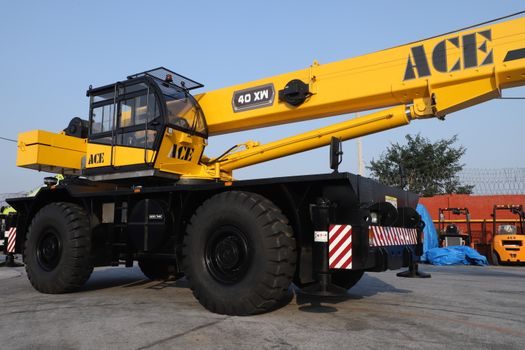
Mobile cranes are the right tool when the lift point moves between sites, when the load is non-repetitive, and when the surface is unpaved or industrial terrain. Mining, harbor, offshore, recycling, and underground operating environments are explicitly named use cases for the boom/telescopic/folding class [S1].
Stacker cranes are the right tool when the lift is repetitive (hundreds to thousands of cycles per shift), the load is pallet- or tote-sized, and the aisle can be fenced and dedicated. They are the wrong tool for a single 50 t turbine lift; a mobile crane is the wrong tool for 24/7 pallet throughput in a 40 m warehouse. Operator skill also diverges: mobile crane operators handle load-weight estimation, stabilisation, and lift-plan coordination [S3]; stacker crane operators mostly supervise an automated control system and intervene on faults.
Direct Comparison: Mobile Crane vs Stacker Crane
Sizing them against four decision criteria clarifies the split: cost, duty rating, integration effort, and lifetime.
Cost per kg lifted. Compact mobile cranes (e.g., MINIDREL 30B at €-class, 1,900 kg machine, 3 kW / 24 V DC electric drive) deliver 3,000 kg capacity at the low end of capital outlay [S1]. Stacker cranes carry a high fixed cost for the mast, rail, and rack integration but amortise over high cycle counts — total cost per cycle is lower when utilisation exceeds ~1,000 cycles/day.
Duty rating. Mobile cranes are intermittent-duty by design, with FEM/ISO classifications typically in the lower groups (e.g., FEM 1Bm–1Am) and rated for short, attended lifts. Stacker cranes are rated for continuous or high-cycle duty (FEM 2m–5m groups) and run unattended in automatic mode.
Integration effort. A mobile crane needs only a flat, load-bearing surface, an operator, and a pallet stacker for the receiving end. A stacker crane needs embedded rail, a structural rack, a WCS/WMS link, and safety light curtains at every aisle entry.
Lifetime and maintenance. Battery-powered mobile cranes use 420 Ah / 24 V lead-acid packs (gel optional) with on-board 110/240 V, 50/60 Hz charging [S1]. Stacker cranes typically use busbar or rail-side power and require periodic rail alignment and hoist-cable inspections rather than battery swap.
Use Cases Mapped to Equipment Class
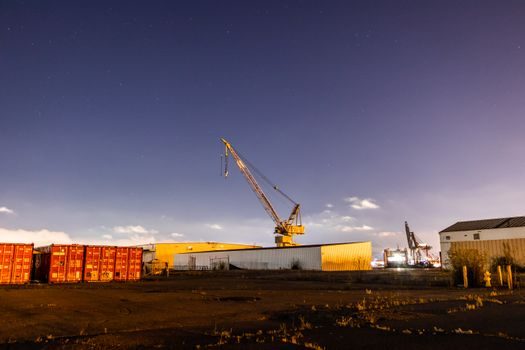
Outdoor single-lift project (lift a 25 t generator onto a foundation pad, working radius 12 m): mobile crane, telescopic boom with outriggers, 60–100 t class. In-aisle pallet retrieval at 12 m storage height, 200 cycles/shift: stacker crane, rail-guided, mast 14 m. [S1]
Hazardous-environment handling — e.g., drum handling in a chemical shed or underground mining — is explicitly listed for the boom/telescopic mobile crane class [S1]. For a contained, ATEX-rated storage room in a chemical plant, see explosion-proof control stations vs lighting for the electrical side that often runs alongside such a crane.
Limitations, Failure Modes, and Standards
Mobile cranes fail most often at the outrigger pad, the slewing-ring lubrication, and the overload-limit switch — all governed by BS EN 13000:2010 clauses on safety devices, marking, and operator information [S4]. Loading a mobile crane past its load-moment-indicator (LMI) curve is the dominant cause of structural overturn.
Stacker cranes fail most often at the rail-rail joint, the hoist wire rope termination, and the encoder/synchronisation chain. Mis-level of more than a few millimetres across the aisle causes the mast to twist and the crane to bind. Neither class tolerates operator improvisation outside the rated chart.
For a comparative read on another fixed-aisle lift class, the tower crane vs stacker crane map covers larger outdoor warehouse builds where the mast is vertical but the crane is not rail-aisle-fixed.
Sourcing, Standards, and Operator Profile
Specifying a mobile crane: confirm BS EN 13000:2010 compliance, request the FEM/ISO 4301 duty group, the LMI model, and the outrigger pad-load chart; verify the operator holds the appropriate national certificate (mobile crane operators handle load weights, stabilisation, inspections, and shipment coordination as standard duties [S3]).
Specifying a stacker crane: confirm FEM 9.341 / 9.511 alignment with the expected cycle count, verify the rack and rail supplier compatibility, and require dual-channel safety PLCs on the travel and hoist axes. Battery-electric mobile units under 4 t (such as the MINIDREL 30B at 1,900 kg with 3 kW drive and 60 m/min adjustable speed [S1]) are increasingly preferred over diesel for indoor and recycling-industry work, where exhaust and noise rule out combustion power.
The next spec revision to watch is any change to the EN 13000 stability and LMI clause language, which directly governs the load chart every buyer must sign against.