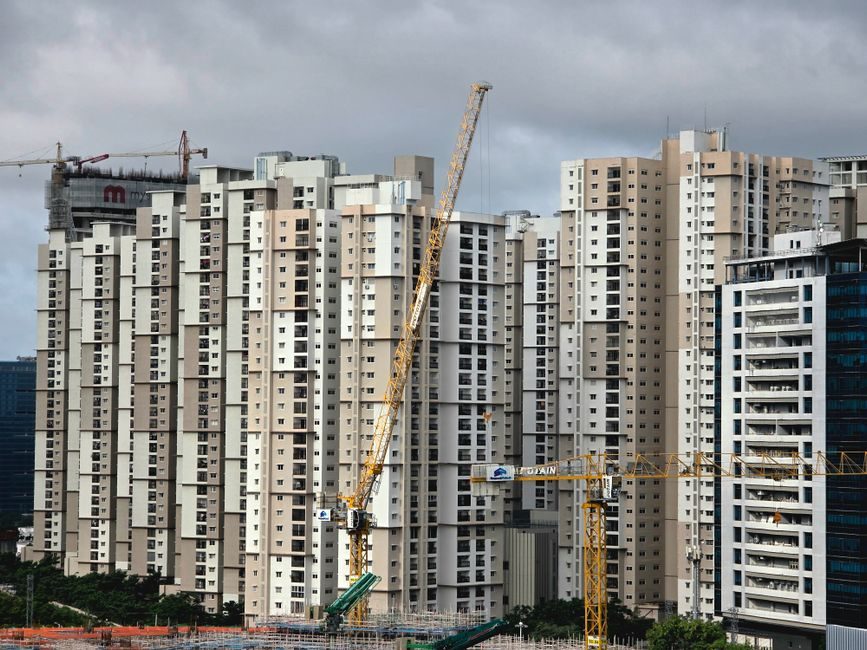
Construction-site tower cranes are rated from 2.5 t mini units (e.g. the 35 m-jib QTZ40(4208) class) up to 600 t topless machines such as the XCMG XGT15000-600S, with jib lengths commonly spanning 35-80 m and free-standing hook heights from 30 m past 150 m once climbing frames are added [S1].
ASRS stacker cranes are warehouse-class machines, typically 1-5 t payload on a single- or double-deep telescoping mast, riding a fixed floor-and-ceiling rail at aisle widths of roughly 1.0-1.6 m, with lift heights from 6 m up to 40 m+ for high-bay pallet storage; the Made-in-China catalog lists ASRS stacker cranes starting around US$20,000 and reaching US$200,000 for custom high-bay units [S4].
Where Each Machine Belongs: Outdoor Lifting vs Indoor Pallet Storage
A tower crane is a slewing, jib-mounted machine anchored to a foundation or slewing ring, used to hoist steel, formwork, concrete buckets, and modular units vertically and radially across an open job site; Zibo Yichi International Trade exports QTZ80, QTZ125 and QTZ250 series tower cranes to South America, Africa, Southeast Asia, Russia and the Middle East, with truck-crane siblings QY35 and QY16H covering mobile work [S2].
A stacker crane (also called a stacker-crane or ASRS crane) is a mast-and-trolley machine running on embedded rails between pallet racks, used to deposit and retrieve standardized loads in fixed aisle coordinates. Boland Cranes in Queensland runs a 15-unit self-erecting and hammerhead tower-crane fleet sized for 3-storey-and-up builds at 6-20 t lift capacity, illustrating how the construction-side spec envelope is fundamentally outdoor, site-mobile, and weather-exposed [S3].
Load, Reach, and Duty-Cycle Comparison
The decision matrix below lines the two machines against the four criteria that drive a buy or hire decision: peak load, lift envelope, operating environment, and integration effort. [S1]
- Peak load: Tower cranes dominate at the heavy end (4 t QTZ40 mini units, 8-10 t QTZ63(5013)/QTZ100(6013) workhorses, 600 t XGT15000-600S for power and process plants). ASRS stacker cranes top out in the 1-5 t pallet range; Made-in-China factory listings cluster at US$12,000 for 1-2 t forged-steel stackers and US$20,000 for high-bay ASRS units [S1][S4].
- Lift envelope: Tower cranes reach 35-80 m radius with hook heights past 150 m once climbing tie-bars are installed. ASRS stacker cranes typically serve racks 6-12 m high in standard distribution centers, scaling to 30-40 m for high-bay ASRS installations, but their reach is a single straight aisle.
- Operating environment: Tower cranes are outdoor, wind-exposed machines requiring foundation design, slewing-ring torque verification, and climb/tie-in planning. ASRS stacker cranes live indoors in conditioned warehouses where rail flatness, rack tolerance, and aisle cleanliness are the dominant constraints.
- Integration effort: A tower crane is a project-based hire or buy with erection crews, slewing-base anchoring, and periodic climbing. A stacker crane is a fixed-asset install tied to the rack and WMS, with commissioning measured in months and integration into the warehouse control system. For adjacent material-handling comparisons, reach truck vs forklift aisle-width and lift-height specs frame the manual-MHE alternative to ASRS.
Decision Rules: When a Tower Crane, When a Stacker Crane
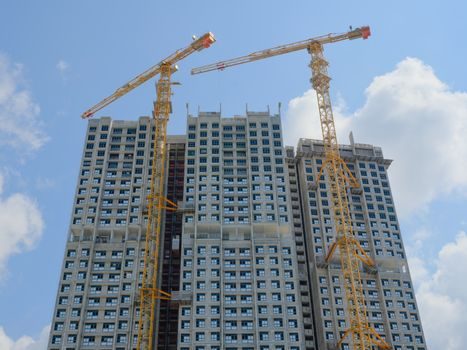
Specify a tower crane when the load is non-standard (formwork, rebar cages, steel beams, precast panels, generator stators), the lift is one-off or short-cycle, the site is open-air, and the radius reaches 30 m or more. Boland Cranes' fleet of self-erecting, hammerhead, flat-top, and luffing tower cranes is structured for 3-storey-plus builds with 6-20 t hook capacity — a typical mid-rise envelope [S3].
Specify an ASRS stacker crane when the load is a unitized pallet or tote, the cycle is repetitive (hundreds of cycles per day), the warehouse is enclosed, and the aisle geometry is fixed. Custom-designed ASRS units for high-bay pallet storage (US$20,000 entry price in the Made-in-China catalog) target exactly that envelope [S4].
Hybrid cases exist but are rare: a luffing-jib tower crane is the right pick on congested inner-city sites with overlap restrictions, while a low-headroom stacker crane (US$12,000 catalog class) is the right pick inside existing manufacturing plants where ceiling height forbids a standard mast [S3][S4].
Failure Modes and Engineering Constraints
Tower-crane risk concentrates outdoors: wind-speed cut-out (typical erection and operating limits set per OEM and local crane code), slewing-ring wear, tie-in load on the host structure, and climb-sequence planning. Zibo Yichi's physical-chemical test center forms the quality-control system backing the QTZ80/125/250 and QY35/QY16H export lines, with reply-on-inquiry inside two working days as a service-level signal rather than a spec [S2].
Stacker-crane risk concentrates indoors: rail alignment and floor flatness, rack upright tolerance, mast deflection under full load at full lift, and WMS/PLC interface latency. A custom ASRS unit at the US$200,000 catalog tier is a designed-to-order build, not a shelf item [S4].
Both classes share one spec trap: payload-at-radius is non-linear, and quoting nameplate tonnage without checking the load chart at the working radius and lift height is the most common spec error on both sides. Adjacent lifting gear selection, including overhead bridge crane vs stacker crane duty cycles, follows the same rule.
Standards, Sourcing, and 2026 Market Signals
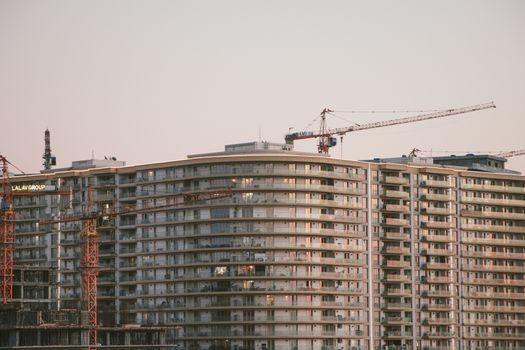
Chinese OEMs dominate the export catalog for both classes: tower-crane model codes follow the QTZ (top-slewing, tower) and QY (truck-crane) conventions seen in the Machmall and Zibo Yichi listings, while ASRS stacker-crane pricing tiers (US$12,000 light, US$20,000 high-bay, US$200,000 custom) come from Made-in-China factory-direct listings [S1][S2][S4].
Australian hire fleets in 2026 still anchor on 6-20 t self-erecting and hammerhead units for commercial builds, with flat-top and luffing jib options added for space-constrained sites, per Boland Cranes' published fleet profile [S3]. Two signals worth tracking through the next quarter: new QTZ-class model code releases on Machmall, and any shift in Made-in-China ASRS stacker-crane factory-direct pricing at the US$20,000 high-bay tier.
Component reference pages worth checking: pallet stacker.