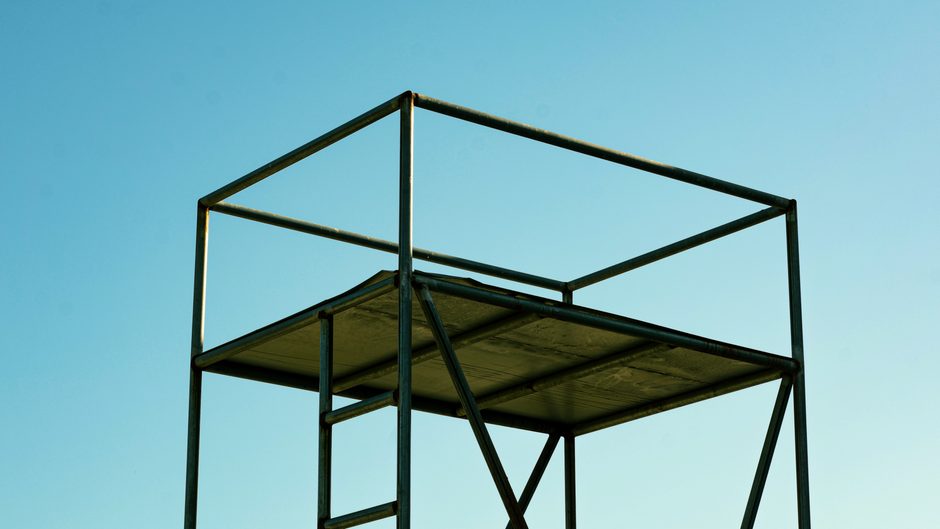
Mobile scaffold towers split cleanly into three material families across the 2026 supplier base: aluminium (working heights 0.8 m to ~14.6 m), hot-dip galvanised steel Ringlock (Ø48.3 × 3.20 mm, Q235), and GRP/fiberglass for live-line or railway work, with the DirectIndustry manufacturer index listing 31 vendors and roughly 80 catalog products in this segment [S1].
The current export price band, sampled from Made-in-China and Okorder listings dated 2026-04 to 2026-07, runs US$700-1,800 per set FOB China for aluminium rolling towers and 22-day typical lead time on Guangdong-shipped tower systems [S2][S3][S5]. Yangzhou-based OEM/ODM suppliers such as Yangzhou Superman Sporting Equipment Co. (20,000 m² floor area, 150+ employees) explicitly position on West Europe, North America, and Australia export channels [S8].
Material Family Comparison: Aluminium vs Steel Ringlock vs GRP
Aluminium rolling towers dominate the short-duration, interior/finish-trades segment — DACAME's ALU 50 line, for example, uses a 50 mm aluminium tube and reaches 4.2 m to 14.6 m working height, and European Special Ladders' 7074 series tops out at 11.25 m platform height in a 720 mm-wide frame [S1]. Altrex and ZARGES sit in the same EN 1004-compliant band, with the Aluxis Junior covering 0.8 m to 2.8 m working height for low-level interior use [S1].
Hot-dip galvanised steel Ringlock is the workhorse for shoring and structural support, with Okorder listings specifying Ø48.3 × 3.20 mm brace tubes in Q235 steel and hot-dip galvanised finish; supplier claims cite roughly 20-year service life with reusable rosettes and 8-spoke wedge connections [S4][S6]. Made-in-China promotional listings price Ringlock frames in a similar US$700-1,800/set band as aluminium, with platform dimensions of 750 × 2,000 mm or 1,350 × 2,000 mm commonly offered [S3][S5].
GRP/fiberglass towers (BELLEGROUP RJP-MR, 3-11 m working height) use 50.8 × 3.2 mm reinforced fiberglass tubes and are specified for non-conductive work near catenary or HV equipment [S1]. For rail-tunnel access, the FT-054 aluminium variant runs 6.7 m working height and breaks down into lightweight sections for hand-carry into vaults [S1]. A practical selection rule: aluminium for ≤14 m, indoor/outdoor finish work; steel Ringlock for heavy load and reuse cycles; GRP only when dielectric isolation is mandatory.
Working-Height and Load Class as Hard Spec Gates
Working height — defined as platform height plus 2 m reach — is the first hard gate. The DirectIndustry index shows a continuous ladder: Aluxis Junior 0.8-2.8 m, BELLEGROUP 3-11 m, ALU 50 4.2-14.6 m, 7074 series 3.25-11.25 m [S1]. Anything beyond ~14 m working height pushes the spec out of light-tower territory and into tube-and-clamp or system-scaffold shoring, which is a different supplier pool.
Load class follows EN 1004 (the European harmonised standard for mobile access and working towers) and is typically quoted as Class 2 (1.5 kN/m²) for light-duty and Class 3 (2.0 kN/m²) for general trades — direct load-class figures per supplier were not in the indexed listings, so the buyer should request the test certificate rather than rely on catalog copy. For U.S. sites, OSHA 1926.452 additionally governs tower scaffolds, and Chinese export suppliers ship with OEM/ODM customisation rather than a single universal certification [S8].
Tube geometry is the second hard gate: Ø48.3 × 3.20 mm is the de facto global standard for Ringlock bracing in Q235 hot-dip galvanised steel [S6]. Mismatched tube OD between bought-in bracing and a tower's standards/ledgers is the single most common field-fit failure, and it is invisible from a price comparison.
Who This Segment Is For — and Who Should Buy Elsewhere
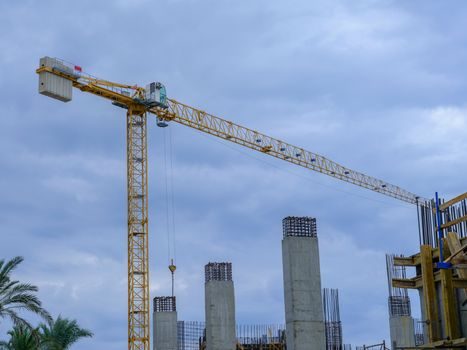
Mobile scaffold towers in the 0.8-14.6 m band are built for short-duration, frequently-relocated work: painting, plastering, EIFS rendering, ceiling-grid installation, M&E rough-in, façade cleaning, and rolling inspection platforms. They are the right answer when the work is spread across a floor plate and the labour cost of repeatedly erecting tube-and-clamp exceeds the tower's rental or amortised cost [S1].
They are the wrong answer for sustained concrete shoring, formwork support, or any loading case that requires dense, fixed falsework — that is the Ringlock shoring segment, which uses the same components but at much higher leg loads and is covered in a different sourcing map (see the frame scaffolding supplier field guide for adjacent shoring-scaffold sourcing context). They are also the wrong answer where a MEWP / scissor-lift is the safer primary access and the tower is only the fall-arrest-rescue platform.
European OEM Tier vs Chinese OEM/ODM Tier: What You Actually Get
The DirectIndustry index clusters the certified European OEM tier around Altrex (Netherlands), Hünnebeck (Germany), ZARGES (Germany), WERNER (US/EU), FORTAL (France), DACAME (Spain), and Entrepose Echafaudages (France) — these are the names a procurement team will see on an EN 1004 / NFE85-014 declaration of conformity [S1]. Lead times here run on distributor stock, not factory orders, and price is typically 2-4× the Chinese OEM/ODM tier for equivalent working height.
The Chinese OEM/ODM tier — Yangzhou Superman Sporting Equipment, Wuxi-based flexible aluminium tower suppliers, and Made-in-China listed Guangdong exporters — quotes FOB at US$700-1,800/set for aluminium rolling towers and ships on 22-day lead times, with OEM/ODM customisation on platform size, height, and colour [S5][S7][S8]. Okorder model MSS-II (Guangdong) advertises "excellent quality, competitive prices" in a stretch-film + plywood-case pack and 22-day delivery [S2]. The trade-off is buyer-side QC: third-party pre-shipment inspection (SGS / BV / TÜV) on hot-dip galvanising thickness, weld integrity, and EN 1004 load test is not optional at this price point.
For projects inside the EU/UK, the practical gate is whether the tower carries a CE mark under EN 1004 and a valid declaration of conformity — without it, the tower is non-compliant regardless of galvanising quality. For projects inside OSHA jurisdiction, the gate is whether the supplier can ship with the manual and the SF calculation required by 29 CFR 1926.452.
Galvanising, Tubes, and Reuse Life: Field-Fit Details
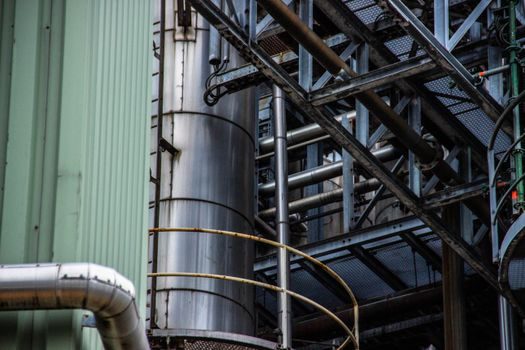
Hot-dip galvanising thickness is the spec that separates a one-job tower from a 20-year reusable asset. Okorder Ringlock listings specify "Hot DIP galva" finish on Ø48.3 × 3.20 mm Q235 braces and claim "can be used again and again for nearly 20 years" — a figure that holds only if the galvanising layer is intact and the rosette wedge cavities are not packed with concrete spatter [S6]. The Wuxi-sourced flexible aluminium towers quote "high loading" capacity but do not publish a fatigue or cycle count, which is the field metric that actually drives reuse economics [S7].
For procurement, three checks gate quality: (1) galvanising mass per EN ISO 1461 (typical spec ≥ 70 µm for 3.2 mm wall); (2) weld procedure qualification on rosette stubs; (3) platform deck load test certificate per EN 1004 Class. Without these on the packing list, the FOB saving disappears in the first rework cycle. Compare this with how a ball screw selection or linear guide TCO model is built — the headline component price is never the controlling number, the lifetime duty cycle is.
Common Failure Modes and Sourcing Constraints
The most common field failures in mobile towers are: (a) castor locking omitted on uneven ground; (b) outriggers not deployed at full working height; (c) incompatible brace tubes from mixed suppliers causing rosette-to-brace slip; (d) galvanising eaten by chloride exposure on coastal sites reducing life below the 20-year claim. None of these are visible on a price sheet. [S1]
Supply-side constraints through mid-2026: aluminium billet and Q235 steel coil pricing remain the dominant cost driver in the US$700-1,800/set band, and freight volatility on China-EU and China-North America lanes continues to swing delivered price by 10-15% quarter-to-quarter. Buyers specifying to Chinese OEM/ODM suppliers should lock INCOTERMS (FOB vs CIF vs DDP) and pre-shipment inspection scope in the PO, not in follow-up emails [S8].
Trackable next signals: the Made-in-China and Okorder indexes refresh weekly with new SKUs and revised price bands; the DirectIndustry manufacturer page lists 31 vendors in the segment and grows when new EU/UK fabricators enter; any change in EN 1004 revision status or OSHA 1926.452 interpretation letters will reset the certification gate for cross-border shipments.
The underlying component specifications are covered under mobile crane, tower crane, and signal tower light.