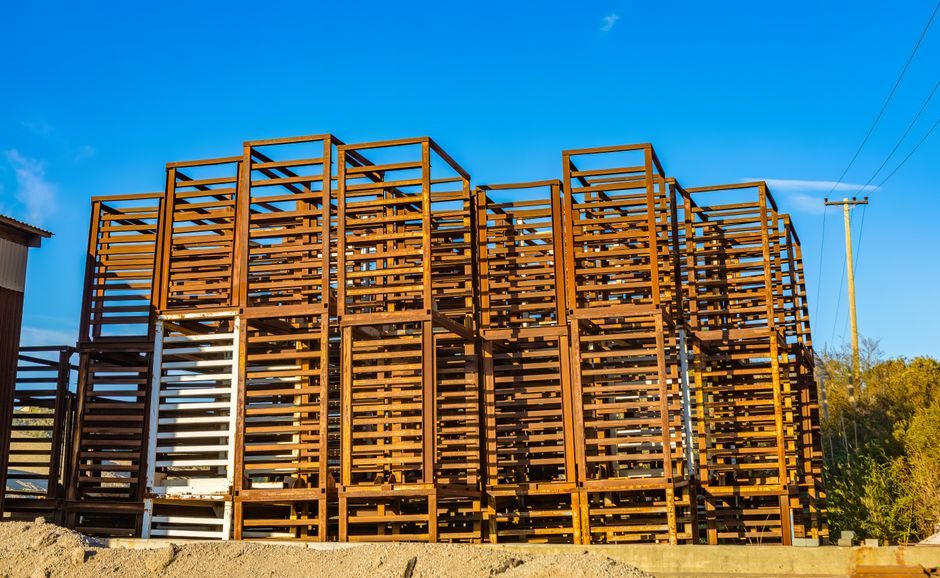
Cuplock scaffolding in 2026 is a cup-and-blade modular steel system centred on verticals (standards) of 48.3 mm OD × 3.25 mm wall, with top and bottom cups welded every 500 mm so that up to four ledgers lock into a single node in one hammer strike [S3][S5]. A complete kit — standards, ledgers, diagonal braces, transoms, planks, screw jack bases, and cantilever/side/ladder brackets — is now sourced predominantly from Chinese mills in Q235 or Q345 steel with electric-galvanized, hot-dip galvanized, powder-coated, or self-colour finishes [S3][S5].
July 2026 sourcing on Made-in-China lists export FOB prices in the US$1,100–1,350/tonne band for full cuplock systems at 20-tonne MOQ, while individual ledgers sell for US$5–50 per piece at 500-piece MOQ and small couplers from US$0.50–2.50 per piece at 1,000-piece MOQ — a spread that reflects component-level versus system-level bidding [S2][S4][S6].
Eight Component Categories That Define a Cuplock System
Standards (verticals) carry the cup pattern: each tube is welded with an upper cup and a lower cup at 500 mm vertical intervals, the spacing that dictates every bay height in the scaffold [S3]. A 48.3 × 3.25 × 1000 mm standard weighs 5.6 kg, a 1500 mm standard 8.75 kg, a 2000 mm standard 11.4 kg, a 2500 mm standard 14.0 kg, a 3000 mm standard 16.70 kg, and a 4000 mm standard 20.36 kg in the most widely shipped Q235 grade [S3].
Ledgers are the horizontal load-spreading members, with one ledger blade welded to each end so the blade drops into the bottom cup and the top cup is hammered down to lock up to four ledgers in a single node [S1][S3]. Manufacturer weight tables show a 0.6 m ledger at 5.44 kg, a 1.0 m at 8.62 kg, a 1.5 m at 12.62 kg, a 2.0 m at 16.58 kg, and a 2.5 m at 20.58 kg, all on OD 48.3 mm tube [S1]. Centre-point ultimate load drops sharply with span: 48 kN at 0.5 m, 21 kN at 1.0 m, 11 kN at 1.5 m, 10 kN at 2.0 m, and 9 kN at 2.5 m [S1].
Transoms, Diagonal Braces, and the Plank/Bracket Layer
Transoms are a second horizontal family, distinguished from ledgers by a one-large/one-small jaw at each tube end that grips the ledger rather than the cup, leaving open platform bays for the working deck [S1]. Diagonal braces (48.3 × 3.25 mm) are pin-connected between bays for racking resistance, with stock lengths of 915 mm at 3.4 kg, 1150 mm at 4.04 kg, 1572 mm at 5.34 kg, 1829 mm at 6.13 kg, 2130 mm at 7.06 kg, 2438 mm at 8.01 kg, and 3050 mm at 9.90 kg [S3].
Steel planks (210 × 45 × 1.2 mm or 250 × 50 × 1.2 mm) in 1000/2000/3000/4000 mm lengths form the working surface, while screw jack bases — 38 × 4.0 × 500 mm at 3.35 kg, 38 × 4.0 × 600 mm at 3.65 kg, 48 × 4.0 × 600 mm at 4.4 kg, and 35 × 500 mm at 4.5 kg — carry the load at the mudsill [S3]. Cantilever, side, and ladder brackets then extend the deck perimeter or carry stair access, and are listed as standard accessories in every cuplock export catalogue [S3][S9].
Standards vs Ledgers vs Transoms: A Decision Comparison
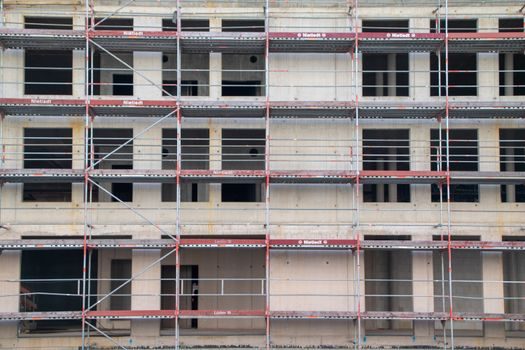
On three project-relevant criteria, the three core horizontals/verticals split cleanly: load direction, connection method, and typical span. Standards take axial compression only and connect to the ground or to the cup above via the 500 mm-spaced cup pattern; ledgers take bending across the bay and connect by blade-into-cup, so the engineer specifies a ledger length knowing its ultimate centre-point load (48 kN at 0.5 m, falling to 9 kN at 2.5 m) [S1][S3]. Transoms also span horizontally but connect to ledgers via jaw couplers, so they carry the platform planks and create the open work area rather than the primary frame [S1].
For spec writing, the cuplock ledger-versus-transom choice is governed by whether the member is a primary frame element (ledger) or a deck-support element (transom), and by span: ledger load capacity halves as span roughly doubles (48 → 21 → 11 kN from 0.5 m to 1.5 m) [S1]. In shoring towers versus access scaffolds, the diagonal-brace density differs — 915 mm braces at 3.4 kg are the most common short panel, while 3050 mm braces at 9.90 kg are reserved for full-height racking [S3]. See the broader scaffolding system overview for how cuplock sits against ringlock and frame systems.
Material, Finish, and Sizing Specifications
Mill-standard raw material is Q235 carbon steel, with Q345 supplied for higher-stress configurations such as shoring legs and long-span ledgers [S3][S5]. Pipe geometry is consistent across the export catalogue at 48.3 mm OD × 3.25 mm wall — the imperial-origin 1.5-inch tube that the cuplock cup geometry was designed around — with the diagonal-brace and ledger families in the same OD so any bay can be braced with stock parts [S3].
Four finishes are offered: electric galvanizing, hot-dip galvanizing (HDG), powder coating, and self-colour (uncoated black steel) [S3][S5]. HDG is the default for marine, coastal, and high-humidity service, with the export literature explicitly listing a hot-dip-galvanized cuplock product as a stock SKU [S8]. Surface finish has a direct effect on re-use cycles: galvanized tubes tolerate repeated site handling without red-rust bleed, while painted and self-colour tubes are typically scoped to short-duration rental pools or single-project use [S1].
Application Map: Bridges, Tunnels, Metro, Marine, and Shoring

Bridge, tunnel, metro station, and pier construction are the headline verticals for the system, leveraging the 500 mm cup-grid that lets crews step bay heights to the formwork elevation without tube cutting [S3][S5]. One 2026 export listing frames the system explicitly for "highways/subways, bridges, tunnels and fire electrical engineering, marine engineering" with the same component set [S5]. For civil buildings, the board-bracket cuplock ledger with side-bracket extensions is a common pattern, and is sold as a building-materials SKU on the Chinese wholesale channels [S6].
For formwork support, the cup-lock system is rated by one manufacturer for 80 kN/m² of fresh-concrete pressure when panels are pre-assembled with built-in plywood, a figure that puts it into heavy-shoring duty rather than light access [S7]. In the access-scaffold role — façade work, shipyard hull access, refinery turnarounds — the 0.5 m to 2.5 m ledger range covers typical bay widths without tube-and-clamp improvisation [S1]. Marine and dock applications are named in the export datasheets because HDG cuplock tolerates salt-air exposure that would pit painted tube within a single rental cycle [S3][S8].
Working Loads, Spans, and What Cuplock Is Not For
The ledger load table is the binding constraint on bay geometry: an engineer sizing a 2.5 m bay is working with a 9 kN ultimate (≈4 kN working) ledger, which is enough for access scaffolds and light-duty shoring but not for heavy formwork loads that concentrate on a single horizontal [S1]. A 0.5 m bay, by contrast, mobilizes 48 kN ultimate and is the geometry used under formwork beams [S1]. This inverse span-versus-load relationship is the single most important number to read off the cuplock datasheet before laying out a bay grid.
Cuplock is not the right pick where the structure requires suspended or cantilevered working platforms beyond the standard cantilever/side brackets, where irregular geometry needs many non-standard tubes, or where the specifier needs an integrated access-system such as ringlock with its rosette node and finer angle-stepping — see the ringlock versus generic scaffolding decision map for that comparison. For shoring towers carrying very high point loads, prop systems or frame-shoring are typically preferred over stacking cuplock standards, because the 48.3 × 3.25 mm standard has a lower axial rating than a dedicated 60 mm shoring prop.
Sourcing, MOQ, and Lead-Time Signals for 2026
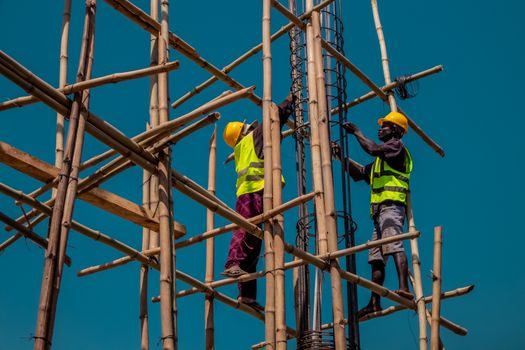
Wholesale pricing tiers in mid-2026 cluster around three points: full-system cuplock at US$1,100–1,350/tonne at 20-tonne MOQ; individual ledger/brackets at US$5–50 per piece at 500-piece MOQ; and small couplers/sleeve-couplers at US$0.50–2.50 per piece at 1,000-piece MOQ [S2][S4][S6]. Shandong and Hebei remain the dominant manufacturing provinces on the audited-supplier lists, and Indian and Gulf-state export channels are active for HDG cuplock specifically [S2][S8].
Three signals worth tracking into the second half of 2026: the continued narrowing of the FOB price band (US$1,100–1,350/tonne) suggests that HDG cuplock supply is no longer constrained, even as raw Q235 coil has moved; the OEM/ODM service flag remains open on most export listings, meaning project-specific cup spacing beyond the 500 mm standard is still negotiable at 1,000 kg MOQ [S3][S4]; and the appearance of dedicated cuplock-accessories exporters alongside the system exporters indicates a maturing two-tier supply chain — system builders plus component specialists — that lets buyers mix-and-match rather than buy a full kit [S9]. For site-planning software teams mapping temporary-works loads, the same kind of modular-spec thinking shows up in adjacent equipment like the track loader types and undercarriage map and the backhoe loader spec tiers, where component families rather than single SKUs drive the spec.
Spec-level background on the components involved: pressure transmitter, and flow meter.