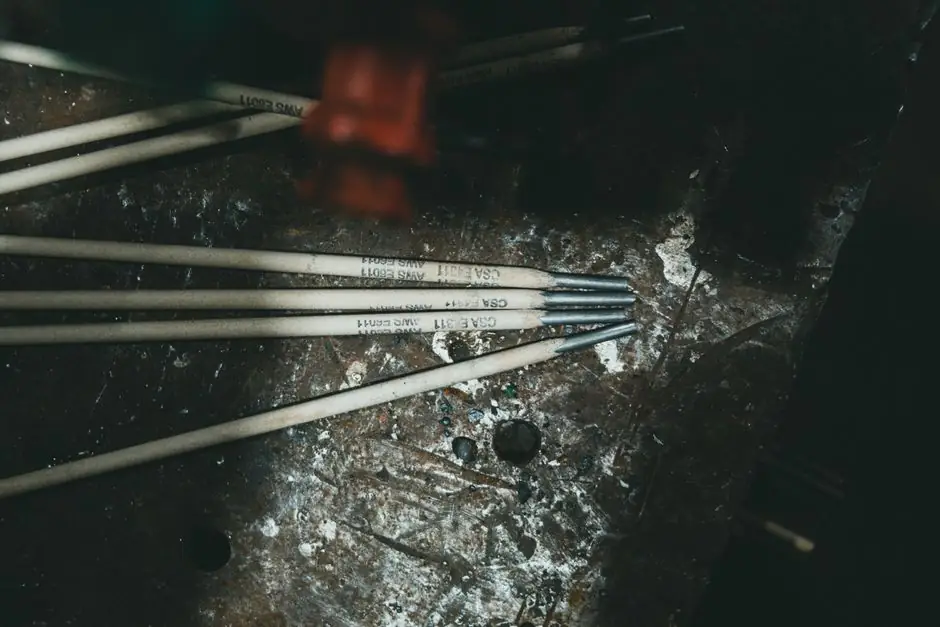
Stud welding fuses a metallic stud to a base plate in roughly a fraction of a second using an electric arc, with no filler metal and no through-hole, and production cells can reach 60 studs per minute on working areas up to 3000 x 2000 mm [S1].
Common process variants are drawn-arc stud welding (continuous arc, suited to thick plate and structural work) and capacitor-discharge stud welding (CD, instantaneous release of stored charge, suited to thin plate and low heat input) [S3]. The process joins dissimilar materials such as aluminum, brass, copper, and steel without filler and is widely used in shipbuilding, automotive, electrical enclosures, and bridge fabrication [S2].
Process definition and where it fits
Stud welding is defined as joining a metallic stud fastener to a base plate by melting the stud tip and a small area of the parent material with an electric arc, then plunging the stud into the molten pool under spring or pneumatic pressure, so a full-strength metallurgical bond forms in milliseconds [S2].
The process is considered nearly automatic and the operator role is closer to a fastener-installer than a traditional welder, which removes the need for steady hand-eye control of a weld bead [S2]. This single-sided access requirement is the dominant reason it displaces spot welding, through-bolting, and back-welded inserts on assemblies where the reverse side is sealed, painted, or structurally critical.
Decision criteria: when stud welding wins
Five engineering criteria separate a good stud-welding application from a marginal one: material compatibility, base-metal thickness, accessibility, throughput target, and cosmetic or leak-tightness requirement [S1][S2][S3].
Stud welding is the right answer when the application needs one-sided access, no reverse-side marking, leak-tight containment, and high cycle counts of identical fasteners on thin-to-medium steel sheet, since the no-hole, no-filler weld does not weaken the parent material and the result is described as stronger than the original stud or plate [S1]. It is the wrong answer for high-carbon steel, where weld-metal crystallization, segregation, and oxidation produce hot and cold cracking [S3].
Comparison: drawn-arc vs capacitor-discharge
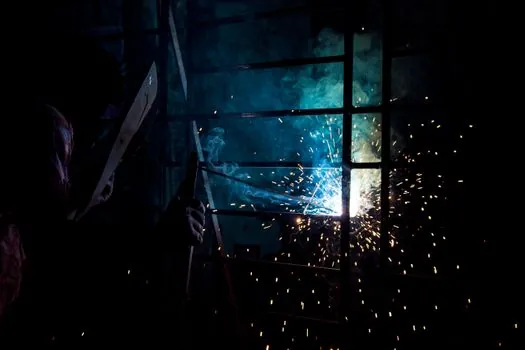
Drawn-arc stud welding uses a continuous arc to heat thicker sections and is the default for cylindrical studs on structural applications including high-rise steelwork, bridges, towers, vehicles, pipelines, and lifting machinery [S3]. Capacitor-discharge stud welding stores energy in capacitors and releases it instantaneously, giving short arc time and low thermal deformation, which makes it the standard for thin-plate work in shipbuilding, automotive, control cabinets, curtain wall, and elevator parts [S3].
For selection, the decision matrix reduces to four axes: maximum base-metal thickness, allowable heat input, stud diameter range, and required positional flexibility. Drawn-arc wins on thickness, structural-grade carbon steel, and large-diameter studs; capacitor-discharge wins on thin-gauge sheet, finished or coated surfaces, and minimal cosmetic distortion.
Advantages with measurable engineering value
Throughput is the headline number: CNC stud welding cells reach up to 60 studs per minute on areas up to 3000 x 2000 mm when set up for multi-axis or robotic loading [S1]. That figure is the benchmark for comparing against manual tapping, riveting, or adhesive cure cycles, which add minutes per fastener.
Mechanical performance is equally concrete: the finished weld is reported as stronger than either the stud or the parent material it joins, with no weakening because no hole is drilled and no reverse marking is left, which is why the method is specified for load-bearing joints and for pressure-tight or liquid-repellent assemblies [S1][S2]. Single-sided access, a fraction-of-a-second cycle, and optional portable power controllers with wheel kits extend the process to field work where two-sided access is impossible [S1][S2].
Disadvantages, failure modes, and material exclusions

The practical disadvantages of stud welding fall into five categories, and they are the reason the process is unsuitable for high-strength structural steel, stainless steel, and high-alloy steels, where metallurgical compatibility and dilution control become limiting [S2]. High initial equipment cost for a CNC cell or capacitor bank is a capex barrier for low-volume shops, and surface preparation requirements, including clean, oxide-free base metal, add process overhead [S4].
Material-grade exclusions are hard limits, not preferences. Stud welding is not used on high-carbon steel because the weld pool tends to crystallize, segregate, and oxidize, producing hot cracks and cold cracks in the heat-affected zone [S3]. Operators also face arc-radiation hazards including infrared and ultraviolet light, metal vapor, and soot, so PPE, fume extraction, and screening are mandatory rather than optional [S3]. The same arc that makes the process fast also concentrates heat at one spot, so base-metal thickness, stud diameter, and weld current must be matched to avoid burn-through on thin sheet or under-fusion on thick plate [S2][S4].
Application scope and the broader welding-equipment context
Stud welding sits inside the wider arc welder family as a specialized sub-process, and most production lines pair it with conventional TIG welder stations for hybrid fabrications where some joints need filler-metal control and others need high-volume fastener attachment. [S2]
For plant-level purchasing, the stud-welding cell is one category inside the broader construction machinery and equipment envelope, alongside other fixed-installation tooling on a fab floor, and a related stud welder selection is typically made alongside picks for cutting, drilling, and finishing stations rather than in isolation.
Sourcing, standards, and procurement signals
Specification work in 2026 is shaped less by a single new regulation and more by sourcing friction on stainless and coated sheet, so buyers comparing stud-welded assemblies against mechanically fastened equivalents should track stainless steel procurement signals and galvanized sheet sourcing, since both directly affect whether a stud-welded joint remains the lowest-total-cost fastener option on a given line. [S2]
Process control still rests on AWS D1.1 structural-welding clauses and ISO 14555 for arc stud welding of metallic materials, with operator qualification typically cross-referenced to AWS D1.1 and, for ship applications, to IACS UR W17 and W28 requirements.
