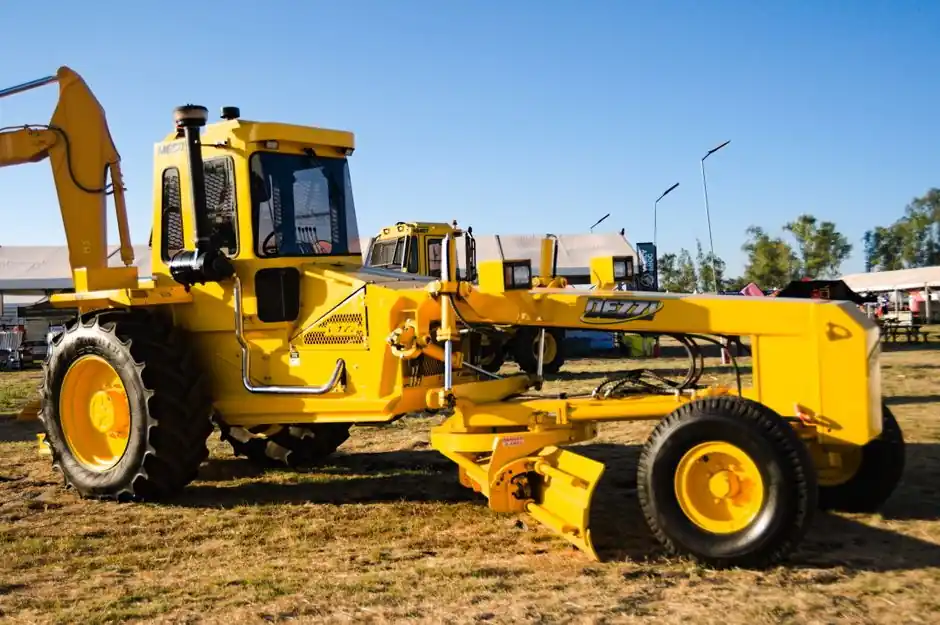
Motor grader safety requirements are dominated by ingress/egress discipline, pre-trip inspection, and reverse-visibility protocols rather than by the machine's rated horsepower, per OEM operator guidance covering current Cat motor grader lines [S1].
The most common motor grader categories in service are 14–18 tonne all-wheel-drive units used in road construction, snow removal, and mine haul-road maintenance, with operators facing struck-by, rollover, and pinch-point hazards daily, a hazard profile that mirrors the broader construction machinery and equipment risk register [S3].
Three-Points-of-Contact Mounting and Dismounting
Slips, trips and falls during cab access account for a measurable share of motor grader injuries, and OEM guidance treats three-points-of-contact as a non-negotiable, specifying that operators should always maintain two hands and one foot, or two feet and one hand, on the steps and grab rails at all times [S1]. Cab step tread, handrail integrity, and debris on platforms are explicitly listed as pre-climb checkpoints, because mud, ice, or oil on a single step breaks the contact rule and turns a controlled descent into a fall [S4].
Aluminum or steel step surfaces with anti-slip punch-plate, plus contrasting yellow grab rails, are the standard geometry on current production units, and operators are instructed to face the machine, never jump, and never carry tools in either hand while climbing [S1][S3]. This protocol is a direct response to documented fall-from-height incidents on motor grader cabs where one hand was occupied with a clipboard or two-way radio.
Pre-Trip Walk-Around and ROPS Verification
A pre-trip inspection should be completed before every shift, with the operator's manual read in full, windows and lights cleaned, and floor debris cleared from the cab and step wells, per UConn safety operations guidance used by US municipal and contractor fleets [S4]. The walk-around must verify tire condition, hydraulic hoses, articulation joint pins, and the integrity of the Rollover Protective Structure (ROPS) and Falling Object Protective Structure (FOPS) where fitted [S3].
Operating weight for a typical 14G-class motor grader sits in the 14–18 tonne band, and with a center of gravity that shifts as the moldboard is angled and the front wheels leaned, any ROPS damage discovered mid-shift must take the machine off the job immediately; field repairs of structural ROPS tubes are explicitly prohibited, replacement is the only corrective action [S4]. This do-not-weld-the-ROPS rule is consistent with general machine safety practice for protective structures on mobile plant.
Personal Protective Equipment Baseline

Operator PPE for motor grader work comprises a hard hat (Type I/II, ANSI Z89.1 or equivalent), Class G or higher safety glasses, high-visibility Class 2 or Class 3 vest, ANSI Z41 steel-toe or composite-toe boots, and hearing protection once in-cab noise exceeds 85 dBA over an 8-hour time-weighted average, per fleet operator guidance [S3]. For snow and shoulder-work applications where visibility drops below 500 ft, Class 3 hi-vis with retroreflective striping is the minimum specified [S3].
Gloves rated to EN 388 cut level 3 or higher are recommended during pre-trip checks, because operators regularly handle hydraulic quick-disconnects, ripper shanks, and moldboard cutting edges that carry residual sharpness even when dulled, a hazard profile that overlaps with general fire safety doctrine on hot-surface and sharp-edge segregation during maintenance [S3][S4].
Reverse Operation, Mirrors, and Camera Systems
Operators should look behind the machine before moving and continuously while backing up, confirming the work area is clear of ground personnel, dump trucks, and obstructions before engaging reverse, and never relying on mirrors alone on a unit with an articulated frame [S2]. Modern motor graders are specified with rear-view cameras and object-detection radar, but camera cleanliness and monitor brightness checks are part of the same pre-trip sequence as the hydraulic inspection [S1].
Tip-line of the moldboard is the single largest blind zone when the machine is articulated and the blade is slewed to the right shoulder, so operators are trained to dismount and visually sweep the work area rather than trust mirrors when ground crews are within 15 m of the rear tires [S2][S3]. This visual-cue protocol is the same approach documented in adjacent safety writing on angle grinder safety, where pre-task visual sweeps substitute for incomplete sensor coverage.
Shutdown, Parking, and Isolation

Shutdown procedure begins with parking the grader on flat ground, placing the transmission in neutral, applying the parking brake, and lowering the scarifier and moldboard fully to the ground before shut-off, per OEM operating-regulation guidance compiled from multiple current manuals [S6]. Auxiliary hydraulic circuits should be depressurized and the battery master switch isolated when the machine is left unattended for more than a shift, to prevent unintended motion from hydraulic creep on cold-start.
Lockout/tagout (LOTO) per OSHA 29 CFR 1910.147 applies to any service work on the blade, ripper, or articulation joint, with a documented energy-isolation point on the hydraulic accumulator and the starter circuit, consistent with broader lighting equipment and electric lamps maintenance doctrine that treats stored energy as a live source until proven otherwise [S3][S6]. Operators should never reach under an unsupported moldboard; a mechanical stand or full lowering is the only safe state.
Transport, Loading, and Yard Handling
Container loading of motor graders requires high-strength non-slip ramps of sufficient size to provide stable machine entry, with speeding, sharp turns, and sudden stops explicitly prohibited during the loading run, per current shipping guidance [S7]. The drive-up angle on a standard 40 ft flat rack should not exceed 15 degrees, and the machine must be centered laterally on the deck to keep the center of gravity inside the container's footprint.
For road-transport on a lowboy, the front wheel lean and articulation lock must be engaged, the parking brake set, and the machine chained at four points with rated binders, a sequence that mirrors the parking-block discipline used for shipping any heavy construction unit [S6][S7]. Failure to center the load is the single most common cause of container-shift incidents, and operators are advised to re-check chain tension after the first 50 km of road transport.
For fleets standardising safe motor grader operation, the two highest-leverage next actions are: (1) require documented pre-trip inspection logs with photo evidence of ROPS and tire condition, and (2) mandate annual operator recertification that includes a hands-on reverse-visibility and three-points-of-contact assessment, per current operator training guidance [S3][S4]. Adjacent technical reading on motor grader working principle: hydraulics, moldboard geometry, and drivetrain gives the mechanical context behind the inspection points called out above.