Caterpillar lists motor graders as a standalone product line alongside articulated trucks, dozers, and wheel loaders, with current production units meeting Tier 4 Final / Stage V emissions standards and supporting machine-control-ready hydraulics for grade-assist automation [S1].
The category spans roughly 11,000 kg compact units used in street maintenance up to heavy mining frames in the 25-30 t bracket, and the two dominant classifiers used in the field are frame architecture and operating-weight class, both published in OEM selection guides [S2][S3].
Rigid vs Articulated Frame: Two Layouts, Two Operating Profiles
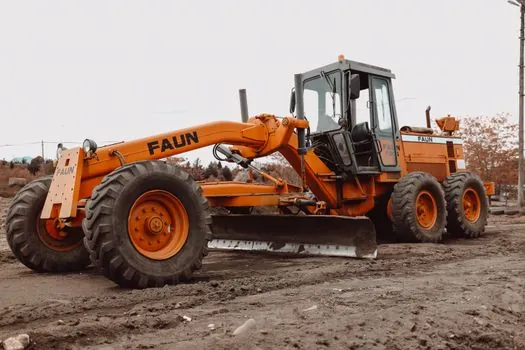
Rigid frame motor graders use a single fixed rectangular frame with the moldboard mounted between the front and rear axles, typically on a six-wheel layout with tandem rear bogies under the cab and engine, which gives the blade a stable cutting angle for long, straight passes [S2]. This is the layout contractors default to for highway grading, farm work, and airport runway finishing where straight-line repeatability matters more than tight turning [S3][S4].
Articulated frame motor graders add a central hinge between the front and rear frames, allowing the front section (and the attached blade) to pivot independently of the rear drive section; the trade-off is a smaller turning radius and better access to confined urban sites, offset by a slightly higher purchase price and a more demanding operator skill curve [S2][S3]. For snow removal, ditch cutting, and street rehabilitation where the machine has to wrap around manholes, curbs, and intersections, the articulated layout is the standard pick.
Size Classes: Small, Medium, and Large Graders
OEM selection guides break the size axis into three bands: small (typically under ~13 t, used for municipal streets, landscaping, and light road maintenance), medium (the workhorse band covering most highway and road-building applications), and large or heavy-duty graders in the 18-30 t class built for mining haul-road maintenance, large dam projects, and motorway earthworks [S2][S7]. Mid-range units are described as the most common configuration in highway and large-construction-site fleets [S7].
Choosing a class is governed by blade downforce, machine width, and transportability: a small frame can be towed on a tag trailer without permits in many jurisdictions, while large frames generally require low-bed haulage and disassembly of the moldboard for road moves [S3][S7]. Horsepower climbs roughly with class, with mid-frame machines clustering in the 150-220 hp band and large mining-oriented rigid frames crossing the 400 hp threshold.
Engine and Emissions Tier in Current Production
Caterpillar's current motor grader offering is positioned as Tier 4 Final / Stage V compliant, with factory-supported attachments covering scarifiers, rippers, snow wings, V-plows, and front-mount straight blades that convert the chassis into a light dozer or spreader [S1]. The Peterson Cat M Series listing confirms the same machine family is targeted at heavy construction, governmental, and mining/haul-road applications, which is consistent with the rigid-frame large-class segment [S5].
Emissions tier matters on the resale market: Tier 4 Final / Stage V units are required for most EU and North American non-attainment job sites, while older Tier 3 / Stage IIIA inventory remains common in export markets and for owner-operators working unregulated rural roads [S1][S6]. Buyers in regulated regions should treat the emissions plate as a hard filter before comparing frame size or horsepower.
Attachments and Work-Tool Choices
The base moldboard is supplemented in practice by scarifiers (front- or mid-mounted toothed shanks that rip hard soil or thin asphalt before grading), rear rippers for breaking up pavement or cemented layers, and specialty blades including serrated blades for sticky or windrowed material and straight front-mount blades for light dozing and backfilling [S4]. Snow removal typically adds a front-mounted snow wing or V-plow and sometimes a rear sand spreader, turning a medium grader into a one-machine winter maintenance unit [S3].
Selection logic: match the work tool to the material, not to the machine. A ripper set too aggressively will stall a small-frame engine; a wide moldboard on a narrow street blocks traffic; and a serrated blade is wasted on dry sand where a plain moldboard already cuts cleanly. Field guides recommend daily walk-around inspection of teeth, shanks, and circle-and-drawbar wear points because those are the components that fail first, not the drivetrain [S4].
Selection Criteria: Frame, Size, Engine Tier, and Site Constraints
A four-axis comparison frames the decision: rigid frame vs articulated frame on maneuverability, small vs large size on transport and cut depth, Tier 4 / Stage V vs older tier on jobsite eligibility, and standard moldboard vs ripper/snow-wing configuration on work-tool cost. Rigid large units win on haul-road maintenance in open-pit mines; articulated medium units win on urban street rehab; small rigid units win on municipal lots and short hauls between job sites [S2][S3][S7].
A buyer who ignores site access usually pays twice: once for the larger machine that does the work in fewer passes, then again for a low-bed permit, an escort vehicle, and a partial disassembly to get the unit on site. Articulated frames cost roughly 10-20% more than equivalent rigid frames in the same size band, with the premium recovering quickly on any job requiring more than ~30% of operating time in tight or curved work [S3]. For a broader look at how motor graders fit into the wider heavy equipment fleet, see the construction machinery and equipment encyclopedia entry.
Use Cases by Industry and Job Type
Highway contractors and road-building agencies use mid-frame rigid graders for finish grading on sub-base and base courses, with the moldboard extended sideways to cut side ditches in the same pass as surface work [S4][S7]. Mining operations run large rigid frames on haul-road maintenance, where grader availability directly affects truck cycle time and tire wear on the haul fleet [S3][S5].
Municipalities and county public works departments typically operate small to mid-frame units for snow removal, gravel-road regrading, and shoulder work, often with snow-wing and V-plow attachments carried through the winter season [S3][S7]. Agricultural users, airstrip operators, and large industrial sites (ports, logistics yards) round out the buyer base with small-frame rigid units optimized for low transport weight and simple mechanical controls rather than automated grade-assist systems [S2][S4].
Limitations, Failure Modes, and Operating Constraints
Motor graders are not loaders: their productivity collapses when used to push or carry material, and the moldboard wears rapidly if the operator treats it like a dozer blade. Circle-and-drawbar wear is the single most common maintenance cost after tires, and on articulated machines the central hinge pins add a second wear point that demands scheduled greasing and periodic shim adjustment [S2][S4].
Transport width and height are the hard physical limits: most mid- and large-frame graders exceed standard highway load envelopes with the moldboard attached, so disassembly or a low-bed trailer is mandatory for road moves between sites. Productivity comparisons also need a fair blade-downforce and travel-speed assumption; published cycle times from OEM brochures assume consistent material and a trained operator, which a buyer should not assume on first deployment [S3][S4].
One comparable reference point for buyers building a broader equipment line is the Crawler Crane vs Gantry Crane spec map, which uses a similar frame-versus-size-and-site-constraint structure to lay out selection logic for a different but adjacent heavy equipment category. A motor grader sits between excavator-class earthmoving and paving-class finishing equipment, which is why most contractors size it against the loader and dozer fleet rather than treating it as a standalone purchase.
Trackable signals for the next planning window: monitor OEM Tier 4 Final / Stage V inventory levels for medium rigid frames, watch for articulated-frame price compression as more Chinese-built units enter export channels, and verify that any used mid-frame unit under consideration has documented circle-and-drawbar wear measurements rather than just hour-meter readings [S1][S6].
For the relevant spec sheets and selection criteria, see motor grader, and lamps and light fittings.