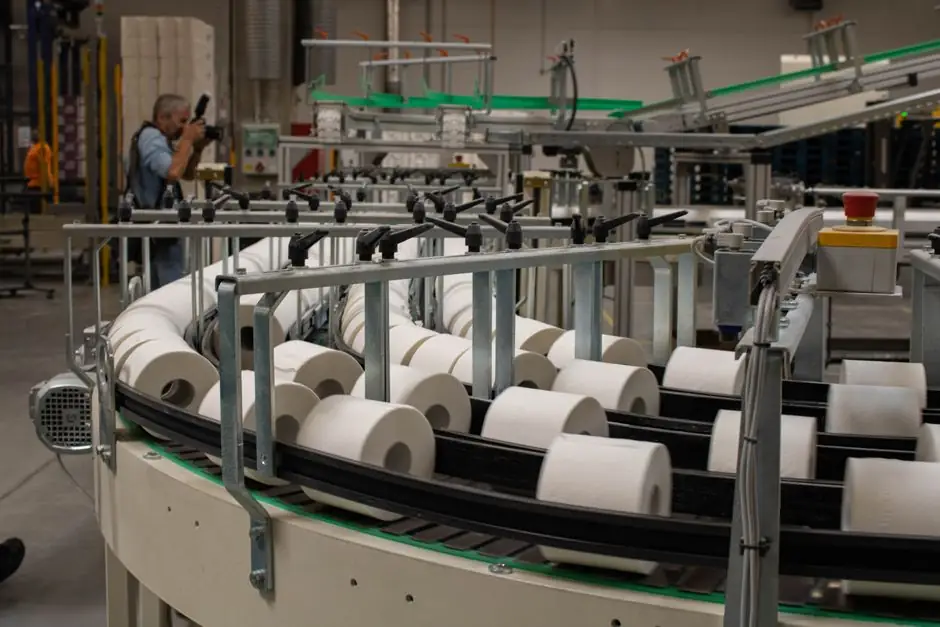
Motor-driven roller conveyors can reduce electrical consumption by 20–50% when their zones run only while product is present [S1][S6][S8].
The comparison applies to 24V DC motor-driven rollers arranged in controlled zones, not to every conveyor carrying the same load over the same duty cycle.
Where the Energy Saving Comes From
A 24V motorized roller drives neighboring rollers through O-bands or poly-V bands, while a photo eye detects product and permits only occupied zones to run [S2]. This demand-based control removes the no-load running time that penalizes a continuously driven line shaft.
TREW specifies a 24VDC system and claims 30–50% lower energy use than line-shaft arrangements [S1]. A separate Pulse Roller source claims an additional 20–30% electrical-power saving for low-energy motorized rollers [S6]. These are vendor-defined comparisons, so a procurement specification should require the same load, speed, line length, and duty cycle for both alternatives.
A 24-volt roller drive in intermittent service can achieve a 30% energy saving compared with 400-volt technology [S8]. This supports the technical case for low-voltage, zone-controlled drives, but it does not prove that every 24V installation beats every line shaft.
MDR and Line Shaft: Decision Criteria
The comparison below separates system architecture rather than treating “electric powered” as one category. A motorized drive roller conveyor distributes power along the line, while a line shaft conveyor concentrates mechanical drive in a longitudinal shaft and belt or spools. [S2]
For load spacing, speed, and accumulation requirements, an MDR conveyor is generally stronger for stop-and-go parcel flow. For long, simple, continuously operating runs with light to medium loads, line shaft remains a valid option because one motor can cover approximately 15–18 m of straight conveyor [S3].
Line Length, Load and Operating Duty

One line-shaft motor can serve approximately 15–18 m of straight conveyor, creating a simple drive arrangement for light and medium boxes and totes [S3]. That mechanical reach does not itself guarantee lower electricity use, because the shaft, spools, polyurethane O-rings, and idler rollers remain exposed to continuous service.
MDR creates a different load profile. Each zone has its own motorized roller and controller and runs only when product is present [S2]. The result is most attractive where cartons or totes arrive intermittently, where accumulation consumes line capacity, or where energized equipment beside a workstation creates pressure to reduce noise.
TREW gives its standard MDR modules a capacity below 75 lb per roller and typical speeds up to 180 ft/min [S1]. Those values illustrate the intended parcel and tote duty, but they are not universal MDR limits. Load mass, roller diameter, drive speed, incline, duty cycle, and the selected roller determine the final capability.
Zero-Pressure Accumulation Changes the Comparison
MDR is designed around zero-pressure accumulation, so each tote can be held independently without compressing the tote behind it [S1][S2]. This mode can prevent product damage, reduce queueing during stops, and eliminate compressed-air equipment when the application does not require pneumatics.
Line-shaft systems are less naturally suited to this requirement. Their minimum-pressure accumulation behavior permits items to contact one another, and additional pneumatic blade stops may be needed at transfer or decision points [S3]. Adding those devices changes the line-shaft energy and maintenance comparison, particularly where compressed air leaks or valves operate repeatedly.
The roller conveyor decision therefore has two separate questions: which system consumes fewer kilowatt-hours, and which system handles accumulation with less product pressure and fewer pneumatic auxiliaries. A pure motor-power comparison cannot answer both.
Where Line Shaft Can Still Win

Line shaft remains suitable for straightforward continuous transport, especially where equipment is already installed, local serviceability is limited, or the economic life of the existing line exceeds the cost of conversion. Its established architecture is robust and easy to maintain [S3].
Motorized rollers are not automatically more efficient in every duty cycle. A continuously running MDR zone still consumes power while active, while a low-utilization line shaft may operate close to its rated efficiency. If both systems run continuously at identical speed, load, line length, and duty cycle, the expected savings from demand control would be much smaller than the advertised 20–50% range [S1][S6].
Motorized roller systems also require zone controllers, 24V power supplies, photo eyes, elastic drive bands, and individual powered rollers [S2]. A line shaft instead uses a drive motor, shaft, spools, and roller belts. The maintenance profile, spare-parts inventory, diagnostic method, and conversion cost therefore belong in the energy calculation.
How to Validate an Energy Claim
Compare two complete systems over a representative shift: product mass, units per minute, conveyor speed, zone occupancy, stop time, accumulated time, and peak operating hours. Meter total electrical input at the drive cabinet rather than comparing nameplate motor ratings, and separate idle, accumulation, and moving periods. [S2]
Use the stated operating case when calculating savings. If the proposed MDR system is expected to consume 40% less power than the line-shaft baseline, the model should identify the duty-cycle assumptions that produce that result. The published figures span 20–30%, 30%, and 30–50%, which indicates that configuration and operating profile materially affect the outcome [S1][S6][S8].
For a practical acceptance test, record baseline kWh per 1,000 units and kWh per operating hour, then repeat the calculation with the motorized system under the same product mix. A defensible procurement result states both metrics, the line length, the conveyor speed, and the percentage of time zones are occupied.
Specification Checkpoints for Lower Consumption
Specify 24V DC zone drives, occupancy sensing, and selective zone operation rather than treating “MDR” as an energy guarantee [S2]. Confirm whether the application needs forward and reverse movement, zero-pressure accumulation, or only one-direction transfer, because added functions change roller and controller requirements.
For a line using roll-on-demand operation, verify that the motorized roller contains a 24V DC brushless motor and that photo-eye-controlled run logic is available [S4]. Then check band type, zone length, roller spacing, speed, load, and maintenance access. TREW lists more than 20 standard module types, with straight, curved, spur, merge, spiral, and lift-gate configurations available for modular layouts [S1].
The trackable signals are operating energy per 1,000 units and the proportion of occupied versus idle time. If those values do not support at least the supplier's stated saving range, a line-shaft or belt conveyor comparison should remain in the approval package.