
NBR selection is governed by four interlocking variables — acrylonitrile (ACN) content, polymer hardness, continuous service temperature and the specific petroleum- or chemical-based fluid the part will see — and buyers who skip any one of these gates routinely end up re-specifying within 12 months [S2].
The polymer is a butadiene-acrylonitrile copolymer; commercial grades cluster into five ACN ranges (18-24 %, 25-30 %, 31-35 %, 36-41 %, 42-46 %), and a higher ACN percentage raises oil and fuel resistance while pushing the brittle point upward [S2]. Standard NBR compounds are generally rated for -30 °C to 100 °C continuous service in air, with short excursions to roughly 120 °C in oil and up to 150 °C in air for peroxide-cured premium grades [S2].
ACN Content: The Master Lever for Oil/Cold Balance
ACN content is the single largest performance lever in any [nitrile rubber (NBR)]( [S1]
) spec — each step up the ACN ladder improves aliphatic hydrocarbon and fuel resistance but costs low-temperature flexibility, so the spec must fix ACN before hardness, durometer or colour is even discussed [S2].
Reference bands commonly published for NBR family selection put very-high-ACN grades (42-46 %) in the top tier for oil/fuel swell resistance, medium-high ACN (31-35 %) in the general-purpose sweet spot, and low-ACN (18-24 %) compounds reserved for cold-flexible dynamic seals where some fuel swell is acceptable [S2]. For wiper and rod-seal applications, an NBR compound with Shore A 90 hardness is one of the standard offerings in the market, paired with a -30 °C to +100 °C service envelope and a 1 m/s rubbing-speed ceiling [S1].
Hardness, Modulus and the Shore A Decision
Most industrial NBR compounds are specified between Shore A 60 and Shore A 90, with 70 ±5 being the default commodity band and 80-90 used where extrusion resistance under system pressure matters, for example in hydraulic rod seals [S1]. Round-section NBR cord stock, sold by the metre from 4.5 mm diameter upward, is typically Shore A 70 and is cut and vulcanised into O-rings for static gland duties [S8].
For sealing, cushioning and damping, the NBR family is positioned alongside [EPDM rubber](
), [silicone rubber](
) and general-purpose [industrial rubber](
) compounds in the MISUMI catalog tree, but the NBR sub-tree is the only one of those four to combine Shore A 70-90 hardness with consistent resistance to petroleum oils in the same compound [S4].
Temperature Window and the Heat-Aging Gate
Continuous service temperature is the second hard gate. Standard NBR is generally limited to 100 °C in air and roughly 120 °C in oil, with peroxide-cured or hydrogenated grades (HNBR derivatives) pushing the air ceiling to 150 °C [S2]. For dry-heat resistance testing, SAE AMS3201J-1990 sets the historical baseline for NBR compounds in the 35-45 Shore A hardness band, and remains a reference cited when 70-90 Shore A NBR seals are qualified for under-bonnet and aerospace service [S5].
The flip side is low-temperature flexibility: standard NBR stiffens rapidly below -20 °C and reaches its practical limit at -30 °C, which is why low-ACN grades are reserved for cold-climate dynamic seals rather than the more oil-resistant high-ACN grades [S1][S2]. Cold-rated NBR is the right call for mobile hydraulics, agricultural machinery and refrigerated-plant service; HNBR or NBR/PVC blends are the right call where the part must survive both -30 °C and 135 °C air exposure.
Fluid Compatibility: Fuels, Oils, Water and the Boundaries
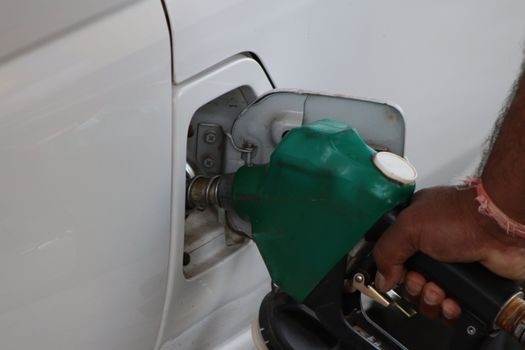
Fluid is the third gate. NBR is the default elastomer for aliphatic hydrocarbons, mineral oils, diesel, gasoline (including ethanol-blended fuels) and silicone greases, and the automotive fuel-line and O-ring cord markets are built almost entirely around it [S2][S7][S8]. For 1/4 in (6.35 mm) EFI fuel lines and flexible gas-line hose, NBR is the polymer on the dominant aftermarket product, and NBR O-ring cord at 4.5 mm diameter is sold by the metre in Shore A 70 for field-fabricated static seals [S7][S8].
Where NBR fails is just as important as where it works. NBR is not specified for strong polar solvents (acetone, MEK, DMF), brake fluid (DOT 3/4/5.1 glycol-ether basis), phosphate-ester hydraulic fluids (Skydrol, Hyjet), chlorinated hydrocarbons, or prolonged exposure to ozone and concentrated acids — those services require [silicone rubber](
), EPDM, FKM or HNBR instead [S2].
Application Mapping: Wipers, O-Rings, Fuel Line and Recompounded NBR
By application, NBR is the dominant polymer for four part families: (1) rod/piston seals and wipers in hydraulic cylinders, typically Shore A 90 with a 1 m/s speed rating; (2) O-rings and O-ring cord, typically Shore A 70 in NBR 70 cord stock; (3) fuel hoses and flexible gas lines, 1/4 in NBR being the most common aftermarket size; and (4) general anti-vibration, damping and sealing parts, where NBR is grouped with urethane, silicone and EPDM in the standard catalog menu [S1][S4][S7][S8].
A fifth lane is devulcanised/recycled NBR. Peer-reviewed work published in 2023 and still being cited in 2026 demonstrates that waste NBR can be devulcanised and recompounded with predictable property recovery, which matters for buyers writing sustainability clauses into their 2026 sourcing RFQs [S6]. For most engineering buyers, that recycled stream is acceptable for non-safety, non-fuel gasketing where virgin NBR is otherwise over-specified.
Selection Gate Table: ACN × Hardness × Temperature × Fluid
A condensed four-gate comparison, expressed as the kind of cut a process engineer writes into a procurement spec: [S2]
• Low ACN (18-24 %) NBR — best low-temperature flexibility, lowest oil swell resistance; use for cold-climate dynamic wipers and rod seals [S2].
• Medium ACN (31-35 %) NBR — general-purpose sweet spot, Shore A 70-80, covers most hydraulic O-rings and wipers from -30 °C to +100 °C [S1][S2][S8].
• High ACN (36-41 %) NBR — fuels, diesel and aromatic-rich oils; pair with Shore A 80-90 and peroxide cure for hot oil up to 120 °C [S2][S7].
• Very-high ACN (42-46 %) NBR or HNBR — aerospace and aggressive-fuel service; air ceiling 150 °C with peroxide cure, but cold limit rises to -20 °C or above [S2].
Outside this envelope — strong polar solvents, phosphate-ester hydraulics, ozone-heavy outdoor exposure — the spec should be re-routed to silicone, EPDM, FKM or HNBR rather than forced into a higher-ACN NBR.
Cost, Lead Time and Sourcing Signals in 2026

On the sourcing side, NBR pricing is dominated by ACN grade, hardness band, cure system (sulphur vs peroxide) and minimum-order quantity, much like the [silicone rubber price and cost guide 2026]( [S3]
/news/silicone-rubber-price-cost-guide-2026-grade-hardness-and-moq-levers.html) cost stack for that competing elastomer family. Standard Shore A 70 NBR O-ring cord in 4.5 mm diameter is sold in cut-metre lengths from UK and EU distributors, and 1/4 in NBR EFI fuel line is held in multi-thousand-unit stock by US-based aftermarket sellers — both signals that the 2026 NBR supply chain for commodity sizes is healthy [S7][S8].
Watch the next 6-12 months for: (1) published revisions to AMS3200-series NBR dry-heat specifications, and (2) growth in devulcanised-NBR grade offerings as recyclate streams scale, both of which will reset the cost-versus-performance curve that the four-gate spec above depends on [S5][S6].
For component-level specifications, see nitrile rubber, epdm rubber, and industrial rubber.
For related coverage, see Manual Pallet Jack Selection: 5 Engineering Gates That Lock the Model Before RFQ in 2026.