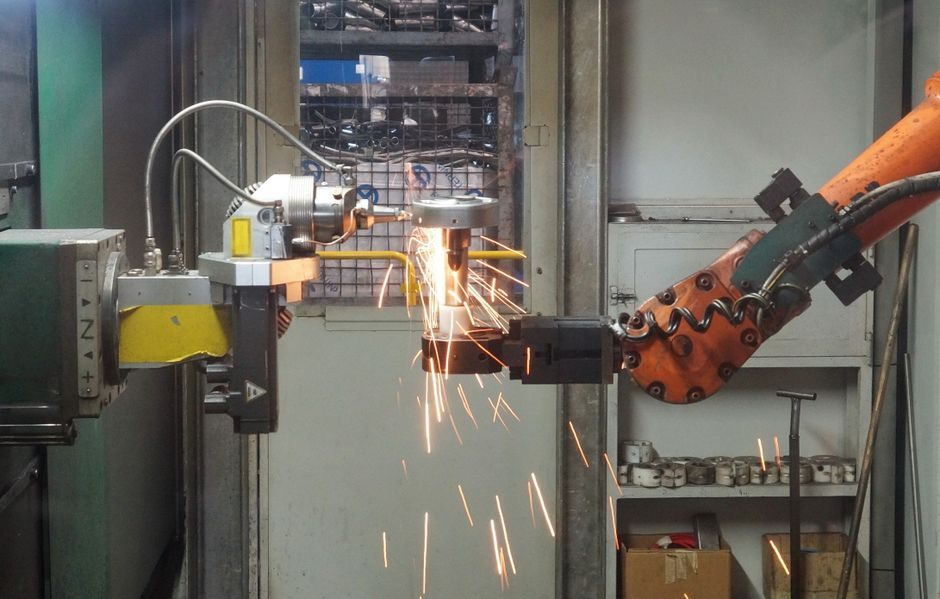
OEM and ODM are not interchangeable on an industrial-robot RFQ: OEM means the buyer ships a complete mechanical/electrical design and the factory builds to print, while ODM means the factory's in-house R&D delivers the kinematic design, controller firmware and bill of materials under the buyer's brand [S3].
On Made-in-China.com, 29 dedicated industrial-robot-application factories and 87 cataloged products were listed in 2026-04, with the majority holding both "Own Brand, ODM, OEM" R&D capacity [S1]. A parallel CNC-robot search returned suppliers such as Dongguan Hayea Automation Co., Ltd., whose 3-axis cobot gantry cell for CNC tending is advertised from US$ 8,000/set at 1-set MOQ [S5].
Definition, Scope and What Each Path Actually Buys
OEM engagement delivers a manufacturing contract: the buyer's CAD, controller firmware, gear reducer selection and EOL test procedure are executed by a factory whose R&D capacity is listed as "OEM" [S3]. Tooling amortization, IP risk and CE/UL liability stay with the buyer; the factory's role is limited to process qualification and capacity.
ODM engagement delivers a product: the factory's R&D team owns the kinematic chain, safety controller logic and cell layout, and the buyer private-labels the result [S3]. VEICHI's 2026-07 catalog, for example, ships scara, collaborative and articulated robots as finished SKUs that a buyer can re-label under an ODM agreement rather than redesign [S7].
Who OEM Fits — and Who It Will Bite
OEM is the right path when the buyer already holds a frozen 2D/3D package, a controller firmware branch, and a safety file conforming to ISO 10218-1 / ISO/TS 15066 for collaborative cells, and only needs tonnage, repeatability and an ISO 9001:2015 audit trail from the factory [S1]. Taian Tongxin Hydraulic Machinery Factory, for instance, lists "Own Brand, ODM, OEM" but its core competence is hydraulic cylinders, not 6-axis kinematics — picking it as an OEM partner for a robot arm would force the buyer to supply every gearbox, servo and safety controller spec.
OEM is the wrong path for first-time integrators, distributors without a firmware team, or anyone whose "design" is a marketing sketch: the factory cannot legally fill in safety-rated soft-axis limits, PL d Cat 3 stop categories or ISO 13849-1 validated I/O — those belong to the designer of record, and an OEM shop that quietly adds them is doing design work under an OEM contract.
Who ODM Fits — and Where It Quietly Fails
ODM is the right path for system integrators and regional OEMs that need a working 6-axis arm, scara or cobot at a known unit price, with the factory already maintaining CE documentation and a controller that speaks EtherCAT or Modbus TCP [S7]. Hayea's 3-axis cobot at US$ 8,000/set with 1-set MOQ is a typical ODM entry point: the buyer drops a label on the cell, not a gearbox into the joint [S5].
ODM fails when the buyer's end-customer needs application-specific ATEX/IECEx zoning (an ODM scara is almost never delivered with a Category 2G/2D certificate from stock), when the cycle-time budget is tighter than the ODM catalog value, or when lifecycle spares — harmonic-drive reducers, servo motor part numbers — must be cross-referenceable to a Western part the buyer already stocks. In those cases the ODM NRE savings disappear inside a 12-month redesign.
Decision Criteria: OEM vs ODM Head-to-Head
Four decision criteria line the two paths up cleanly. (1) Design ownership: OEM = buyer, ODM = factory. (2) Time-to-first-unit: OEM typically 12-24 weeks for a new arm, ODM typically 4-8 weeks for a catalog SKU [S3][S7]. (3) Unit-cost floor: OEM cell runs US$ 200,000-5,000,000/piece for an AGV-style platform and US$ 208,000-286,000/set for a welding robot, while ODM cobots start at US$ 8,000/set [S4][S5]. (4) Compliance liability: under OEM the buyer files the Declaration of Conformity, under ODM the factory's existing certificate transfers with the private-label agreement.
Within Guangdong alone, factory concentration is high: Made-in-China.com's 2026-04 audit shows Diamond-tier suppliers in Guangzhou and Zhuhai carrying ISO9001:2015 + ISO14001 + ISO45001:2018 triple certification [S1]. The same supplier base services OEM, ODM and own-brand SKUs from the same production line, which is why a "pick the same factory" decision often resolves to ODM for speed and OEM only when the buyer's IP cannot leave the buyer's vault.
Use Cases, Failure Modes and Sourcing Signals
Use case A — a Tier-1 automotive welder needing a 6-axis arm with a Fanuc-compatible controller and 12-month process FMEA: OEM, because the integrator owns the weld schedule. Use case B — a warehouse distributor selling into light-payload palletizing under its own label: ODM, because VEICHI-class catalog robots are already palletizer-ready [S7]. Use case C — a CNC machine builder buying a 3-axis loader for US$ 8,000/set under its own brand: ODM, as demonstrated by Hayea's 1-set MOQ gantry cobot [S5].
Failure mode to watch on ODM: the factory's "ODM" label can mean "we will paint your logo on a stock SKU" rather than "we will engineer a derivative" — verify by asking for the kinematic diagram revision history, not the brochure. Failure mode on OEM: suppliers with "OEM" R&D capacity but a non-robot core product (hydraulic cylinders, silicone wire) are common on the same search page; cross-check the main-products line before issuing an RFQ [S1].
Trackable next signals: a 2026-07 listing refresh on Made-in-China.com showing new Guangdong ODM cobot entries with EtherCAT as standard, and any 2026-Q3 movement in VEICHI's articulated-robot price band relative to the 2026-07 catalog [S7]. For related decision logic, the industrial robot capacity planning sizing map and the BOM and TCO driver breakdown extend this OEM/ODM split into the cell-level economics, while additive-manufacturing material notes the same Guangdong supply cluster supplies metal-AM spares for robot-arm end-effectors.
Component reference pages worth checking: industrial adhesive, and industrial borescope.