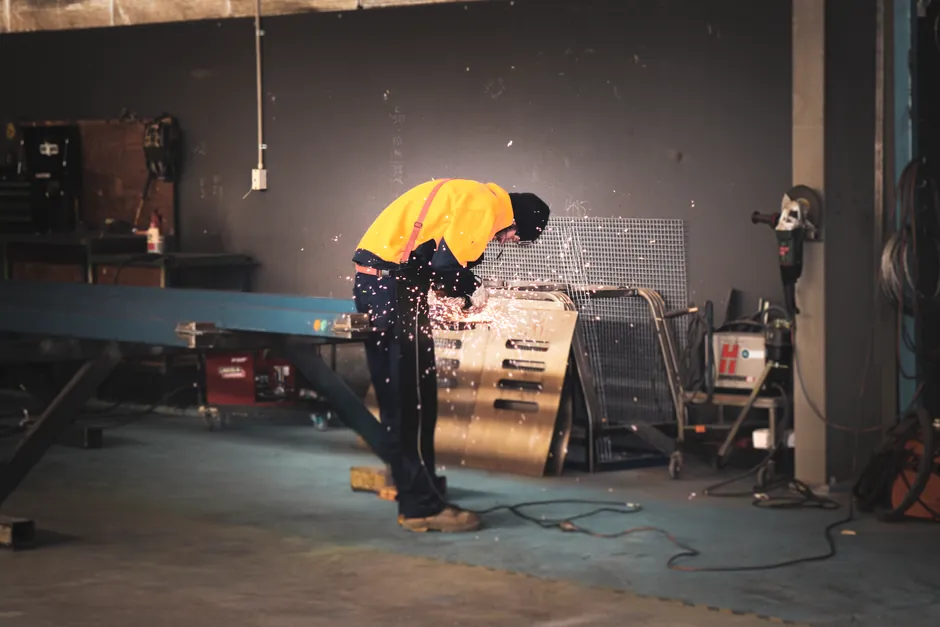
An order picker, as a category of order picker typically derived from counterbalanced or reach forklift chassis, must clear four interface gates against the host structure or upstream equipment: mechanical mounting (mast profile, carriage, load wheel envelope), power (battery voltage 24/36/48/80 V DC or diesel/LPG), electrical/control (CAN-bus, 24 V I/O, safety relay), and structural weld geometry on the host frame. Fabrication method (MIG/MAG, laser-hybrid, robotic spot, machined billet) is downstream of those gates, not upstream of them.
Plants that flip this order, specifying a welding process before confirming lift height, load capacity, and aisle width, end up re-cutting rails or retrofitting carriages. The 2026 sourcing pattern in warehousing and light-assembly lines treats the order picker as a constraints package: lift 2.5–12.0 m, load 1.0–2.5 t, aisle 2.4–3.6 m, then a fabrication spec is generated around the chosen SKU rather than the reverse.
Mechanical and mast interface, the dominant gate
Mast profile (simplex, duplex, triplex, quad) and lift height (2.5–12.0 m typical) drive carriage envelope, which in turn sets the host frame's machined rail flatness and parallel tolerance at 0.5–1.0 mm/m on rails over 6 m. Duplex masts add collapsed-height penalty of 200–400 mm versus simplex at the same lift, which forces taller doorways or pit-mounted platforms in low-bay retrofits. Triplex and quad masts require free-roller deflection check because free-lift chains stretch under partial extension; this is a fabrication input on the host, not on the picker.
For Class II order pickers (reach-style variants), wheelbase 1.4–2.2 m and articulation 90–180 deg frame swing constrain the host's floor flatness, typically 3 mm/m with no localised crowns above 6 mm, because mast deflection under combined torsion and vertical load scales with floor error. Truck-mounted order pickers on mezzanines add a live-load check: dynamic factor 1.3–1.5 against mezzanine rating, and that figure is the binding fabrication tolerance on mezzanine beam spacing.
Power, voltage, and electrical interface compatibility
Order picker voltage classes are 24 V DC (low-duty, 1.0–1.6 t), 36 V DC (mid-duty), 48 V DC (heavy-duty, 1.6–2.5 t, dominant class for warehouse order picking in 2025–2026), and 80 V DC for high-rise turret order pickers. Battery tray dimensions are not standardised across OEMs, so host compartment cut-out tolerances on charging bays are 2–4 mm, requiring machined reference edges, not plasma-cut free forms. Lithium-ion retrofits (LFP, 51.2 V or 80 V nominal) are increasingly specified in 2024–2026 warehouse builds and carry CAN-bus comms for BMS handshake; this forces a 4-conductor shielded harness run (power, CAN-H, CAN-L, ground) and a separate 24 V control tap if the picker's stack-light and brake circuits are not on the BMS bus. [S3]
Diesel and LPG order pickers (rare but still ordered for outdoor lumber and beverage operations) demand ATEX 2014/34/EU or IECEx zone classification when the operating envelope is adjacent to flammable vapours, and a 6–10 mm spark-arrestor clearance on exhaust routing, which is a welded-pipe fabrication gate, not a fork-mast gate. For non-ATEX indoor diesel, the 4.5–7.5 kW auxiliary alternator output drives 24 V housekeeping, and a pressure sensor at the hydraulic line (typical 160–200 bar working) interfaces with the lift-cutout interlock.
Control protocol, safety circuits, and PLC handshake
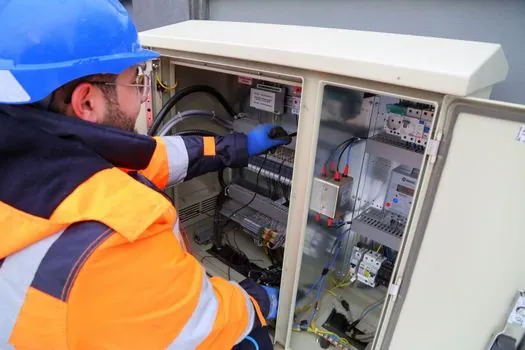
Modern order pickers expose 24 V DC discrete I/O (lift, lower, travel enable, horn, brake) and a CAN 2.0B or CANopen J1939 stack for drive status. Integration to a host PLC requires the I/O map be declared, and the safety-rated stop circuit (EN ISO 3691-1, performance level PL d minimum for stand-on riders) be wired to the host's category-3 safety relay, not to a generic 24 V input. A 24 V signal tied directly to a non-safety PLC input is the most common field-rewire fault: it passes bench tests and fails the first emergency-stop audit.
Zigbee, Wi-Fi HaLow, and 5G NR-Light telematics on the picker add an antenna-mount fabrication gate, typically an M5 or M6 stud on a flat 60 × 60 mm boss with no paint-pooling pocket. Picker-end RFID reading at pick faces (13.56 MHz HF, or UHF 860–960 MHz ETSI 302 208) means the host shelf structure is also an antenna near-field; metal backs without 30–50 mm air gap drop read rate below 90%, which is the typical minimum to avoid picker dwell-time overshoot.
Comparison: simplex vs duplex vs triplex mast on the four gates
On mechanical envelope, simplex wins for height-constrained sites (collapsed mast 1.9–2.4 m at 3.3 m lift), triplex wins for high-bay 6.0–12.0 m lift with collapsed mast under 2.5 m, and duplex sits between. On power, all three mast classes run on the same 24/36/48 V DC chassis, so mast choice does not change battery sizing, a non-obvious point that procurement teams sometimes miss. On control, simplex-only mid-rise units often ship without CAN-bus telematics, which forces a retrofitted pressure transmitter tap on the lift cylinder for load-weighing if the WMS needs it. On fabrication, triplex and quad masts push the highest dynamic load per cycle into the host, so welded beam splices must be full-penetration CJP at the mast-rail interface, not fillet welds; this is the most common fabrication re-spec during commissioning.
Materials, weld geometry, and fabrication process alignment
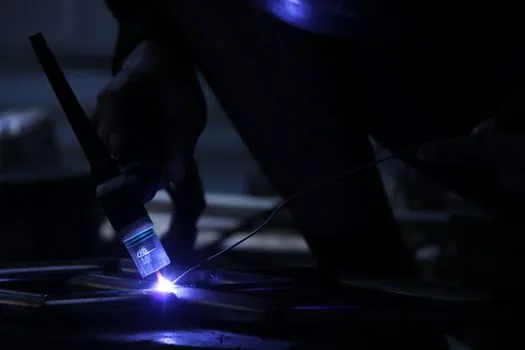
Host steel selection follows the mast reaction. For 1.0–2.5 t order pickers on mezzanines, S275JR or S355JR (EN 10025) with 8–15 mm web thickness is typical, and MAG welding with G3Si1/ER70S-6 wire on a 0.8–1.0 mm root gap, no backing, is the dominant 2024–2026 fabrication route. Robotic laser-hybrid (laser + MAG in the same weld pool) shows up on high-tier OEM rail production for laser-flatness under 0.3 mm/m, but it is not required for most Class II installs. Machined reference pads (milled flat to 0.05 mm over 200 mm) are required where the rail-to-beam clamp is a friction-grip rather than a welded strap; this is a true fabrication-method fork in the spec. [S3]
For outdoor or wash-down sites, hot-dip galvanising after fabrication (EN ISO 1461) is incompatible with pre-machined tolerance pads unless the pads are masked and re-machined post-galv, and that secondary operation often negates the cost saving. Powder-coat over cold-rolled AISI 304 stainless rail (1.4301) is the alternative for cold-store order pickers at -25 deg C, where the rail's thermal contraction (17.3 x 10^-6 /K) must be allowed for in slotted rail-hole patterns of 8 mm elongation per 4 m run.
Failure modes that pass a datasheet check and fail on site
Three integration pitfalls recur. First, a 48 V DC chassis and a 36 V DC BMS box from different vendors, both within the nominal band, with a 12 V mismatch on the contactor coil, blowing the contactor on first energise. The fix is to read the contactor coil spec, not the pack nominal. Second, host floor flatness at 5 mm/m is within the host spec but outside the 3 mm/m needed for the reach-class picker under load, causing mast skew above the 1 deg alarm threshold. Third, 24 V I/O is wired but the safety-rated stop is not, and the site audit flags it under EN ISO 3691-1 PL d.
A fourth, more silent failure, is flow meter integration on hydraulic standby: many order pickers do not have continuous hydraulic circulation, and a turbine flow meter installed on the lift line for predictive maintenance will under-read because the standby flow is below the meter cut-in (typically 1.5–3.0 L/min). Spool-position or pressure-based monitoring is the correct signal, not a flow meter.
Sourcing and standards map for 2026 procurement
Governing standards are EN ISO 3691-1 (driver-in industrial trucks, safety), EN 1726-1 (order pickers, specific), EN 1175 (electrical requirements), EN ISO 13849-1 (PL d safety circuits), ATEX 2014/34/EU where zone applies, and IEC 60204-1 for electrical equipment of machines. For US sites, ANSI/ITSDF B56.1 (2020 revision) covers the equivalent safety frame. The Sora Network Order Book pull request [S1] and Microsoft Learn OrderBy documentation [S5] are unrelated software artefacts and are not normative references for this hardware category; they are noted only because they appeared in the source pull and are sometimes mis-tagged in shared procurement databases.
Related spec maps to cross-read alongside this one: the Thermowell assembly selection: stem profile, material and wake-frequency gates piece for the same interface-layer logic, the AGV robot selection for air cargo terminals: payload, navigation, and zone rating gates for warehouse-automation adjacency, and the Dock Leveler Compatibility With Switching Repeatability: A Spec Map for the upstream loading-bay interface that feeds the picker zone. Trackable signals for the next procurement cycle: lithium retrofit kit lead times on 48 V/80 V packs, EN 1726-1 amendment drafts, and mezzanine live-load factor harmonisation under FEM 9.341 vs EN 1991-1-1.