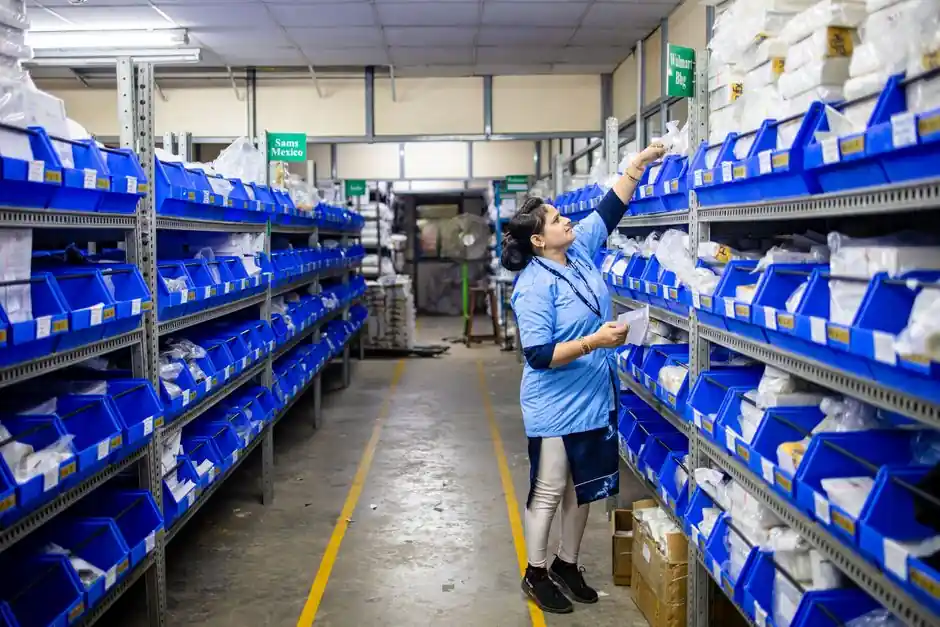
Order picker selection for e-commerce fulfillment hinges on three measurable inputs: top rack pick level, floor layout, and units-per-order density. As of 2026, self-propelled platforms such as the OPC-03 (3 m lift) and OPC-04 (4 m lift) bracket the working height envelope most distribution centers actually use [S5].
Market signals point to sustained demand: a Los Angeles apparel e-com order picker role posted on 2026-07-13 at $18.50-19.50/hr lists SKU-matched style, color, and size verification plus daily speed and accuracy targets as core duties [S4]. That posting is a useful proxy for what facilities expect from the equipment that supports the worker, not just the worker alone.
Order Picker vs Reach Truck: When Each Earns Its Slot
An order picker is a narrow-aisle lift truck whose operator platform rises with the load so workers can select individual items or cases directly from rack bays, a configuration built for piece-pick and high-level case-pick workflows rather than full-pallet moves [S1]. A order picker is the right call when the unit of work is the SKU, not the pallet.
Reach trucks, by contrast, are designed for pallet putaway and retrieval in narrow-aisle layouts, with a reach mechanism that extends forks into the rack and retracts the load into the wheelbase. Reach truck throughput is driven by travel speed and pallet handling efficiency; order picker throughput is driven by pick ergonomics and pick-path optimization. Conflating the two is the most common spec error in small-to-mid e-com facilities, and it shows up as bent rack uprights, slow pick rates, and operator fatigue on the platform [S1]. For deeper narrow-aisle detail, the Reach Truck Selection for Warehouse Automation: Spec Map guide covers the pallet-side decision tree.
Self-Propelled Platform Specs: OPC-03 vs OPC-04
Two self-propelled order picker models currently define the small-format segment: the OPC-03 with 3 m lift height, and the OPC-04 with 4 m lift height. Both use a planetary gear transmission motor at the base for ground travel, a hydraulic lift cylinder on a vertical mast for platform elevation, and a consolidated one-hand drive-and-steer control that leaves the operator's other hand free to handle picked items [S5].
Selection between OPC-03 and OPC-04 reduces to three variables: top rack pick level (must sit inside the unit's lift envelope), ceiling clearance, and facility footprint. The 3 m OPC-03 is the better fit for compact storage, retail backrooms, and lower-ceiling mezzanines; the 4 m OPC-04 fits mid-size distribution centers with adequate vertical clearance. Both share single-operator platform geometry, so floor surface condition and battery duty cycle are the secondary spec checks, not core differentiators [S5].
Pick Method Selection: Matching Method to Order Profile

Equipment choice is only half the problem; the pick method decides whether the truck earns its keep. The five methods most e-com 3PLs evaluate in 2026 are discrete, batch, zone, wave, and cluster picking, with pick-to-cart layered on top for direct pack transfer [S2].
Batch picking groups orders sharing SKUs so one trip covers multiple shipments, which cuts walking distance and raises picks-per-hour in apparel and accessories with high SKU overlap [S6][S7]. Cluster picking is similar in that one picker gathers items for several orders in one pass, but uses separate totes or bins per order, which keeps verification and sortation clean at the cost of more handling hardware. Zone picking assigns pickers to fixed warehouse zones, useful in larger layouts but requiring controlled handoffs. Wave picking batches orders into scheduled release windows; it scales well but breaks when urgent exceptions arrive mid-wave. Discrete picking, one order at a time, is the simplest method and the slowest at higher volumes [S2]. The method that wins is the one that matches SKU overlap, units per order, and peak-period shape, not the one that sounds most modern.
Selection Criteria: Inputs That Drive a Confident Buy
Five inputs reliably separate a working order picker spec from a wasted one. First, maximum pick height, measured to the top rack level the operator must reach, with a margin for the platform's own height plus the tallest SKU footprint. Second, aisle width and floor surface, because self-propelled travel assumes level, unobstructed flooring across the pick path. Third, battery duty cycle, since runtime must cover the planned shift without mid-shift charging gaps that cascade into wave misses [S5].
Fourth, pick volume and units per order at peak, which sets whether batch or zone methods can absorb the load. Fifth, operator ergonomics, specifically one-hand drive-and-steer geometry, hand-truck or pallet-jack integration, and RF scanner or WMS integration for SKU matching. The 2026-07-13 Spherion posting makes the operator-side criteria explicit: it requires comfort with RF inventory scanners and digital warehouse management systems, plus 0-1 years of prior experience verifying style, color, and size on apparel SKUs [S4]. If the equipment spec ignores what the operator is being asked to scan and verify, the pick rate targets in the spec sheet are fiction.
Where Order Pickers Are the Wrong Choice

Order pickers are the wrong tool for full-pallet putaway and retrieval, for inbound receiving flows dominated by pallet quantities, and for very low-SKU-count operations where a counterbalance forklift or reach truck covers every move more cheaply. The narrow-aisle pallet-handling niche is reach-truck territory, and the throughput driver there is travel speed and pallet handling efficiency, not pick ergonomics [S1]. Specifying an order picker for pallet-only work is a common error in 3PL startups and shows up as low platform utilization, slow pallet cycles, and an over-staffed floor.
Order pickers also lose to fixed automation, such as tote AS/RS or shuttle-based goods-to-person systems, when SKU count is in the tens of thousands, order volume is consistently high, and unit economics justify the capex. For 2026 small-to-mid e-com, the honest cutoff is usually below the volume threshold where goods-to-person returns its cost, which keeps the self-propelled OPC-class units relevant for the broad middle of the market [S5].
Failure Modes and Operator-Safety Constraints
Elevated operator platforms change the risk profile compared with reach trucks. The primary failure mode is fall from height during transition between platform and rack, followed by rack-interface damage when the platform is driven against uprights without clearance. Self-propelled units mitigate the travel risk through planetary gear transmission, which reduces energy loss during acceleration and deceleration and supports smoother starts and stops while the operator is elevated [S5].
Operator controls also matter: a one-hand drive-and-steer layout, with the control positioned within easy reach on the platform console, reduces awkward wrist and shoulder angles and keeps one hand free for handling items between picks. Facilities that ignore this and specify two-hand controls, or that mount the control outside the operator's natural reach envelope, see higher fatigue and more stop-and-go micro-errors during the shift. Floor-level controls and WMS scan workflows must be defined before volume grows, since retrofits after the peak quarter cost more than the original spec [S2]. For adjacent material-handling safety criteria, the Reach truck selection for electronics handling: aisle, lift height, ESD guide covers electrostatic-protected zone considerations that overlap with e-com electronics SKUs.
Comparable Alternatives at a Glance

Track three signals going into Q4 2026: continued self-propelled OPC-class adoption in mid-size 3PL builds (3-4 m pick heights remain the sweet spot), tighter WMS and RF-scanner integration requirements in job postings (the 2026-07-13 Spherion listing already lists them as required qualifications [S4]), and any shift in batch vs cluster picking preference as apparel e-com SKU overlap tightens under marketplace search algorithms [S6][S7].
Spec-level background on the components involved: pressure transmitter, and flow meter.