
Welded steel mesh is a spot-welded grid of longitudinal and transverse steel wires, with intersections fused by electrical resistance welding rather than woven, and it is specified on five independent variables: base-metal grade, wire diameter, mesh opening, surface coating, and panel or roll format [S1][S2]. Each variable changes both unit price and service life, so the grade cannot be picked before the wire diameter and the aperture are pinned.
Across the industrial supply chain in mid-2026, welded mesh is sourced either as factory stock panels — typically 1.2 m × 2.4 m — or slit-to-width rolls, and is offered in three base-metal families: mild carbon steel, hot-dip galvanized steel, and austenitic stainless steel (commonly 304 and 316) [S1][S2]. Procurement teams should treat those three families as separate products; substituting one for another to chase a lower quote is the single most common root cause of field failure.
Gate 1: Base-Metal Grade and the Corrosion Question
For dry interior concrete reinforcement, the low-carbon welded mesh manufactured to a wire diameter of 4 mm to 12 mm remains the default, with a typical yield strength around 500 MPa in cold-rolled hard-drawn wire [S2]. Where the mesh is exposed to weather, splash, chlorides or mild chemicals, hot-dip galvanized welded mesh is the next step up: the zinc coating acts as a sacrificial anode, and standard zinc-coat weights sit in the 60–600 g/m² band depending on service class [S1][S2].
Austenitic stainless welded mesh (304 and 316) is reserved for chloride-bearing, food-grade or architectural-facade service; 316 is the only sensible pick inside a 5 km marine splash zone or any pool-chloride atmosphere [S1]. For higher-temperature oxidation or acid/alkali screening duty, the stainless steel family is also the default over carbon alternatives, and the cross-reference to steel mesh shows why the wire, not just the grade, drives corrosion behaviour. In heavy chemical or marine builds, 316 welded panels at 4 mm wire / 50 mm × 50 mm aperture can carry roughly three to five times the service life of a hot-dip galvanized equivalent in the same exposure, with a 2–4× material cost premium [S1].
Gate 2: Wire Diameter and Tensile Capacity
Wire diameter is the single largest driver of panel stiffness and per-square-metre price. Common stock diameters sit in a 1.0 mm to 12 mm band: 1.0–3.0 mm is the insect-screen and light-architectural range, 4–6 mm is the standard concrete-reinforcement and fencing range, and 8–12 mm is reserved for heavy slab, machine guard and retaining-panel service [S1][S2].
Cross-sectional area scales with the square of the wire diameter, so a jump from 4 mm to 6 mm wire — keeping the aperture constant — increases the steel mass per square metre by roughly 2.25×, and per-panel price by a similar factor before coating and welding costs are added [S2]. For load-bearing panels, diameter selection should be driven by the calculated moment capacity and crack-width limit of the slab, not by the lowest available stock gauge. A carbon steel 6 mm wire at 200 mm × 200 mm aperture is the typical starting point for industrial ground slabs; a 4 mm wire at the same aperture is not equivalent and should not be substituted in writing without re-checking the structural calc.
Gate 3: Mesh Aperture and What It Actually Filters
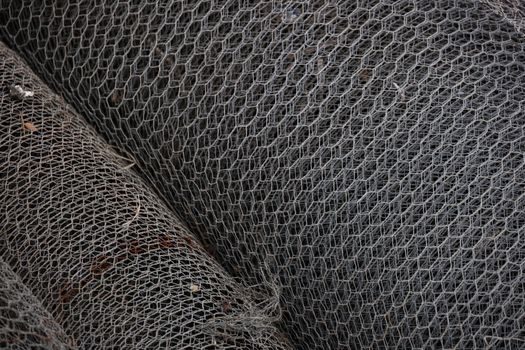
Aperture — the clear opening between wires — is the spec most often misquoted. It is not the centre-to-centre wire pitch; it is the clear distance, and a 50 mm × 50 mm opening on 4 mm wire is sold as "50 × 50" with an implied centre-to-centre pitch of 54 mm [S1]. The most common stock apertures sit in a 6 mm × 6 mm to 200 mm × 200 mm range, with sub-25 mm openings used for safety guards, machine enclosures, and small-aggregate screening [S1][S2].
Aperture selection is driven by what must be retained and what must pass. For 20 mm aggregate concrete, a 100 mm × 100 mm welded panel is the conventional minimum; for architectural renders, 20 mm × 20 mm at 1.0–1.6 mm wire is more typical; for safety guarding around rotating equipment, the panel must reject a 20 mm test probe, which forces the aperture to 18 mm or smaller in most jurisdictions [S1]. When the duty is filtration rather than reinforcement, the welded format gives way to woven or stainless steel variants only when the open area has to exceed roughly 60% of the panel — welded panels rarely break 70% open area regardless of aperture.
Gate 4: Surface Coating, Galvanizing and Weld Integrity
Surface coating is decided by environment, not aesthetics. Electro-galvanized welded mesh carries a thinner zinc coat (typically 10–30 g/m²) suited to indoor, dry-service use; hot-dip galvanizing after welding pushes the coat weight to 60 g/m² and above, with the zinc fused through the weld nugget so the intersection is not a corrosion initiation point [S1][S2]. For pool, marine and chemical exposures, a PVC or powder coating over hot-dip galvanized wire adds a 0.4–1.0 mm polymer sleeve and extends the service life of the zinc layer in chloride spray.
Weld integrity at the intersection is a hidden cost driver. Two production routes exist: weld-then-galvanize and galvanize-then-weld. Weld-then-galvanize gives a continuous zinc skin across the joint and is the preferred route for outdoor service; galvanize-then-weld burns the zinc locally at each intersection and relies on a repair coat to recover corrosion performance [S1]. For a process-engineer procurement audit, the correct question to the mill is "weld-before or weld-after galvanizing?", because the answer changes field life by a factor of 2–3× in coastal service.
Gate 5: Panel Geometry, Edge Trim and On-Site Handling
Panel format — sheet versus roll, and whether the panel is sheared or has a protruding wire stub at the cut edge — drives installation cost as much as the material cost. Standard factory sheets come in 1.2 m × 2.4 m, 1.5 m × 3.0 m, and 2.0 m × 4.0 m footprints; rolls are typically 1.0 m, 1.2 m and 1.5 m wide at 15–30 m length for sub-3 mm wire diameters only [S1][S2].
Rolls are cheaper per square metre but only practical for thin wires and large apertures; above 4 mm wire, the roll memory is severe and panels must be specified. Edge condition is the second decision: sheared-to-flat panels are safer to handle and easier to tie; "stub" panels with wires protruding past the outer weld allow lap splices on the slab but require gloves and slow handling. For alloy steel or higher-carbon grades specified for impact resistance, a sheared edge is mandatory because the protruding stubs crack under impact.
Side-by-Side Comparison: Mild Carbon vs Hot-Dip Galvanized vs Stainless 304/316
Three base-metal families cover roughly 95% of welded-mesh purchases, and the right choice is driven by environment first, then by mechanical duty, then by budget [S1][S2]. The table below is for direct RFQ use, with all figures grounded in the manufacturer data referenced.
Mild carbon (uncoated): low unit cost (baseline 1.0×), 4–12 mm wire common, 500 MPa-class yield, indoor/dry service only, 5–15 year life in dry concrete.
Hot-dip galvanized (60 g/m² Zn): 1.2–1.5× mild-carbon cost, 1.0–8 mm wire common, 500 MPa-class yield, exterior and mild-exposure service, 15–30 year life in C3 atmospheres.
Stainless 304: 3.0–4.0× mild-carbon cost, 1.0–6 mm wire common, 520–550 MPa yield, food-grade and architectural service, 30+ year life in C4 atmospheres.
Stainless 316: 4.0–6.0× mild-carbon cost, 1.0–6 mm wire common, 520–550 MPa yield, marine, pool and chloride service, 30+ year life in C5-M atmospheres [S1].
When Welded Mesh Is the Wrong Choice
Welded mesh is not the right product when (a) the open area must exceed 70%, (b) the panel must absorb dynamic impact, or (c) the wire has to flex repeatedly without fatigue cracking at the weld nugget. Woven or steel mesh products replace welded mesh in those duties because the load path is the wire itself, not a welded intersection [S3].
It is also the wrong choice for very fine filtration below roughly 2 mm aperture: at that point, weld-tip imprecision dominates the aperture tolerance, and a woven or sintered mesh becomes both more accurate and cheaper. Procurement audits should fail any RFQ that asks for a welded panel at less than 6 mm clear opening without a written tolerance and a sample.
Standards, Tolerances and the RFQ Checklist
The most common international reference points for welded steel mesh are ISO 6935-3 for steel for the reinforcement of concrete (welded fabric), ASTM A1064/A1064M for carbon-steel wire and welded wire reinforcement, and ASTM A580/A580M for stainless-steel wire. EN 10080 governs European fabrication tolerances, while galvanized coatings are typically specified to ISO 1461 for hot-dip and to ASTM A641 for electro-galvanized wire [S1][S2].
A clean RFQ for a welded-mesh order, in 2026 practice, should pin the following eight items in writing: (1) base-metal grade and standard reference, (2) wire diameter with ± tolerance, (3) aperture clear opening with ± tolerance, (4) panel format (sheet or roll) and footprint, (5) weld-before or weld-after galvanizing, (6) coating weight in g/m² or polymer thickness, (7) edge condition (sheared flat or stub), and (8) third-party mill certificate to the standard named in (1). Any quotation that does not address all eight is a quote for a different product.
For plants that already operate a welded-mesh conveyor line, the stainless steel grade selection directly drives the mesh belt conveyor duty window, and the material-science linkage is the same as for static panels. Two trackable signals to watch over the rest of 2026 are mill-level price moves on 316 wire (a 5–10% quarterly swing is the trigger to re-tender) and any new ISO 6935-3 amendment that tightens weld-shear test requirements, which historically shifts the spec toward heavier wire diameters for the same nominal panel rating.
For related coverage, see Power Semiconductor Smart Manufacturing: 2026 Automation Stack and OSAT Retrofit Map.