
For road and bridge construction, an overhead bridge crane is normally specified in the 5-160 t range as a double-girder EOT unit on rail-mounted runways, with QD-class working duty and 30 m typical lift height [S4].
Selection on a road job is driven by four spec inputs: lift capacity (t), span (m), lift height (m), and power source (cable reel or busbar), all of which the buyer must lock down before the OEM cuts steel [S4].
Single Girder vs Double Girder: Capacity and Duty Split
Single-girder OBCs with monorail electric hoists cover the 1-16 t range and are the common pick for light precast yards and rebar handling, with listed 16 t monorail-with-hoist configurations widely offered from Chinese factories [S3]. A 30 t remote-control hoist trolley rated M3/M5 duty, -20 to 40 °C working temperature, and 6-30 m lift height sits at the upper edge of the single-girder envelope [S3].
Double-girder OBCs take over from 20 t upward and are the default for bridge-beam erection: a 160 t QD-type rail-mobile unit is documented for sale, with the vendor noting that compared with single-girder designs, the QD-160 supports heavier bridge-lift capacity and is more suitable for heavy work duty [S4]. Double-girder geometry also leaves headroom for a faster hoist (typically 6 m/min vs 4 m/min) and a longer hook approach, both of which matter when landing a 30 m prestressed girder onto elastomeric bearings.
Runway Engineering: Rail, Span, and Headroom on a Road Job
Road jobs almost always run the OBC on a temporary or permanent rail runway rather than on the building structure, because the crane must span the full deck width plus a walk lane. Common spans land between 18 m and 34 m; the QD-160 quoted in vendor data is built for medium to heavy industrial lifting, with a hoist or winch traveling along the bridge between parallel runways [S4].
Rail selection follows the lift: 38 kg/m rail (QU70 or CR100) is standard for 5-50 t units, while 160 t class typically moves to QU120 rail with welded joints to keep the wheel-rail contact stress inside allowable limits. End-car buffer travel is normally 100-150 mm, and the runway must be checked for surcharge, since a 160 t crane plus 1.25 dynamic factor can land 200 t point loads on the abutment.
Duty Class, Motors, and the Electrical Package

Working duty on a road site is rarely as clean as an indoor plant, so FEM/ISO 4301 classification matters: QD maps roughly to FEM 2m / A5-A6 (medium), while heavy beam erection jumps to FEM 3m / A7. The QD-160 example is offered with three control options: pendent push-button, radio remote, or cabin (space-capsule seat) with joystick, and the cabin option is the practical default for 80 t and up [S4].
Power supply choices are cable reel (cheap, fine below 50 t) or busbar (Duct-O-Bar or similar, required for the 100-160 t class and for any installation where the crane will travel more than 80-100 m). Enclosure rating should be at least IP54 for outdoor road work, with IP55 specified near dust-heavy earthworks; vendor warranty on the QD-160 is 18 months from receipt of goods, with a documented service life of about 30 years under common use [S4].
Safety Devices the Spec Must List by Name
A road-site OBC spec that does not enumerate safety devices by name tends to come back short. The vendor's safety-device list for a 160 t QD unit is a usable baseline: overload limiter, lifting and traveling limit switches, interlock protection device, buffer, overhaul cage, rail clear plate, protective cover, busbar prevent plate, anti-collision device, main isolating switch, emergency stop system, and motor overload protection [S4].
Two items are non-negotiable on outdoor work: an anemometer tied into the rail clamp (cut-out at roughly 72 km/h, 20 m/s), because a gantry on rails becomes a sail, and a lightning arrestor on the runway busbar. Hazardous-environment options (acid-proof or explosion-proof finishes) are available as custom builds when the crane sits near fuel storage or a batching plant [S4].
Comparison: Single Girder, Double Girder, and Gantry Alternatives
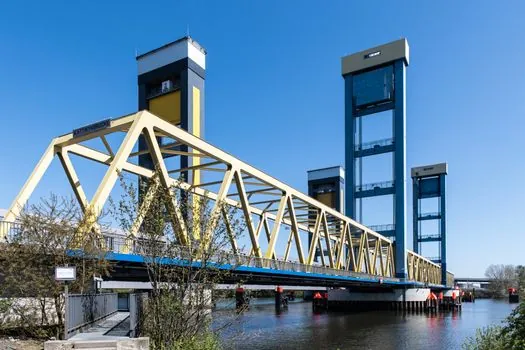
On a road site the three real options line up against capacity, headroom, mobility, and cost. A 5-16 t single-girder monorail OBC is the cheapest (lowest fab cost, lightest runway steel) but is limited on hook approach and hoist speed. A 20-160 t double-girder OBC is the workhorse for beam erection, with 1.5-2x the headroom and a faster hoist, at roughly 1.4-1.8x the price of an equivalent-capacity single girder. [S4]
Where the foundation cannot accept rail loads, or the crane must move between pours, a gantry crane on rubber tires or rails is the alternative, and similar selection logic (span, capacity, mobility) is laid out for pipeline work in the gantry crane selection for pipeline construction guide. For precast beam handling specifically, a launcher crane (double-truss gantry) is often substituted for an OBC because it can drive the girder onto the cap without a runway across the gap.
Logistics, Installation, and Lead Time
Lead time for a custom QD-class OBC sits in the 30-40 working day range after deposit, with 35-50 days port-to-port for export builds, and main beams, end beams, and hoist packed in plastic woven cloth while electric parts ship in plywood crates to limit vibration damage in transit [S4]. Installation is usually a senior-engineer guided job on a road site, since the runway alignment, rail joint welding, and limit-switch calibration must be signed off before the first test lift; OEM guidance typically covers on-site erection plus operator training [S4].
Buyers should also plan for related construction tooling: a road roller for sub-base compaction is commonly paired with the crane on the same mobilization, and where rebar splicing is required at the pier cap, a separate rebar coupler selection spec should run in parallel to the crane procurement, since the two are on the same critical path.
What Road-Site Buyers Get Wrong
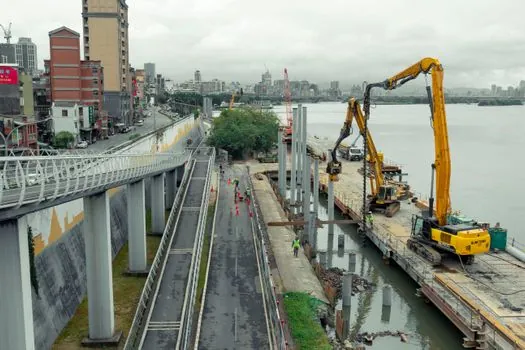
Three spec errors repeat on road jobs. First, buyers under-size span to save runway steel, then find the hook cannot reach the far girder bearing, forcing a crane change mid-project. Second, they specify a single-girder unit at 25 t because the price is attractive, not realising the duty class drops to FEM 1Am and the hoist will thermal-trip within a shift of continuous beam cycles. Third, they omit the anemometer and rail-clamps because the runway is "only temporary", then lose the crane to a storm in week two. [S4]
The corrective move is to lock the four inputs (capacity, span, lift height, power source) at inquiry, then enumerate the safety device list and duty class on the PO, exactly the way the QD-160 vendor data structures its inquiry form (lift capacity, span, lift height, power source, plus any specials) [S4]. For matching process tools, the construction tools reference covers the ancillary equipment that usually travels with an OBC on a road site.
The next trackable signal is the rollout of revised GB/T 3811 and FEM 1.001 update notes by major Chinese OEM technical bulletins in Q4 2026, which historically shift duty-class mapping and may push mid-range OBCs from FEM 2m to 2n for road-site service. Watch for OEM datasheet revisions on 30-100 t QD units, and cross-check whether the 18-month warranty and 30-year design life figures stay consistent across vendors [S4].