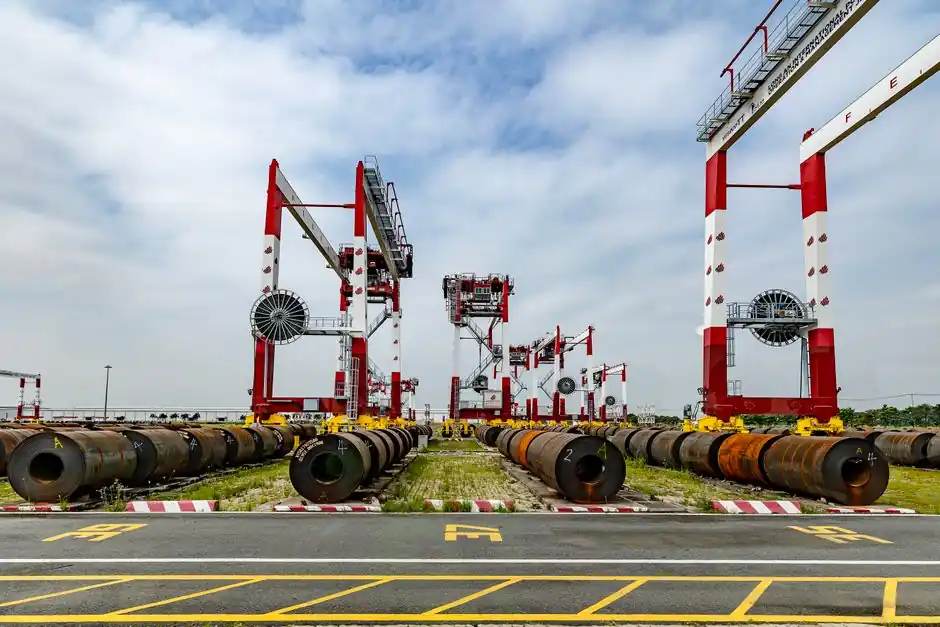
Portable and rail-mounted gantry cranes in the 1-10 ton capacity band cover the majority of agricultural lifting tasks, from bulk-bag handling at fertilizer sheds to engine and implement service in farm workshops [S1][S2].
Unlike fixed yard cranes in steel mills, agricultural gantry cranes are sized against three farm-specific constraints: seasonal rather than continuous duty, soft or uneven ground (gravel pads, field-edge concrete, bedding pack lanes), and exposure to ammonia, slurry, fertilizer dust, and wash-down water that attack standard finishes [S2][S3].
Capacity bands: matching the 1-10 ton farm workload
Single-girder gantry cranes commonly cover 0.5-20 t ratings, with 1-5 t units being the workhorse for hay bale, IBC tote, and small-implement lifts on livestock operations [S3].
Double-girder configurations enter the picture from roughly 10 t upward and are reserved on farms for bulk seed handling, grain-bin erection, and feed-mill mixer service where the higher hook height (often 6-9 m) and longer span (20-35 m) of a box-section main girder is required [S2][S3]. For example, a 10 t single-girder unit typically spans 6-20 m at A3-A5 FEM/ISO duty, while a 20 t double-girder unit stretches to 20-35 m at A6-A7 with two hoists operating in tandem [S3].
Span, height, and ground-condition tradeoffs
Span on a portable agricultural gantry is set by the clear width of the building or yard, plus at least 0.5 m clearance each side for trolley travel and operator safety [S2].
For outdoor pads without a permanent rail, the structural type is a single-girder A-frame with a wheelbase of 3-6 m, and 360-degree swivel casters with polyurethane or rubber treads rated for 4-6 kN point load to protect concrete less than 100 mm thick [S2][S3]. A wider wheelbase lowers ground-bearing pressure below 50 kPa, which is the threshold for unsurfaced farm lanes without rutting. Fixed-height gantries are cheaper; adjustable-height units (telescopic leg or screw-jack) add roughly 15-25% to cost but allow the same crane to clear both low-bed trailers and taller mixer wagons [S3].
Corrosion and wash-down protection: hot-dip galvanizing vs. paint systems
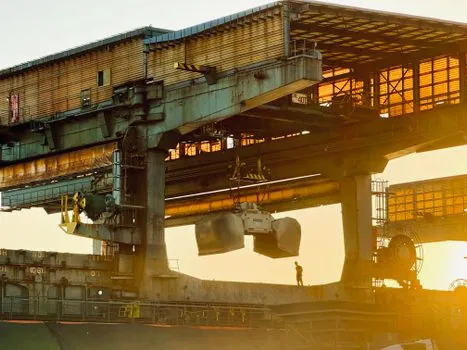
Hot-dip galvanizing to ISO 1461 (minimum 85 μm coating) is the default finish specified for poultry-house, dairy-parlor, and outdoor yard cranes exposed to ammonia and slurry wash-down, with documented service life of 15-25 years in livestock environments [S1][S2].
Epoxy-polyurethane paint systems (typically 120-160 μm DFT over a zinc-rich primer) cost 20-30% less upfront but require recoating at 7-10 year intervals in the same conditions [S1]. Stainless steel 304/316 fittings (load hooks, bottom blocks, cable terminations) are a common upgrade for aquaculture and produce-packhouse cranes where chlorinated wash water is constant; expect a 40-60% material-cost premium on hoist components alone [S1][S3]. Buyers in coastal regions should also specify ISO 12944 C4 or C5 corrosivity category for any painted components, with a documented zinc-rich primer plus epoxy build, and a 10-year first-maintenance paint system rather than the default C3 [S1].
Duty class, hoist type, and power supply choices
Agricultural gantry cranes are overwhelmingly specified at FEM/ISO duty A3 (1,600 hr/year) to A5 (5,000 hr/year), corresponding to 2-3 shifts of seasonal grain or feed-mill work; A6-A8 ratings are over-specified for farm duty and waste capital cost on higher-tier hoist gearboxes [S2][S3].
For lifts below 5 t at moderate frequency, an electric wire-rope hoist (typically 4/1 or 6/1 reeving, 6-12 m/min hoist speed) is standard, paired with a 400 V three-phase supply on fixed units and 230 V single-phase on portable frames under 2 t [S2]. Above 5 t or for very intermittent duty (less than 50 cycles/day), a manual chain hoist remains a cost-effective option at roughly 30-50% of an equivalent electric unit, though it adds operator fatigue on repetitive bag-stacking work [S2][S3]. Battery-powered hoists have entered the agricultural market since 2023 and suit remote or generator-only sites; typical 24 V or 48 V DC packs deliver 80-150 lifts per charge at 2-3 t, but cycle counts drop sharply below 0 °C [S1].
Certification, controls, and farm-safety standards
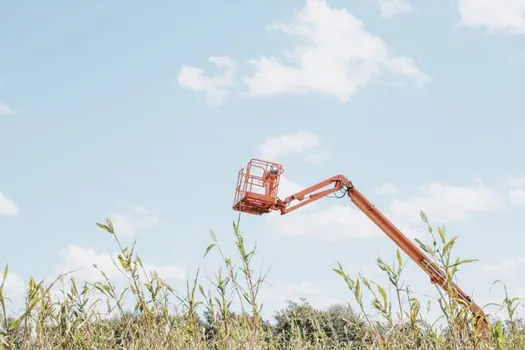
CE marking under the EU Machinery Directive 2006/42/EC is the baseline European farm specification, with EN 15011 (cranes, safety) and EN 13001 (crane safety principles) cited as the governing design standards for new builds [S1][S3].
Australian farm buyers should check compliance with AS 1418.1 (general crane requirements) and relevant state WHS codes for lift-truck-mounted jibs, since AS 1418 covers fixed gantries and the state code governs the mobile host vehicle [S2]. Common safety accessories specified for farm use include upper/lower limit switches, overload devices set at 110% of rated capacity, anti-collision buffers on multi-crane rails, and a 24 V pendant or radio remote (the Flex EX series is a representative 2026 OEM option) [S2]. For operations around combustible grain dust, ATEX zone 21 or 22 ratings on the hoist motor and pendant are a real but uncommon specification, limited to large on-farm drying and storage facilities [S1].
Comparison: portable vs. rail-mounted vs. fixed gantry on farm
Three gantry configurations dominate farm purchasing. Portable A-frame units (1-5 t, 3-6 m wheelbase, 6-15 m span) cost the least at roughly USD 3,000-12,000 and move between sites, but top hook height is limited to about 4-5 m and travel speed is manual [S2][S3].
Rail-mounted gantries (5-20 t, 20-35 m span, A5 duty) suit long feed mills and machinery sheds with a permanent concrete rail; capital cost runs USD 25,000-80,000 but crane travel at 10-20 m/min covers a 50 m shed in under 3 minutes [S1][S2]. Fixed stationary gantries (10-50 t, 15-30 m span, A6 duty) are anchored to foundations and used at grain terminals, fertilizer depots, and large dairy facilities; lead time from order to commissioning is typically 8-16 weeks, versus 4-8 weeks for portable stock units [S1][S3]. For selection, the order of priority is: site ground and rail availability, then span and hook height, then rated capacity, then duty class; inverting this sequence is the most common farm-crane spec error and forces redesign mid-project [S3].
Limitations and failure modes specific to farm duty
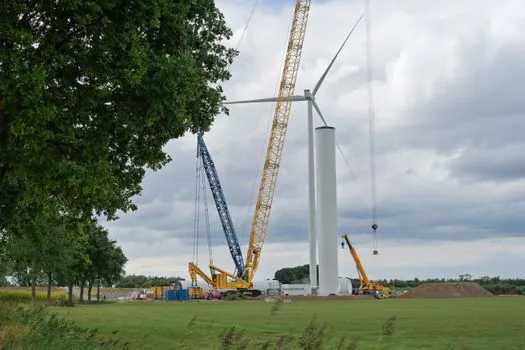
The three failure modes that drive agricultural gantry downtime are wheel/rail misalignment on uneven ground, corrosion at the hoist cable entry, and overload from oversized tote bags assumed to weigh 500 kg but actually scaling 800-1,000 kg when wet [S1][S2].
Portable gantries without outrigger pads concentrate point loads on small casters and can punch through asphalt less than 50 mm thick; steel spreader plates or sole-board timbers are the standard farm mitigation [S2]. For related heavy-lift decision logic in mining and quarry settings, the same capacity-vs-span-vs-duty tradeoff framework is applied in quarry gantry crane selection guidance, where A6-A8 duty and abrasive dust exposure push the spec well above farm requirements.
Trackable signals for the rest of 2026: AS 1418 series revisions under public comment through Q4 2026 may tighten farm-crane inspection intervals, and battery hoist cycle counts in sub-zero livestock barns remain an open OEM data point worth watching for cold-region buyers. [S1][S2]
Component reference pages worth checking: gantry crane, crane scale, and crawler crane.