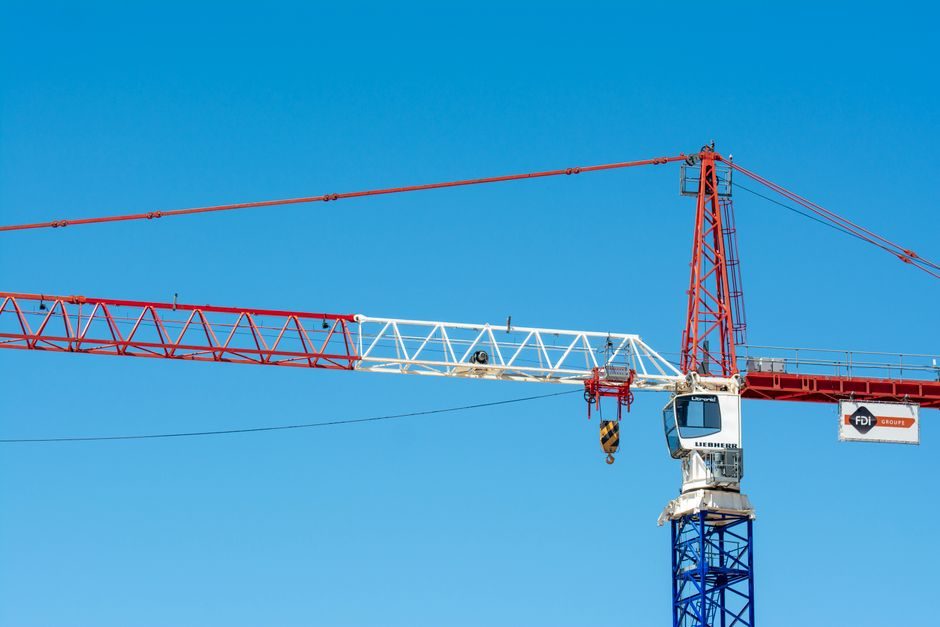
Overhead bridge cranes, also called EOT cranes, lift and traverse loads between parallel runways and split first by girder count (single vs double) under 29 CFR 1910.179, with sub-classes driven by control station, duty service, and bridge geometry [S1][S3].
U.S. installations are specified to ASME/ANSI B30.2 with OSHA 1910.179 incorporated by reference through 29 CFR 1910.6, while crane manufacturers in the CMAA orbit publish the matching duty classifications CMAA 70, 74, 78, and 79 [S2][S3].
Primary Girder Count: Single-Girder vs Double-Girder
29 CFR 1910.179 defines an overhead crane as "a crane with a movable bridge carrying a movable or fixed hoisting mechanism and traveling on an overhead fixed runway structure," and the marketplace splits that bridge into single-girder (one load-bearing beam plus an underhung hoist) and double-girder (two beams with the hoist trolley riding on top between rails) [S1][S3]. Single-girder units typically cover lower capacities and lighter CMAA duty classes, while the double-girder configuration is required when hook height, hoist reeving, or capacity scales up, which is the path taken for a 160 t QD-type mobile bridge crane built for heavy industrial service [S1].
Mechanically, the single-girder layout puts the hoist under the beam (underrunning trolley) and uses the runway as a structural member; the double-girder layout carries the hoist between the girders (top-running trolley), which allows heavier end-carriages, larger service platforms, and higher CMAA 70/74 classifications without overstressing the bridge [S2].
Sub-Classes Defined by 29 CFR 1910.179
Beyond girder count, 29 CFR 1910.179(a) creates explicit sub-classes by bridge support and operator position: overhead crane, gantry crane, semigantry crane, cantilever gantry crane, wall crane, storage bridge crane, cab-operated, floor-operated, pulpit-operated, remote-operated, automatic, and hot metal handling crane [S3]. A wall crane "operates on a runway attached to the side wall or columns," while a storage bridge crane is "a gantry type crane of long span usually used for bulk storage of material" [S3].
The same section defines power-operated as a crane "driven by electric, air, hydraulic, or internal combustion means," a holding brake as one that "automatically prevents motion when power is off," and a bumper (buffer) as an "energy absorbing device for reducing impact when a moving crane or trolley reaches the end of its permitted travel; or when two moving cranes or trolleys come in contact" [S3]. These terms reappear verbatim in the OSHA 1910.179 inspection checklists and in CMAA inspection forms used by third-party crane surveyors [S2][S3].
Operator-Control Sub-Types
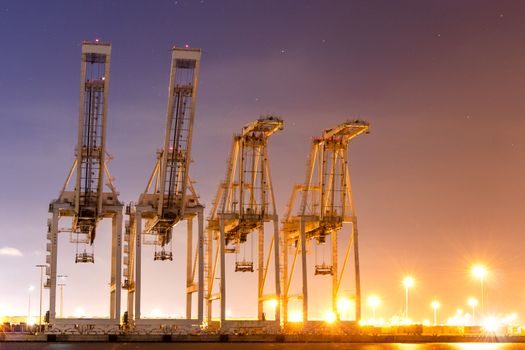
Five control modes are codified in 1910.179(a): cab-operated (cab on the bridge or trolley), floor-operated (pendant or nonconductive rope from the floor), pulpit-operated (fixed station not attached to the crane), remote-operated (radio/infra-red, not pendant or rope), and automatic (preset cycles) [S3]. A pendant push-button station, a wireless remote, and a cab joystick are the three options most often quoted in 2026 product enquiries, with the cab option standard for CMAA 70/74 heavy-duty service [S1].
The same regulation separates an auxiliary hoist, "a supplemental hoisting unit of lighter capacity and usually higher speed than provided for the main hoist," which is the basis for the main-plus-aux dual-hoist builds common in steel-mill and maintenance bays [S3].
Duty-Service Classes: CMAA 70 / 74 / 78 / 79
CMAA 70 covers cranes for general-purpose indoor service (standby or infrequent use), CMAA 74 covers indoor cranes for moderate production duty, CMAA 78 covers indoor cranes for heavy-duty production, and CMAA 79 covers indoor/outdoor cranes for severe-duty bulk-handling [S2]. The CMAA number is the working-stress classification that aligns with the OSHA 1910.179 inspection-frequency tables and the ASME/ANSI B30.2 design rules, and it is the single most important selection number on a U.S. crane nameplate after rated load [S2][S3].
Outside the U.S. CMAA block, FEM/ISO 9 511 and DIN 15018 historically classify by load spectrum and group-of-mechanisms; an engineer matching a European-built crane into a U.S. plant typically has to convert FEM group to CMAA class and re-check bridge deflection limits, which ASME/ANSI B30.2 ties to span/500 in most indoor cases [S2].
Drive and Power-Delivery Components
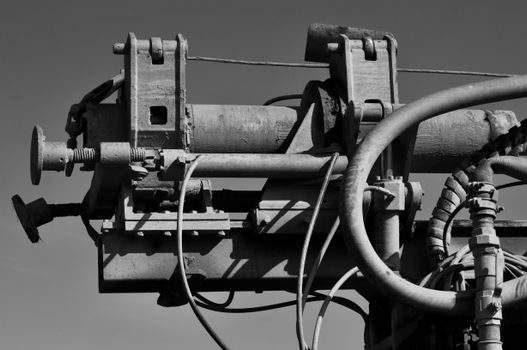
1910.179(a)(28) defines runway conductors as "the electrical conductors located along a crane runway," and bridge conductors as those "located along the bridge structure of a crane to provide power to the trolley," with collectors (current) as "contacting devices for collecting current from runway or bridge conductors" [S3]. Modern retrofits replace legacy conductor bars with festoon systems or cable reels on CMAA 70/74 duty cranes, while insulated conductor bars (Duct-O-Bar or equivalent) remain standard for CMAA 78/79 [S2][S3].
Power-operated as defined in 1910.179 includes electric, air, hydraulic, and internal combustion drive; electric is dominant for indoor EOT service, hydraulic is common on low-headroom monorail and wall-crane sub-classes, and air-driven hoists are still specified in some classified-area paint shops where electric sparks are a concern [S1][S3].
Safety Devices and Mandatory Buffers
A 160 t class QD-type mobile overhead bridge crane is sold with a fixed safety-device list: overload limiter, lifting and traveling limit switches, interlock protection, buffer, overhaul cage, rail clear plate, protective cover, bus-bar prevent plate, anti-collision device, main isolating switch, emergency stop system, and motor overload protection [S1]. The buffer in that list maps directly to the 1910.179(a)(23) bumper definition, and the overload limiter is the device that enforces the rated-load number on the nameplate before the brake sees a stall load [S1][S3].
Comparison: Single-Girder vs Double-Girder vs Gantry

On four decision criteria, single-girder wins on hook-approach from the side and installed cost, double-girder wins on capacity, CMAA duty class, and maintenance access, and gantry wins on outdoor/ground-rail flexibility. Single-girder typically caps at CMAA 74 in standard builds; double-girder extends to CMAA 78/79 and to the 160 t class shown in current vendor offerings [S1]. Gantry and semigantry variants, defined in 1910.179(a)(6) and 1910.179(a)(12), exchange the building-supported runway for ground-supported legs, which is the choice when the building has no runway steel or when the crane must move between bays [S3].
For indoor production work with heavy CMAA 78/79 duty and 24/7 operation, double-girder overhead is the default; for low-duty, light-capacity, or budget-constrained lines, single-girder overhead or a top-running single-girder under the overhead bridge crane product class remains common; for outdoor yards and bulk storage, a gantry crane is the parallel choice, and a mobile crane or crawler crane replaces the whole overhead concept where runway steel is impossible [S1][S3].
Selection Criteria and Common Failure Modes
First selection criterion is rated load plus CMAA duty, second is span and hook-height, third is control mode (cab vs pendant vs remote), and fourth is environment (indoor, outdoor, hazardous-area, hot-metal) [S1][S2]. Indoor EOT cranes paired with crane scales for load verification must keep the scale within the hoist reeving envelope so the load cell sees pure vertical force, and engineers frequently route the overhead conveyor interface through the same runway conductor run as the crane trolley to keep wiring rational [S2].
Most common in-service failures documented by crane consultants are runway-conductor wear, buffer deformation after an end-travel event, and brake-hold loss on holding brakes that fail the 1910.179(a)(20) definition; preventive action is annual runway-rail alignment, monthly buffer visual, and quarterly brake-torque verification [S2][S3]. Compared to mobile and tower crane fleets, where rigging and ground-condition errors dominate incident reports, the EOT failure mode is overwhelmingly mechanical-component wear on a fixed runway, which is why CMAA and ASME/ANSI B30.2 inspections focus on the rail, the buffer, and the brake first [S2].
Traceable Signals to Watch
For spec work in the second half of 2026, three signals are worth tracking: any 1910.179 amendment activity in the e-CFR revision log, the next CMAA Specification 70/74/78/79 revision cycle (the last major revision was 2020 and a refresh is the normal five-year cadence), and the third-party inspection frequency mandated by 29 CFR 1910.179 paragraph (k) for the relevant CMAA duty class [S2][S3].
For related coverage, see Smart Cold Chain Equipment: Automation, AI Control and Spec Bands 2026.