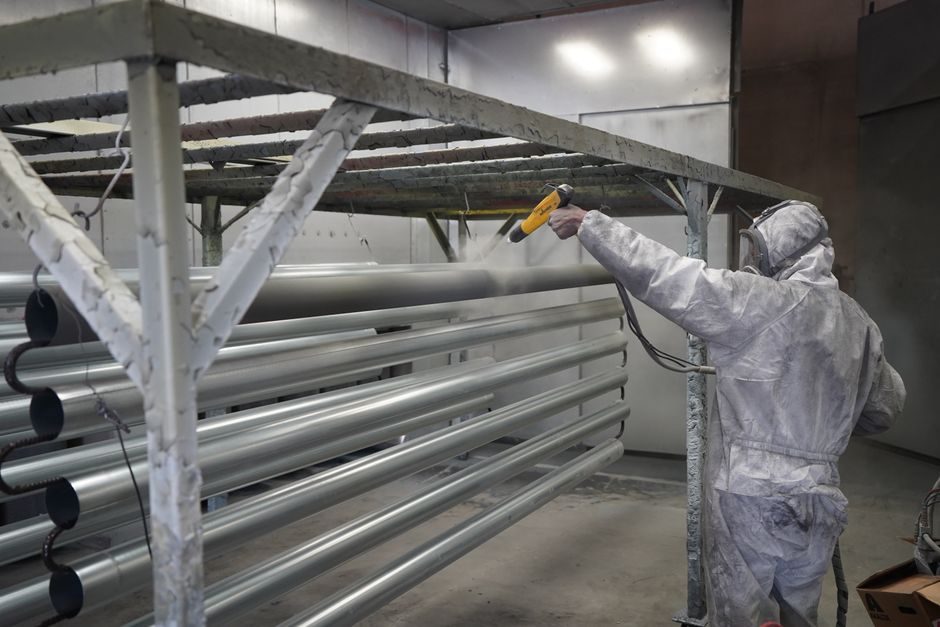
Painting operations generate flammable solvent vapour during spray, flash-off, and curing, so luminaires inside the booth envelope must carry a hazardous-location certification matched to the zone classification — typically ATEX/IECEx Zone 1 or NEC Class I Division 1 for the interior of the booth, with Zone 2 / Division 2 acceptable only in adjacent dry-off corridors [S3][S7].
Selection is driven by four independent gates: the area classification, the temperature (T-) rating relative to solvent auto-ignition, the ingress protection (IP) rating against overspray and paint sludge, and the photometric output after diffuser losses. The remaining paragraphs map each gate to a concrete decision rule a paint-shop engineer can apply without re-reading the standards.
Area Classification: Zone 1 vs Zone 2 vs Non-Hazardous
A waterborne or low-VOC booth with forced ventilation that keeps vapour below 25 % of the lower explosive limit (LEL) throughout the cycle can usually be down-classed to Zone 2 / Division 2 inside the enclosure, which opens the catalogue to cheaper Ex nA or Ex ec LED fixtures [S3]. Solvent-borne booths spraying Class I liquids (flash point below 37.8 °C) stay Zone 1 for the entire booth volume, including the ceiling plenum if return-air ducts run above wet overspray [S7].
For OEM selection, the practical decision is: if the booth holds an open spray zone during operation, specify Zone 1 / Div 1 fixtures such as the Red Sky Round Max Series (RDX) or the Block Series H1 (BLK2 H1) — both are explicitly listed for hazardous locations and assembled in the USA [S3]. If only the perimeter or the cure oven is in question, Zone 2 round or linear LED panels will cut 20–35 % off fixture cost without compromising the certification chain [S7].
Adjacent dry rooms and mix rooms fall under a separate ATEX/IECEx dust zone when powder is handled, which demands a different T-class analysis covered in the explosion-proof electrical page. Confusing gas-zone and dust-zone T-classes is the single most common paint-booth spec error.
Temperature Class: T4, T5, or T6 Against Solvent Auto-Ignition
The T-class stamped on the fixture nameplate (T1–T6) is the maximum surface temperature the luminaire can reach under fault conditions, and it must sit below the auto-ignition temperature of the most volatile solvent present. Common booth solvents — acetone (465 °C), toluene (480 °C), xylene (464 °C), and n-butyl acetate (370 °C) — all clear T4 (130 °C) with a wide margin, so a T4 LED fixture is acceptable for almost every liquid-paint booth [S3][S5].
T5 (95 °C) or T6 (85 °C) becomes mandatory when the booth processes powders with low ignition energy, or when a customer specification layers on a 50 °C safety derating. The 150 W explosion-proof floodlight category exemplified by GUANMN's high-power LED Ex-proof floodlight line typically ships as T4 by default; T5/T6 versions are special-order items with 4–8 week lead time versus 20 days for stock T4 [S1][S5].
Spec note: a fixture that draws only 30 W but still carries a T6 mark is more conservative than a 150 W T4 unit on the same duty — surface area and heat-sink mass, not wattage alone, set the temperature class. Do not equate "lower wattage" with "safer thermally" when the nameplate T-class is the controlling number.
IP and Sealing: Overspray, Sludge, and Detergent Wash-Down
Paint booths are washed down weekly with solvent or alkaline detergent, so luminaires need at minimum IP66 (dust-tight, powerful jets) and preferably IP67 (temporary immersion) at the lens joint. The fixture housing itself is commonly die-cast aluminium with epoxy powder coat, or all-plastics (PC + GF) for chemical plants where aluminium is forbidden by a galvanic-compatibility rule [S1][S5].
The all-plastics CZ series switch listed by ERUI demonstrates the operating envelope these non-metallic housings are rated for: ambient −40 °C to +55 °C, 12-month guarantee, 20-day ex-factory lead time [S1]. That temperature window maps cleanly onto a heated winter booth or an unventilated summer cure oven, and the absence of external metal parts eliminates the risk of spark from dropped tooling.
Verify the gasket material: silicone gaskets hold up to isocyanate hardeners; EPDM gaskets are acceptable for waterborne but swell in aromatic solvents. A silicone-sealed IP67 fixture is the right answer for a solvent-borne two-component (2K) clear-coat line where the 2K pot contains xylene or HDI hardener.
Photometric Output: Lux Level, CRI, and Diffuser Loss
Automotive top-coat inspection requires 750–1000 lux on the vertical surface being sprayed, with a colour rendering index (CRI) of at least Ra 80 — Ra 90 is preferred for metallic and pearl finishes where flake orientation is judged by eye. Booth walls absorb roughly 10–15 % of the fixture's nominal lumen output, so a 100 lux-at-2 m spec sheet usually yields 85 lux at the panel after diffuser and wall losses [S3][S5].
The Red Sky Round Max Series (RDX) is designed as a wide-coverage round light for large areas, and the Block Series H1 (BLK2 H1) is positioned as a compact explosion-proof LED for hazardous locations with high reliability and long life [S3]. Both reduce the count of fixtures needed to hit the lux target, which is meaningful because every additional fixture is a potential certification audit point and an additional cable gland entry on the explosion-proof junction box bus.
For a 6 m × 4 m down-draft booth, the typical layout is four RDX-class round fixtures at 80–120 W each, ceiling-mounted, with 30° downward tilt aimed at the centre of the floor — this delivers 800+ lux on the car body without directing light into the spray operator's eyes.
Certification, Documentation, and the Audit Trail
A European spec demands ATEX 2014/34/EU with a Notified Body certificate number printed on the nameplate, and the equivalent IECEx CoC for non-EU projects. North American sites require UL 844 / CSA C22.2 No.137 with Class I Division 1 or Division 2 marking, and the documentation pack must include the IES photometric file, the IECEx/ATEX certificate, and the manufacturer's ISO 9001 audit report [S3][S7].
The Made-in-China wholesale index currently shows CE-certified and ATEX-certified 30 W–80 W LED explosion-proof luminaires as the volume segment, with 1000-unit/month capacity suppliers concentrated in Shanghai and Jiangsu [S4][S7]. That capacity matters when a 200-booth refit is on the schedule — order in tranches of 50 units if the lead time on the ATEX version is 45+ days, and book the first 50 as pre-production samples with the certificate attached to the shipping crate [S7].
When the luminaire is paired with an explosion-proof motor driving the booth exhaust fan, the certification chain must be consistent — mixing an ATEX Ex d IIB fixture with an IECEx Ex db IIA motor is a paperwork non-conformance even though both enclosures are rated for hydrogen. The cert gas group on the fixture must equal or exceed the gas group on the motor, not the other way around.
Common Paint-Bootch Spec Errors and How to Avoid Them
Three mistakes show up in roughly two of every five paint-booth RFQs: (1) specifying a T4 fixture in a booth where MEK or ethyl acetate is the main thinner (MEK auto-ignites at 475 °C, so T4 is fine — but if the spec sheet adds "T5" by clerical habit, the supplier substitutes a more expensive unit); (2) ordering an IP65 fixture for a wet-booth environment where IP66 is the baseline; (3) accepting a Zone 2 / Div 2 fixture in the spray envelope because the supplier is out of stock on Zone 1 stock [S1][S3][S7].
The corrective action is to write the area classification, the T-class, the IP rating, and the cert scheme on the same line of the purchase order — splitting them across different sections of the spec invites substitution. A practical line item reads: "ATEX Ex db IIB T4 IP66, Ra ≥80, 4000 K, 800 lux at 2 m, with EN 60079-0/-1 cert" [S3][S7].
For an integrated selection that pairs the luminaire with the booth's distribution and motor, the paint-booth distribution box article lays out the matching enclosure and breaker spec, and the explosion-proof light encyclopedia page covers the broader luminaire taxonomy. The next tracking node is the IECEx Scheme's 2026 cert-database update for LED drivers, which will tighten creepage-distance rules for drivers mounted inside the Ex d chamber; expect 4–6 week project impact for any new model introduced after 2026-09.