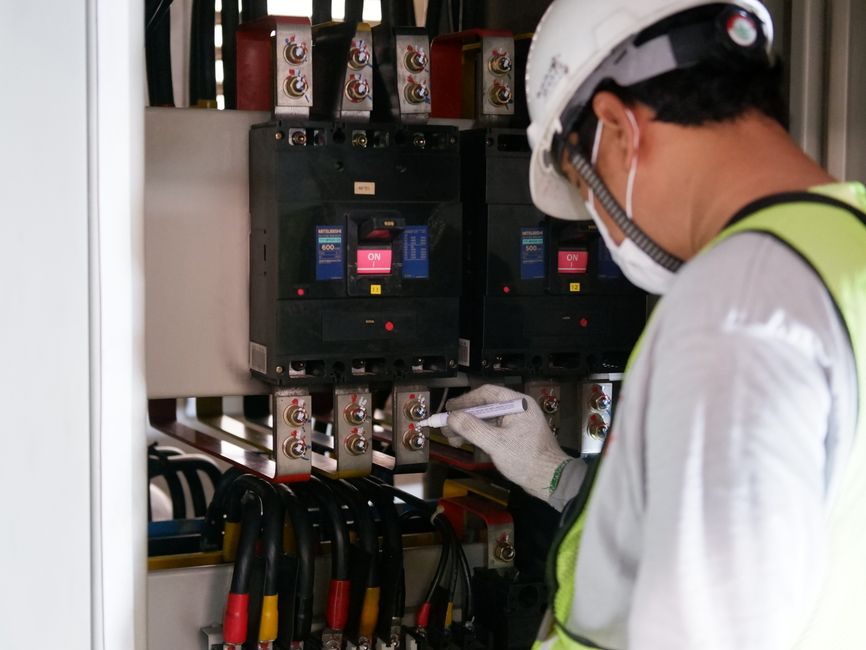
A passive explosion-proof junction box is certified only as an empty enclosure (or with factory-fitted terminals) under the flameproof/increased-safety standards, whereas an explosion-proof control station adds a component-level certificate for every internal actuator, indicator, and switch [S3][S5].
The two product families are routinely co-specified on the same skid — junction boxes for cable splices and tee-offs, control stations for motor starters and push-button interfaces — and both follow the GB3836 / IEC 60079 family with a typical Ex d IIB T6 or Ex d IIC T6 marking at 380 V rated voltage [S3].
What the Ex Marking Actually Covers on Each
A junction-box certificate (e.g. CE021138) lists the empty-shell test plus any factory-installed terminal blocks; current ratings of 20 A, 100 A, and 225 A are the typical tiers the certificate explicitly carries, with IP54 as the baseline dust/water ingress figure for the Ex d version and IP65 for the Ex e version [S3].
A control-station certificate adds the same enclosure approvals but extends the type-test scope to cover every operator interface — push-buttons, selector switches, ammeter windows, signal lamps — each treated as a separately catalogued Ex component, which is why Alibaba ATEX supplier listings such as DWEX02 signal lamps are shown as individually CNEx/ATEX/IECEx-certified rather than bundled under a single enclosure approval [S5]. Junction-box entry threads default to G/BSP pipe thread with optional metric and NPT cut on order, while control stations must also declare the gland model (commonly DQM-series) used at every inlet because the gland is part of the certified assembly [S3].
Material, Shell, and Mechanical-Construction Differences
Most Chinese OEM junction boxes use ZL102 aluminium-alloy die-cast shells with high-pressure electrostatic spray, the joint face being a flat-planar flamepath for IIB gas groups and a threaded flamepath for the IIC gas group [S3]. The same ZL102 shell shows up in BCH-series and Ex-proof threading boxes from Leoyo, where the product line is split explicitly between "junction box / cable box" SKUs and "control station" SKUs with operator cut-outs [S6].
Galvanised-iron round conduit boxes are the heavier-duty alternative for above-deck marine and oilfield cable transitions, supplied with CCC and CE 9000 marks and a 1000-set minimum-order quantity from Tianjin [S2]. Shenhai's 130-series, 500-specification catalogue covers the full ecosystem — junction boxes, control stations, pipe fittings, lighting — under a single factory audit, which simplifies cross-component certificate traceability but does not eliminate the need for per-SKU Ex marking [S4]. For a deeper look at how the control station fits into the broader explosion-proof electrical product tree, the GB3836 / IEC 60079 family is the same umbrella that covers distribution boards and motors.
Selection Criteria Mapped to Certificate Scope
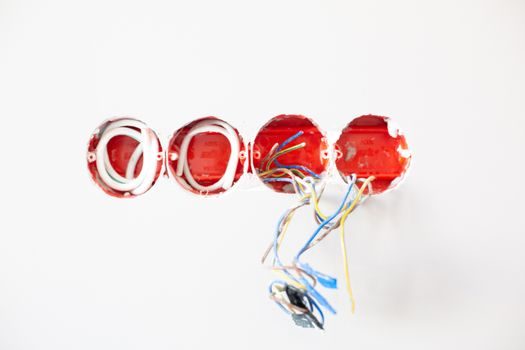
Four decision criteria separate the two families at the RFQ stage. (1) Internal components: a junction box may ship with terminals only, a control station must declare every component Ex certificate. (2) Operator interface: choose control station if pilot lights, push-buttons, or ammeter windows are required — they cannot be retrofitted into a passive junction-box enclosure without re-certification. (3) Gas group: IIC requires threaded flamepath joints, which both families can supply but at higher cost [S3]. (4) Voltage/current: 380 V / 225 A is the upper tier published on the junction-box certificate; anything above that needs a control-station or distribution-box certificate scope instead.
Engineers designing skids that need both functions typically terminate field cabling into a junction box first, then loop into a control station for the operator interface — keeping the two certificates separate makes FAT punch-list resolution far cleaner than retrofitting buttons into a passive enclosure. For the operator-side hardware, the explosion-proof button certificate and the station enclosure certificate must both appear on the same nameplate stack, otherwise the assembly as built is not the assembly as tested.
Use-Case Mapping: Which Family When
Use a junction box when the requirement is purely a sealed splice or tee point in Zone 1 / Zone 2 (gas) or Zone 21 / Zone 22 (dust), with no human-machine interface and no active switching — typical on cable trays between field instruments and the marshalling cabinet [S3][S7]. Use a control station when the operator needs to start/stop a motor locally, read a process variable, or trigger an emergency stop; each pushbutton and indicator is then a separate ATEX/IECEx component under the station's master certificate [S5].
Avoid the hybrid trap: bolting push-buttons into a junction-box enclosure without updating the certificate invalidates the Ex marking on the nameplate. If the skid needs Zone 1 lighting plus local controls, split the BOM — a light on its own LCM certificate, a control station on its own, and a junction box for the splice between them.
Limitations and Common Audit Findings

The single largest traceability failure in 2024–2026 third-party audits has been a missing gland model on the junction-box inlet: the certificate names the approved DQM-series gland, but the as-built unit ships with a different maker's gland, breaking the certified assembly [S3].
Other recurring findings include IP rating drift (a junction box rated Ex d IIB T6 is only IP54, not IP65, unless explicitly ordered as the Ex e variant), and unmarked retrofit terminals inside an Ex d IIC enclosure where the original certificate only covered 20 A terminal blocks. Both findings are visible at the nameplate; both are catchable at the goods-in inspection before installation. The Shenhai product-line breadth — 130 series, 500 specifications — is helpful only if the receiving inspector cross-checks each sub-assembly certificate against the master station certificate [S4].
Standards, Certificates, and Sourcing Signals to Track
The governing standard stack is GB3836.1/2/3-2000 (China), equivalent to IEC 60079-0, IEC 60079-1, and IEC 60079-7, with EN 50014/50018/50019 cited on the European side of the same certificate [S3]. Typical nameplate data is "Ex d IIB T6 / II 2G EEx d IIB T6" at 380 V / 20–225 A with certificate numbers such as CE021138, CE021122, and CE051001 [S3].
Trackable signals through the rest of 2026: the ATEX supplier base on Alibaba remains China-dominated with 2,564 listed suppliers as of 2026-06-11 and CNEx/ATEX/IECEx triple-certificate capability is now the default listing badge for any new control-station SKU [S5]; separately, the OKorder platform continues to surface CCC + CE 9000 dual-marked galvanised-iron conduit boxes at 1000-set MOQ, signalling steady Chinese capacity for the heavier-duty junction-box segment [S2]. Cross-link the BOM across the explosion-proof distribution and explosion-proof motor certificate scopes so the same FAT reviewer can trace every Ex marking back to one of three master certificates on the skid.
This topic is covered further in Mesh Belt Conveyor Selection for Electronics Handling: Spec Map.