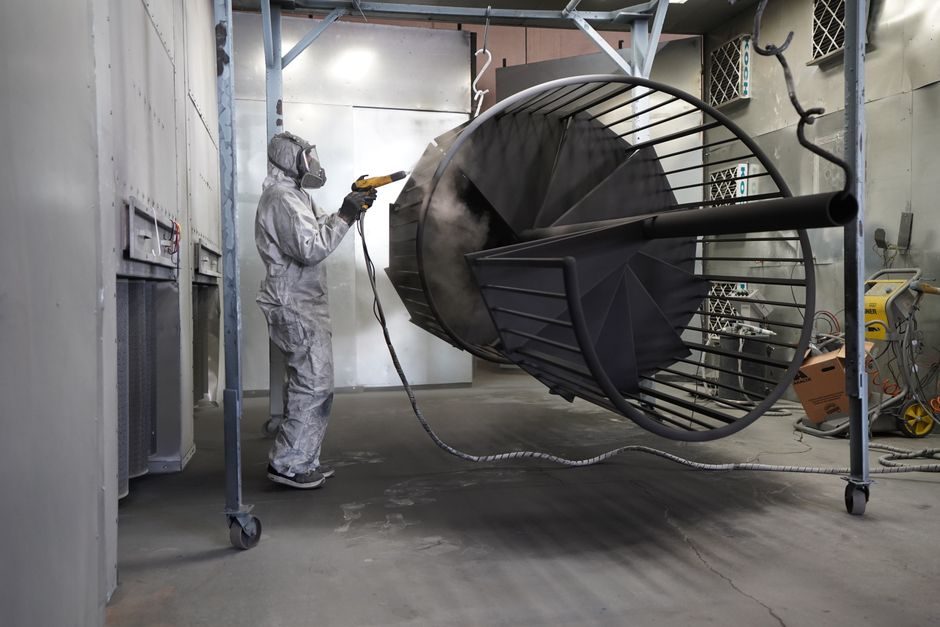
Paint booths fall under hazardous-area Zone 1 (gas) plus Zone 21 (combustible dust from sanding/primer fillers) under the IEC 60079 framework, and a single correctly-rated explosion-proof distribution box must cover both duties simultaneously [S1][S6].
For a 2026 build, the realistic candidate set is the cast-aluminium BXM(D)51 / BXD51 / BXS51 series, the BJX51 / AH / BMG junction families, and the galvanised-iron BXX8050 conduit-style boxes offered by Chinese OEMs [S1][S4].
Hazardous-area classification: which Zone drives the spec?
A waterborne or solvent-borne spray booth normally classifies as Zone 1 for vapour during spray, with Zone 2 only when the booth is purged and interlocked — and Zone 21 for dust when dry sanding or primer mixing happens in the same room [S6].
Gas group selection follows the propellant: pure styrene or aromatic solvents push the spec to IIC, while common alkyds and most gun washers are IIB — the explosion-proof junction box catalogue tier you pick must therefore be the IIC/DIP-marked line, not the cheaper IIB-only variant [S1][S6].
Enclosure material: cast aluminium vs galvanised iron vs engineering plastic
Cast aluminium (Alu-alloy) gives the lowest mass for a given wall thickness, dissipates internal heat to keep surface temperature below the T-class limit, and accepts the epoxy-powder coatings typically specified against isocyanate attack [S5].
Galvanised-iron round conduit boxes (e.g. the BXX8050 corrosion-proof socket line) carry thicker walls and are preferred where the enclosure is exposed to mechanical impact from trolley rails or forklift tines inside the booth [S1][S2]. Engineering-plastic (GRP) enclosures trade thermal rating for chemical resistance and are usually limited to T4 and below on paint lines [S6].
Protection concept: Ex d flameproof vs Ex e increased safety vs positive-pressure
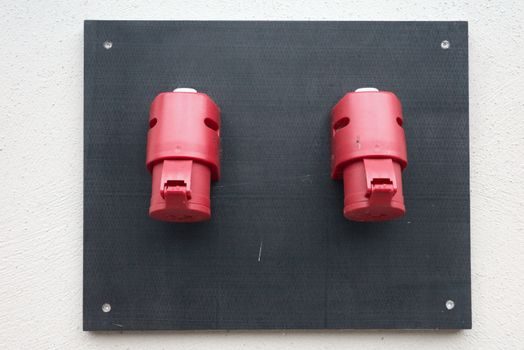
For a paint-booth distribution board that switches live loads, Ex d (flameproof) enclosures such as the BXM(D)51 / BXD51 are the default because the internal arc is contained even if solvent vapour migrates through conduit threads [S1][S5].
Ex e (increased-safety) junction boxes such as the BJX51 / AH / BMG families are acceptable only for passive wiring — never for a circuit breaker, contactor, or lighting ballast that can produce an arc or hot surface during normal operation [S1][S6]. Positive-pressure (PBb) cabinets are reserved for analyser rooms or purge-controlled booths where instrument-grade air is supplied continuously [S5].
Surface temperature (T-class) and IP rating for solvent + dust duty
Most paint-booth solids (alkyds, acrylics, 2K polyurethanes) auto-ignite above 200-300 °C, so a T4 (≤135 °C) or T5 (≤100 °C) enclosure rating is sufficient on the gas side; T6 (≤85 °C) is required only where hydrogen or very thin solvent films are present [S6].
Dust-side marking DIP A21 / DIP B21 (IEC 60079-31 family) must be printed on the nameplate alongside the gas marking, and the enclosure should be IP65 minimum to block overspray ingress around gaskets and cable glands [S1][S6]. For booths with active wash-down between shifts, step up to IP66 with stainless or captive-bolt cover hardware.
Cable entry, earthing and accessories
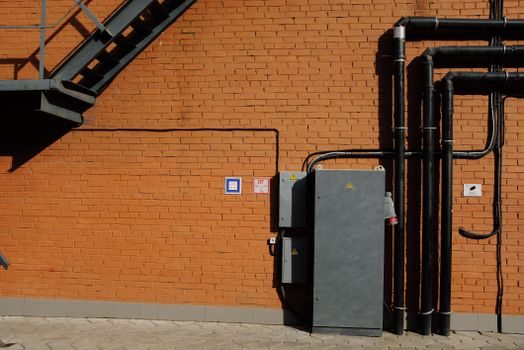
Spec the power distribution box with barrier-type (Ex d) cable glands sized to the actual conductor cross-section; using a standard gland on a flat paint-booth cable typically voids the DIP rating [S1][S4].
Internal/external earthing studs (usually M6 or M8 brass, not aluminium) and a dedicated bonding lug for the ductwork are mandatory; Shenhai-class OEMs supply these pre-fitted on the BXX/BJX castings [S4]. For operator controls inside the booth, pair the distribution box with an explosion-proof button station (typically Ex d IIC T6, IP65) and an explosion-proof light fitting on the same certification line, so the inspector sees a single matching nameplate family [S1][S4].
Comparison: realistic 2026 paint-booth options
Three configurations cover roughly 90% of the booths an EPC will see in 2026: (1) cast-aluminium BXM(D)51 / BXD51 Ex d IIC T5 IP65 — for the main MCB distribution board driving fans, lights and pumps; (2) cast-aluminium BJX51 / AH Ex e IIC T6 IP65 — for wiring junctions and pass-through; (3) galvanised-iron BXX8050 Ex d IIC DIP IP65 — for floor-level socket outlets and trolley plug points exposed to mechanical abuse [S1][S2][S4].
Failure modes and who should NOT pick the cheap option
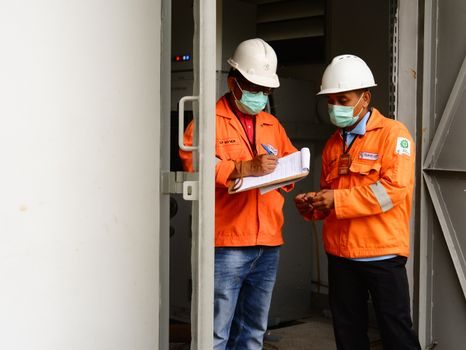
Specifying an IIB-only box on a booth that uses styrene or aromatic thinners is the single most common audit finding; the gas group on the nameplate must read IIC, and the supplier must show a current IECEx/ATEX certificate, not a self-declaration [S1][S6].
Buyers who should walk away from the lowest quote: any booth handling 2K isocyanate hardeners (sensitiser + flammable), any booth with routine waterborne purge, and any retrofit in a Class I Div 1 (NEC) facility — all three demand Ex d + DIP + IP66 plus dual-certification [S1][S4][S6]. A related engineering trade-off worth scanning when sizing conductors for these circuits is the broader PSU selection guide on input, output, ripple and topology match, since the upstream control PSU inside the booth cabinet must hold ripple inside the same Ex-d thermal envelope.
For a 2026 shortlist, demand: cast-aluminium or galvanised-iron body; Ex d IIC (or IIC+DIP combined) marking; T5 or T6; IP65 minimum; Ex d barrier glands matched to cable OD; brass earth studs; and an IECEx/ATEX certificate number traceable to a notified body, with Shenhai, Feice and Feipu-class OEMs all offering that documentation as of 2026-06-13 [S1][S4][S5]. For chemical-resistance context on the cable and conductor side, this copper material selection map for oil and gas sets the matching rules for conductor alloy in adjacent hazardous areas.