
A four-axis 60 kg SAN-RPM-class palletizing robot is offered at roughly 900 cycles/hour handling capacity with 3,200 mm motion range on Chinese B2B catalogs as of mid-2026 [S10], and sits inside a wider 2026 palletizing-robot price band of roughly US$8,888 to US$70,000 per set depending on payload, axis count and controller brand [S3][S7].
The 2026 market for these cells spans a near-continuous spectrum: collaborative 10 kg units from European specialists, four-axis 40-150 kg Chinese OEM cells, and four-axis 60 kg floor-mounted machines with 3,200 mm reach. The total spend the buyer is actually evaluating is the cell cost, not just the arm — gripper, infeed conveyor, pallet dispenser, fencing, safety scanner and commissioning all add to the articulated robot line item on the PO.
2026 palletizing robot price bands by payload class
On Made-in-China listings refreshed 2026-04-05, four-axis 120 kg palletizing robots for woven-bag and rice-grain handling are listed between US$15,000 and US$70,000 per set; the same data set shows 40 kg four-axis cells from US$6,000 to US$70,000, and a 150 kg food-and-beverage carton cell at US$20,000-22,000 per set [S3]. A separate "Customized Palletizing Robot" supplier listing carries a single-unit MOQ price of US$8,888 per set [S7], which sets a usable lower bound for a generic-spec four-axis cell.
Reading across the listings, three payload tiers repeat consistently: a 10 kg collaborative class, a 40-150 kg general-industry class, and a 150 kg-plus heavy-bag or carton class. The collaborative tier is priced as an application cell, not as a bare arm — Flexlink's RC12 specifies 10 kg payload at up to 14 boxes per minute and is sold as a complete palletizer [S4], which is why a like-for-like price comparison with a Chinese 120 kg arm is misleading.
What actually moves the price: five cost drivers
1) Payload and reach. Bigger gear means bigger servo motors, larger gear reducers, and a heavier base. The 150 kg Smecta/Smecta-class cells list in the upper band of US$20,000-22,000 [S3], while 40 kg cells overlap with 120 kg cells because the controllers, not the arms, often dominate the bill of materials.
2) Controller and reducer brand. Smecta's bag-palletizing cell integrates a KEBA controller and Teijin reducer [S5]; that brand pairing is a measurable price line, because Teijin (now Nabtesco-adjacent in many Chinese integrations) and KEBA both sit at the premium end of the four-axis Chinese supply chain.
3) Axis count and cycle rate. Most Chinese cells in the listings are four-axis (J1 base rotate, J2 horizontal, J3 vertical, J4 wrist), with the SAN-RPM platform rated 3.20 rad J1, +1.65/-0.71 rad J2, +0.30/-2.04 rad J3, and 6.28 rad J4, hitting 900 cycles/hour at 60 kg [S10]. A five- or six-axis arm — closer to a full articulated robot — adds axes, servo packs, and programming complexity and lifts the cell price accordingly.
4) End-effector. Clamping, bag-style, vacuum, and fork grippers are not interchangeable. Smecta offers a dedicated carton clamping head [S6] and a separate bag palletizing head [S5] in its product family, each priced and quoted as a sub-assembly. Buyers who switch product profiles mid-life should budget for a second gripper, typically 8-15% of the cell price.
5) Safety, fencing and integration. A caged 60 kg cell with light curtain and safety PLC is the baseline. A collaborative 10 kg RC12 cell removes the fence and uses power-and-force-limiting monitoring instead [S4], which changes the install footprint but introduces its own application-tier cost in the cell quote.
Collaborative vs caged: when each class fits
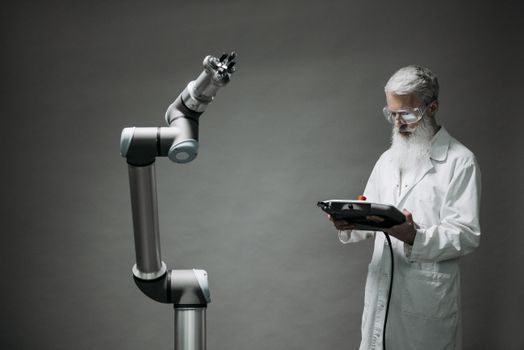
The Flexlink RC12 carries a 10 kg payload and a 14 boxes/minute throughput, and is explicitly aimed at personal care, food, dairy, tissue, pet food, beverage, electronics, pharma and home-care end-of-line [S4]. Throughput of 14 boxes/minute equals 840 cycles/hour, which sits just below the SAN-RPM 60 kg caged rating of 900 cycles/hour [S10] — meaning that for light boxes the cobot class can match a heavier caged cell on rate, at a lower payload and a different safety architecture.
Where a cobot is wrong: any cell above ~12-16 kg payload, any application with sharp tools, high-speed infeed, or mixed-SKU heavy bags. For woven-bag rice/grain work at 120 kg load, a four-axis caged cell is the only credible option in the 2026 price book [S3]. The right question is not "cobot or robot" but "is the product cube inside 10 kg, and is the line rate inside 14 boxes/minute?" If yes to both, the RC12 class is in scope; if no, plan a caged four-axis cell. A collaborative robot for a 60 kg bag stack is a mis-spec, not a bargain.
Spec-driven comparison: main options on the 2026 shortlist
Four-axis 40-60 kg caged (SAN-RPM-class): payload 40-60 kg, reach ~3,200 mm, 900 cycles/hour, KEBA/domestic controller, clamp or bag gripper, US$8,888-25,000 typical [S3][S7][S10]. Best fit: mid-rate food, chemical, and general carton lines where footprint matters more than extreme cycle rate.
Four-axis 120-150 kg caged (Smecta/Smecta-class): payload 120-150 kg, Teijin reducer, KEBA controller, 150 kg variant US$20,000-22,000 per set, 120 kg variant US$15,000-70,000 per set [S3][S5][S6]. Best fit: woven-bag rice/grain, seasoning, beverage-carton, home-appliance end-of-line where the bag or carton tips the 60 kg ceiling.
Collaborative 10 kg (Flexlink RC12-class): payload 10 kg, 14 boxes/minute (840 cycles/hour), no fence, PFL safety [S4]. Best fit: low-payload, mixed-SKU, space-constrained end-of-line in personal care, food, electronics, pharma. Sourcing logic for these is closer to a signal tower light line item than a capital-equipment PO — typically quoted as a turnkey cell with a defined scope.
Heavy-pail robotic palletizers (CAST Automation, GREIF-VELOX, Möllers) form a separate niche: layer or robotic architectures aimed at pail and drum handling with throughput rated in pails/hour [S2]. Pricing for this niche is project-quoted and rarely published as a per-set number.
Total cost of ownership: what the PO line doesn't show
Purchase price is roughly 55-70% of a delivered-and-running cell. Energy for a 60 kg class cell is dominated by the servo pack and is small (single-digit kW) relative to mechanical install, so it is rarely a deal-breaker on ROI. Spare-parts holding — gearboxes, servo fans, gripper fingers — is the variable that bites two years in; buyers should require a recommended spares list at PO, not at breakdown. [S3]
A practical sourcing rule: ask the vendor for an itemized quote broken into (a) arm, (b) controller, (c) gripper, (d) safety package, (e) integration. If they will not break it out, walk; the cell price is not comparable to the next vendor's cell price without that split.
Failure modes and what to derisk before signing
Three failure modes recur in 2026 palletizing cell audits. First, cycle-rate misspec: a 900 cycles/hour rating is for a defined pick-and-place path, not for a complex multi-pallet pattern; quote the cell against your worst-case pattern, not the catalog headline. Second, gripper-product mismatch: a clamping head designed for uniform cartons will not survive woven-bag duty [S5][S6]; specify the gripper against your actual product sample before PO. Third, controller-lifecycle lock: KEBA- and PLC-class controllers have multi-year replacement-part windows; confirm firmware-update policy and spare-part availability at quote stage, not at breakdown.
Trackable signals for the next buying window: 2026 H2 Chinese OEM price lists for 120 kg four-axis cells (published range US$15,000-70,000 per set [S3] suggests wide spread that should compress as controller brands standardize); the rollout of 10-12 kg cobot variants with higher IP ratings for washdown food lines; and integrator published lead times, which moved from 8-12 weeks to 16-24 weeks on European-brand cells through 2025 and remain a more reliable indicator of true cost than the headline cell price.
Spec-level background on the components involved: linear guide.