
According to Blumenbecker's article on flexible robotic palletizing systems, modern robotic workstations are capable of increasing packaging-line capacity by up to 15% while significantly reducing the need for physically demanding, repetitive manual handling [S1]. Industrial buyers now spec four-axis articulated arms for case and bag work, and reserve higher-payload five-axis units for drum, ingot, and bale lines where single-piece mass exceeds 100 kg.
Selection is driven by four numbers: payload (kg), reach (mm), axis count, and end-of-arm tooling (EOAT) family — bag gripper, clamp, suction, or magnetic. The 2026 supplier roster spans Fanuc M-410iB, Motoman MPL160 II, ABB IRB 460, and KUKA KR QUANTEC PA for new builds, with T.I.E. Industrial listing over 35 years of integration across new and reconditioned units [S3]. On the Chinese OEM side, Qingdao Ausense (YUPACK) lists robot palletizers alongside single-column, low-level, and high-level conventional palletizers in 13 series, shipping to more than 80 countries from a 10,000 m² factory [S2].
Payload and Reach Bands: Matching Arm to Product
Payload bands cluster around 4-6 axes with reach from 700 mm to 3,150 mm, and the right cell depends on case mass plus stack height [S3]. For case and carton lines under 50 kg, the ABB IRB 460-class four-axis arm with 2.4 m reach is a common fit; for 160 kg-class bag or drum work, the Motoman MPL160 II and KUKA KR QUANTEC PA series carry the duty [S3]. Heavy-payload five-axis cells (often 450-700 kg rated) are used in aluminium-ingot palletising, where the project scope runs from casting-belt discharge to final pack and demands a customised EOAT [S1].
Buyers should map SKU weight × pick rate × stack height against arm payload × reach before brand shopping. A 4-axis arm cannot build a 2.0 m CHEP-height pallet with a 1.6 m reach without a seventh-axis linear slide, which adds footprint and control integration. For 200-800 mm stack patterns in food and pharma, an articulated robot with a 1.85 m reach covers most standard GMA pallet footprints without a track.
Axis Count, Footprint, and Cycle Time
Four-axis (4-DOF) palletizers dominate because stacking is essentially a pick-and-place above a fixed pallet, and removing a wrist axis cuts cost and shortens cycle time. Robots.com lists the ABB IRB 460 as "the fastest palletizer in its class" for compact high-speed cells, with the Fanuc M-410iB and Motoman MPL160 II framed for high-throughput mixed-SKU lines [S3]. Five-axis arms add a wrist rotate that lets the EOAT reorient bags or drums mid-flight — useful when the infeed conveyor angle differs from the pallet face.
For low-ceiling retrofit cells (under 3.5 m), a 4-axis knuckle arm with a 1.4 m vertical stroke fits where a 6-axis collaborative robot would not. Cobot palletizers are now sold by Chinese pack-equipment OEMs as a dedicated "collaborative robot packing series," targeting <30 kg payloads where the fence can be removed and operators can hand-feed trays [S2]. Cycle-time claims in vendor brochures should be derated by 20-30% for mixed-SKU real lines, where pattern changes and EOAT swaps dominate.
EOAT Selection: Bag, Clamp, Suction, Magnetic
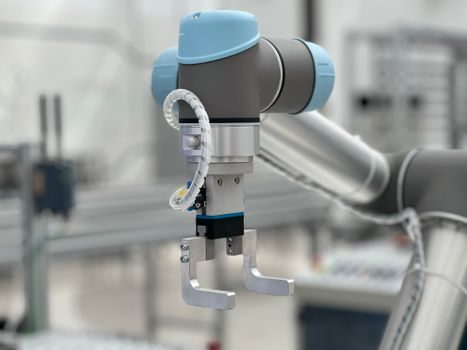
End-of-arm tooling is the single largest driver of line flexibility, and the four common families map cleanly to product geometry [S3]. Bag grippers cradle polyethylene or paper sacks from the bottom for stability and are standard in feed, seed, and chemical lines. Clamp grippers (mechanical finger or pneumatic jaw) handle rigid cartons, crates, and shrink-wrapped trays; the SAN-RPM series is described as a four-DOF cylinder-coordinate palletizer with horizontal, vertical, and rotation axes plus a front-end clamp for case handling [S6].
Suction and magnetic grippers pick from the top and suit flat-rigid items, including boxes, sheet metal, and steel cans, where a top-down lift is faster than a side clamp [S3]. The Chinese OEM Smecta offers a clamping-tooling carton palletizer with a "zero-compensation system" for continuous batch changeover, marketed into chemical-fibre, home-appliance, and food plants [S7]. For mixed-SKU cells, specify a quick-change EOAT coupler so that bag, clamp, and suction heads can swap in under 60 seconds — otherwise changeover time erases the 15% throughput gain the cell was sold on [S1].
Comparison: 4-Axis Articulated vs Cobot vs Gantry Palletizer
Three architectures compete for the same end-of-line slot, and the choice is set by payload, footprint, and operator interface. A 4-axis articulated arm in the 50-160 kg class is the mainstream pick for case and bag duty; a cobot cell suits low-payload, mixed-SKU, fence-free cells; a gantry or truss palletizer handles very high throughput on a single SKU. The detailed side-by-side below summarises the key decision numbers for spec-writing. [S2]
Architecture / Typical payload / Reach / Footprint / Best fit: 4-axis articulated, 50-160 kg, 1.85-3.15 m, ~3 × 3 m cell, mixed-SKU cases and bags at 10-20 picks/min; Cobot palletizer, 5-30 kg, 1.3-1.7 m, 2 × 2 m fence-free, low-speed lines with operator hand-feed; Truss/gantry palletizer, 30-80 kg, full pallet plane, 4 × 4 m+ overhead, single-SKU high-rate beverage and bag lines [S2][S3]. The mainstream 4-axis arm is the wrong pick when the line needs <5 picks/min with frequent operator intervention — a cobot is cheaper to deploy there — and the wrong pick for 24/7 single-SKU lines above 25 picks/min, where a gantry or dedicated layer-forming palletizer wins on cycle time.
Integration, Standards, and Sourcing Reality

Integration risk is dominated by upstream conveyor timing, pallet-conveyor hand-off, and shrink-wrapper sync, not by the robot itself. Vision systems and sensors let a single cell run multiple SKUs without extensive reprogramming, which is the basis for the "fast changeover" claim made for robotic palletizing cells [S1][S3]. For buyers comparing new versus reconditioned, T.I.E. Industrial explicitly markets both paths across Fanuc, Motoman, ABB, and KUKA lines [S3], while Chinese OEMs such as YUPACK, Youngsun, and Smecta ship new cells in 13-20 series from 10,000 m²-plus factories, with export footprints across 80+ countries [S2][S4][S7].
Standards anchoring palletising work sit inside ISO 9283 (manipulating industrial robots — performance criteria and related test methods) for repeatability numbers, ISO 10218-1 and ISO 10218-2 for industrial robot safety requirements, and ISO/TS 15066 for the collaborative-robot subset used in fence-free cells. For the surrounding packaging line, ISO 4151 and pallet-pattern guidance from the Fibre Box Association or the European Federation of Wooden Pallet Manufacturers (FEFPEB) apply on the load side, while CE Machinery Directive 2006/42/EC governs the integrated cell in the EU. Buyers should request ISO 9283 repeatability figures in mm, ISO 10218-1 risk-assessment documentation, and a documented EOAT changeover time-to-product in the RFQ package.
Limitations, Failure Modes, and When Not to Specify a Robot Palletizer
Robotic palletizing fails when the upstream pack is unstable, the SKU mix changes every shift, or the cell is undersized for stack height. Bag lines with variable bag dimensions and low bag-stiffness still need a bag gripper with bottom-support plus side-clamp; a suction-only EOAT will drop them. A 4-axis arm with 1.6 m reach cannot build a 1.8 m CHEP pallet without a linear slide, and adding the slide resets the safety-validated footprint under ISO 10218-1. [S1]
For very low-rate lines below 3 picks/min, the ROI math collapses: a $120k-class cell with a 2-3 year payback assumes two shifts and 5,000+ hours/year [S1]. A cobot arm may suit mixed-SKU 5-30 kg work, but buyers should verify ISO/TS 15066 power-and-force-limiting data and a stop time below the contact-injury threshold before removing the fence. For 24/7 single-SKU lines above 25 picks/min, a conventional layer-forming palletizer or a linear guide-driven truss gantry is mechanically simpler and easier to maintain than a robot cell, and is the default spec in beverage, salt, and cement plants [S2].
Closing signal: watch two numbers over the next 12 months — quoted cycle time at 100% rated payload (mm of repeatability, picks/min) and EOAT swap time in seconds. For related capex reference, the articulated robot arm price and cost guide breaks down spec-to-cost across the same Fanuc/KUKA/ABB/Motoman tier, and the cobot selection guide covers the fence-free sub-30 kg niche these cells are eating into.