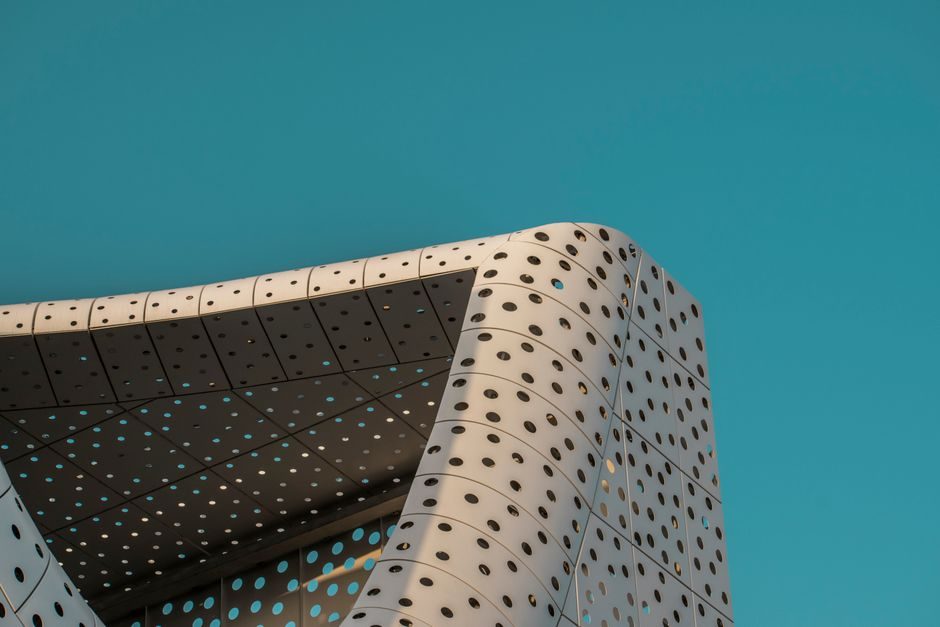
A perforated metal sheet is a flat stock — carbon steel, galvanised steel, stainless steel (commonly 304 / 316), aluminum (1100 / 5052), copper, brass or titanium — mechanically punched with a regular array of round, square, slot, hexagonal or decorative holes [S1][S5].
The four selection levers that determine whether a sheet performs in service are hole pattern + pitch, open area percentage, base material + finish, and thickness range; commercial perforators routinely run from foil-thin stock up to 1 in (25.4 mm) plate [S1]. Specifying out of order — picking a pattern before defining open-area and corrosion class — is the most common root cause of field failure.
Pattern families, pitch and the open-area arithmetic
Round-hole 60° staggered pitch is the default industrial pattern, giving the highest open area for a given hole diameter and is the geometry most CAD libraries (e.g. Inventor sheet-metal appearance presets) emulate. Open area for staggered round holes is calculated from hole diameter d and pitch p; for a typical 6 mm hole on 10 mm pitch (a frequently drawn stair-tread geometry) open area lands near 30 %, which sets the acoustic and load-bearing baseline. [S1]
Square / straight-row patterns simplify nesting and bolt alignment but reduce open area at the same hole size; slot patterns (oblong) are specified when flow direction matters — sieve bends, conveyor screens, and acoustic liner slots. Decorative / architectural patterns (hexagonal, diamond, custom) are sold by Chinese mills alongside the structural families, with catalog lines covering facades, ceilings and window screens [S5]. As a rule of thumb: thicker stock and higher open area both raise whistle risk, so acoustic-sensitive facades are detuned with staggered micro-perforations or by breaking the pitch rhythm.
Material selection by corrosion and temperature class
Stainless steel 304 is the architectural default for indoor facades and food-grade screens; 316 (or 316L) is specified for chloride exposure — coastal cladding, swimming-pool rooms, and chemical-plant walkways — and is the grade most often quoted on supplier datasheets under "stainless steel perforated sheet" [S3]. Galvanised mild steel remains the lowest-cost option for indoor partitions, machine guards and non-corrosive filtration support, while aluminium 5052 is the standard for marine and lightweight architectural panels where weight below 2.7 g/cm³ matters [S4][S5].
For high-temperature or aggressive-chemical service, titanium perforated sheet is a stocked micro-perforation product in some Asian catalogues (filter grades, electrolyser electrodes), and hot-rolled carbon steel plate is the workhorse for mining screens and heavy-duty grouting [S5]. When matching to the application, anchor the choice on three values: pH / chloride exposure, max continuous service temperature, and required post-fabrication finish (mill, brushed, powder-coat, anodised). Cross-reference against the same matrix used for metal curtain wall panel selection — both products share a facade exposure envelope.
Thickness range, flatness and fabricability
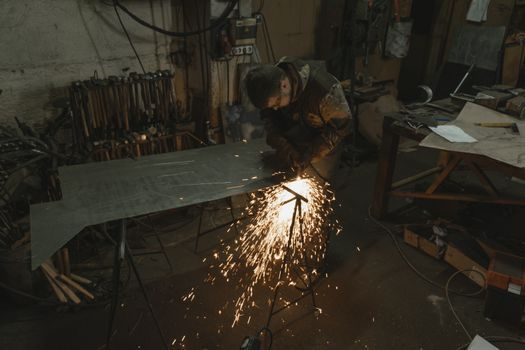
Commercial perforating presses cover foil-thin decorative stock up to 1 in (25.4 mm) plate in a single setup, which lets one supplier serve both acoustic ceiling tiles and structural stair treads without retooling [S1]. Thin-gauge aluminium (0.5–1.5 mm) is the envelope for ceiling clouds and window screens; 2–6 mm galvanised or stainless covers most guards, baskets and filter shells; 6–12 mm plate is the floor-plate / stair-tread range; above 12 mm you are usually buying a sieve or heavy grating rather than a sheet [S4].
Open area and thickness move in opposite directions for stiffness — a 30 %-open 2 mm sheet feels like fabric, the same pattern in 6 mm plate behaves like a deck. When the drawing calls for a 2400 × 1200 mm panel with 6 mm holes on 10 mm pitch, expect to specify a sub-frame or a return lip, because the panel's own bending stiffness at that aspect ratio will not span the opening unbraced. Flatness tolerance is typically published as ±1.5 mm/m on decorative grades and tighter (±0.5 mm/m) on filter / sieve grades; confirm this on the mill certificate before releasing to fabrication.
Where perforated sheet is the right answer — and where it is not
Specify perforated metal for: architectural facades and sun-screens (acoustic + daylight control), filtration media and sieve supports, machine guards and balustrade infill, stair treads and floor plates, ceiling acoustics, and EMI/RFI shielding where the conductive substrate doubles as a Faraday layer. The same open-area logic that picks a facade screen also drives flow-meter inlet straightener and pressure-transmitter impulse-line bracket selection on process skids. [S2]
Do not specify perforated sheet for: high-pressure (>PN40) process piping reinforcement (use forged fittings), primary structural beams (use hot-rolled section), or any application requiring a pressure-retention boundary certified to ASME B31.3 — perforation is a hole, not a stress-raiser you can ignore. For dust-laden process gas above 60 °C with spark risk, perforated sheet is also a poor substitute for a properly certified flame arrester, which must satisfy MESG / burn-velocity criteria, not just open area.
Comparison table — picking among the four common material families
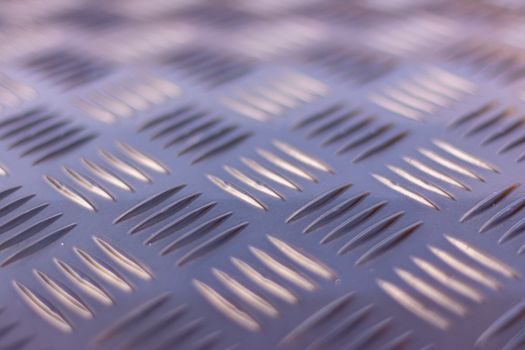
The matrix below lines up the four most-quoted material families against four decision criteria. Values reflect typical catalogue ranges from the surveyed suppliers and are intended as a starting point for RFQ, not as a mill certificate [S1][S2][S3][S4][S5].
Galvanised mild steel: low material cost (lowest of the four), poor chloride resistance, max continuous service ~200 °C on the zinc coating, density ~7.85 g/cm³, best fit for indoor machine guards and non-corrosive filtration. Stainless 304: mid cost, good general corrosion resistance, max continuous ~870 °C (oxidation-limited), density 7.93 g/cm³, default for food-grade screens and architectural facades. Stainless 316 / 316L: 20–35 % cost premium over 304, chloride-resistant, same ~870 °C ceiling, density 7.98 g/cm³, specified for coastal and chemical exposure. Aluminium 5052: mid cost by area but ~⅓ the weight of steel, good marine corrosion resistance, max continuous ~150 °C before creep, density 2.68 g/cm³, specified for lightweight facades, ceiling panels, and any linear guide enclosure where mass budget is tight.
Sourcing, MOQ and lead-time signals to track
MOQ on export channels starts at 500 pieces with quoted production capacity of 20,000 t/yr on large Chinese trading-platform listings — useful as an upper-bound benchmark when negotiating a release program [S2]. Domestic architectural catalogues (e.g. Argger) quote custom thicknesses, hole patterns and panel sizes with direct sales contact lines and ship mixed containers, which is the typical small-project route [S4]. Tier-1 North-American perforators (H&K) operate release-program pricing — call-off against a blanket order with the mill holding stock and the customer drawing down against a schedule [S1].
Two signals to watch on the next sourcing cycle: (a) whether architectural-grade 5052 / 5005 stock tightens during the Q3 2026 facade build season, which would push lead-times past the usual 4–6 weeks; and (b) whether stocked titanium micro-perforation expands beyond filter grades into electrolyser and bipolar-plate applications, since several Asian mills already list the SKU [S5]. For buyers cross-shopping fabrication partners, the same supplier-evaluation logic used in aluminum die casting sourcing applies — audit mill certificates, not just datasheet claims.