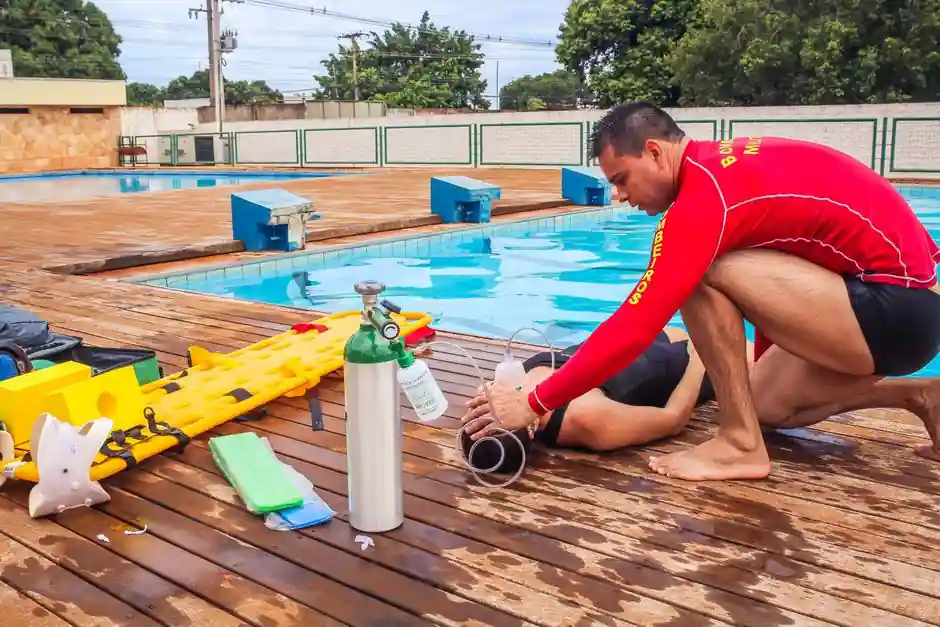
Under ANSI Z358.1-2014, personal eyewash bottles are not listed as compliant primary equipment; the standard recognizes only plumbed eyewashes and self-contained gravity-fed portable eyewashes as acceptable primary fixtures [S8]. A 500 mL squeeze bottle typically delivers roughly 30 to 60 seconds of flush, versus the 15 minutes of continuous, tepid potable water that the standard requires for the primary fixture [S3][S8].
OSHA's regulation at 29 CFR 1910.151(c) does not specify equipment details; instead, it directs employers to ANSI/ISEA Z358.1 for the technical performance criteria, which is why AHJs, auditors, and insurance carriers consistently treat the ANSI document as the de facto compliance benchmark in U.S. facilities [S9]. In a separate but related maintenance question, the same logic applies to equipment life-cycle data on flow meters used to verify the 0.4 gpm minimum flushing rate.
What ANSI Z358.1-2014 Actually Mandates at the Fixture
The standard requires the primary eyewash to deliver flushing fluid for at least 15 continuous minutes at a minimum flow of 0.4 gpm (1.5 L/min) per nozzle, with a flush pattern capable of covering both eyes simultaneously [S3]. Water temperature must be tepid, defined as 60 to 100 °F (16 to 38 °C), to avoid scalding or cold-shock that could shorten the rinse [S1][S3].
The unit must be located on an unobstructed path no more than 10 seconds (about 55 ft / 16.4 m) from the hazard, with the valve going from off to fully on in one second or less and remaining in the open position without the operator holding it [S1][S9]. These figures are not interpretive, they are the literal pass/fail criteria an auditor will check on a walk-through [S9].
Why a Squeeze Bottle Fails Every One of Those Criteria
A 16 oz (≈ 473 mL) personal eyewash bottle holds roughly 1/114th of the 15-minute minimum flush volume that a 0.4 gpm plumbed station must deliver, and on the high end the largest off-the-shelf bottles top out near 32 oz (≈ 946 mL) [S3]. At a useful 0.4 gpm flow, even a full litre empties in about 2.5 minutes, so the geometry alone disqualifies the bottle as a primary fixture [S3].
Bottles also fail on temperature control (sealed saline sits at ambient), on hands-free operation (the injured worker must grip and squeeze), and on the simultaneous dual-eye coverage that the standard's spray pattern demands [S3][S8]. Industry guidance, including the ISEA and OSHA commentary, is consistent: a personal bottle is a "first few seconds" supplement while the victim moves to a real eye wash station, nothing more [S6][S8].
Where Bottles Are Permitted: the "Personal Eyewash" Category

ANSI Z358.1 does allow a third category, the personal eyewash unit, but only for immediate flushing on the way to a compliant fixture, not as a substitute [S3][S4][S8]. CCOHS guidance states plainly that "eyewash bottles or personal eyewash units supplement plumbed and self-contained stations but in no way can replace them" [S4]. OSHA Education Center reaches the same conclusion: a portable bottle is "a lifesaver in the first few seconds," not a compliant unit on its own [S6].
Grainger's 2026 safety myth-buster is even more direct, calling the "eyewash flushing bottle counts as OSHA-compliant eyewash" claim incorrect, and pointing users back to the ANSI/ISEA standard for the definition of compliant equipment [S2]. For facility planners sizing chemical-handling areas, the practical read is: bottles on every bench, plumbed or self-contained eye wash station within 10 seconds of the hazard.
Plumbed vs Self-Contained vs Personal: a Side-by-Side Read
Plumbed eyewashes tie into the building's potable water and meet the 0.4 gpm, 15-minute, tepid-temperature criteria indefinitely, which is why ANSI and the model plumbing codes (IPC section 411, UPC section 416) treat them as the default primary fixture [S7][S8]. Self-contained gravity-fed portables use a sterile flushing fluid reservoir and are the only ANSI-acceptable alternative where plumbing is impractical, but they still must meet the same 15-minute flush duration and identical flow rate [S8].
Personal eyewash bottles are the lowest tier: they can support immediate irrigation during the walk to a primary fixture, but they fail the duration, flow-rate, temperature, and hands-free requirements when judged against the standard [S2][S3][S6]. Choosing between plumbed and self-contained is therefore a question of site logistics (water line availability, freeze risk, mobile crews), not a question of whether to skip the primary fixture entirely [S7][S8].
When the Bottle-Only Setup Actually Exposes the Employer
OSHA citations for inadequate eyewash provisions are typically issued under 29 CFR 1910.151(c) when the inspector finds no compliant fixture within the 10-second travel distance, regardless of how many bottles are present on benches or in kits [S9]. During a 2024 OSHA enforcement cycle, eyewash-and-shower deficiencies were among the top 10 most frequently cited serious violations in chemical and battery manufacturing, with individual penalty values commonly running into five-figure dollar amounts before any state-plan multipliers [S9].
Insurance loss-control surveys in chemical, pharmaceutical, and surface-finishing lines treat the absence of a compliant fixture as a "high severity, high probability" finding, which can affect policy renewals and deductibles independent of any OSHA action [S5][S7]. Specifying a pressure transmitter or line-mounted flow meter to log flush-line pressure is one way engineering teams turn the flushing verification from a paper exercise into a measurable KPI.
Real-World Layout: How Facilities Stack the Three Tiers
A typical ANSI-compliant cell on a battery formation line or a solvent-blending skid pairs a plumbed eyewash (or a self-contained unit if no water line is within reach) located 16.4 m or less from the hazard, with personal bottles at each workstation and on the chemist's cart [S1][S3][S8]. The bottle buys time on the walk, the primary unit does the 15-minute rinse, and a written flush-test log proves both that the flow is being delivered and that the tepid range is being held [S1][S5].
Weekly flush activation is the minimum to keep sediment out of the line and to verify the valve opens in under one second; the more rigorous practice, especially where lines sit idle, is a 3-minute flush per week plus an annual flow-and-temperature verification, which lines up with manufacturer recommendations captured in Haws and Grainger maintenance guidance [S3][S5]. Documented activation is also the most defensible evidence if an auditor ever questions the unit's real operating condition [S5][S9].
What to Verify Before You Sign off on a Bottle-Only Setup

If a site currently has only personal bottles, the audit checklist is short: confirm whether the work area generates any chemical or particulate exposure that triggers 29 CFR 1910.151(c); if yes, install a plumbed or self-contained ANSI Z358.1-2014 fixture within 10 seconds of the hazard; and keep the bottles strictly as the supplementary tier [S2][S4][S9]. Sites whose chemistry is limited to water-based, non-hazardous detergents may have a different baseline, but that judgement needs a documented hazard assessment, not an assumption [S4][S7].
One trackable signal worth monitoring in 2026: model plumbing code updates and the ISEA interpretation letters issued against Z358.1, which tend to clarify edge cases like drench-hose-only labs, lockable dust caps on nozzles, and the boundary between bottles and secondary eyewashes. For cross-discipline safety programs, integrating PPE selection with compliant emergency fixtures is the same exercise as choosing the right chemical glove, a topic our butyl vs Viton vs neoprene selection guide covers in detail, while the practical side of face-shield mounting is mapped in the browguard vs headgear-mounted face shields reference.