
Pharmaceutical distribution buyers should specify a VLM with fully enclosed trays, dual-level delivery, and cleanroom-rated construction when integrating with GMP warehouse flows, with Kardex, Modula, Hänel, and SSI SCHAEFER cited as the top-tier OEMs in 2024 industry analysis [S4].
The vertical lift module segment reached US$950.19 million in 2024 and is forecast to reach US$1,766.08 million by 2031 at a 9.7% CAGR, with dual-level delivery units already accounting for 65.3% of 2024 shipments [S4]. Europe alone held 37% of that 2024 demand, and the Asia Pacific region is tracking a 12.3% CAGR through 2031 [S4].
Why a closed VLM maps onto pharma GDP/GMP storage
Vertical lift modules store items in two tall columns with an automated lift that moves trays vertically and presents them at an ergonomic pick window, which keeps the load enclosed against dust, light exposure, and casual contact during the picking cycle [S4]. That physical containment aligns directly with the Good Distribution Practice (GDP) expectation that medicinal products remain protected from contamination and from operator handling variability between receipt and dispatch.
For a 2 to 8 degrees Celsius cold chain, the analyst report projects non-refrigerated VLMs as the fastest-growing storage type at a 10.7% CAGR through 2031, but refrigerated and temperature-controlled cabinets are listed as a Kardex product-line option that pharma buyers can specify when a controlled ambient envelope is required [S2][S4]. Independent academic work on small-items picking has also shown that VLMs shorten picker travel distance versus static shelving, which compresses the time a tote sits outside the controlled environment [S1].
Selection Criteria for Pharma Distribution VLMs
Five spec gates separate a generic VLM from a pharma-grade VLM. The first is tray enclosure: the unit must be a fully closed cabinet, not an open-frame carousal, to keep particulates off secondary packaging. The second is delivery ergonomics: dual-level delivery, which already represents 65.3% of 2024 installations, lets a picker stage inbound and outbound trays at separate openings and cuts cross-handling [S4].
The third gate is software. Look for WMS/ERP integration with batch number, lot, expiry, and FEFO (first-expiry-first-out) logic rather than a simple SKU locator, and confirm the OEM publishes a validated GAMP 5 or equivalent software lifecycle posture. The fourth gate is cleanroom or hygienic finishing: stainless or powder-coated surfaces that tolerate isopropyl alcohol wipe-down, with no exposed cardboard-bearing rollers inside the lift shaft. The fifth is throughput: peak picks per hour per operator, which academic benchmarking on small-items order picking tied to picker travel time reduction is the single biggest lever VLMs provide [S1]. For a deeper look at how pick-density specs translate into warehouse layouts, the recent VLM selection for food and beverage: spec gates, hygiene, and 2026 layout data walkthrough applies a similar hygiene-first filter to a related regulated industry.
Main VLM Type Options Lined Up for Pharma Buyers
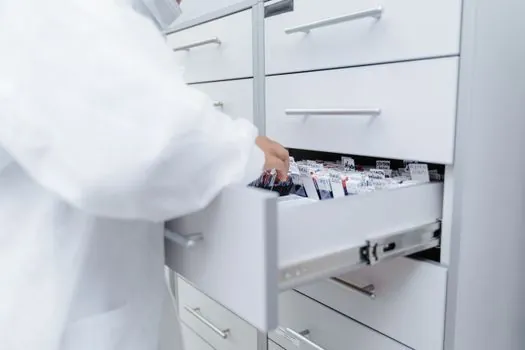
Three VLM architectures show up on most pharma RFQs. The first is the standard enclosed tray VLM, exemplified by the Kardex Shuttle product family, which is positioned as a closed, shelf-based storage lift designed to raise storage density on a small footprint and is offered in temperature-controlled and cleanroom variants [S2]. The second is the high-bay VLM such as the Modula Lift, marketed by Modula as its most popular VLM model and supported by a North American dealer network of 70+ partners serving 20,000 customers worldwide [S3].
The third is the slim-footprint VLM, for example Modula Slim, aimed at low-ceiling or mezzanine-edge sites where a tall unit will not fit. All three share the same dual-column, lift-and-present topology, but they diverge on unit height, tray payload, and cleanroom option codes. The Kardex Shuttle and Modula Lift both expose software suites (Kardex Power Pick System, Kardex Control Center) for WMS/ERP coupling, and SSI SCHAEFER and Hänel round out the four-OEM shortlist that the 2031 market report names as market leaders [S4]. For a comparable spec-gate comparison in a different automation class, the Shuttle System Selection for Warehouse Automation: 2026 Spec Gates article applies a similar four-vendor shortlist logic to horizontal shuttle systems.
Throughput Economics and Footprint Recovery
Independent research on small-items order picking found that VLMs reduce picker walking time and raise picks per hour compared with static shelving, with the magnitude depending on SKU count, pick window height, and storage policy [S1]. Modula customers cited the company directly on this point: one US parts operation reported that the VLM stored approximately 90% of their inventory in a single footprint that previously could not hold the same SKU count, and an industrial automation distributor stated the system was "key in our future growth" because it allowed much more activity in much less space [S3].
The market sizing shows that footprint recovery is a primary commercial driver: VLM revenue is forecast to grow from US$950.19 million in 2024 to US$1,766.08 million by 2031, with the addressable market across 2025 to 2031 sized at US$9,798.36 million [S4]. For pharma, where cold-room or cleanroom square metre cost dominates total facility economics, that footprint ratio often determines whether a VLM pays back inside the OEM-stated 3 to 5 year window or stalls at the procurement committee. Related automation payback math is explored in the Shuttle system selection for port logistics: salt-fog, vibration, and load-securing gates piece, which applies a similar footprint-versus-throughput lens to a harsher environment.
Integration, Validation, and Where Buyers Mis-Spec

Most pharma VLM mis-specs trace back to three points. First, the buyer treats the VLM as a passive shelving replacement and skips a URS (user requirements specification) that names batch, lot, expiry, and quarantine status as first-class data fields. The WMS-facing interface should carry those fields, not just SKU codes. Second, the buyer omits the cleaning regime from the spec: the lift shaft, extractor carriage, and tray bottoms all need a documented wipe-down procedure compatible with the site's disinfectants, and stainless or coated finishes should be confirmed against the OEM's cleanroom option list [S2][S4].
Third, the buyer under-specs the safety envelope. VLMs are heavy moving machinery with a vertical lift, and the analyst report flags regulatory compliance and safety standards as a continuing restraint on market expansion, so EN ISO 13849-1 performance level on the access-door interlocks and a documented risk assessment are non-negotiable for a regulated site [S4]. For context on how safety and regulatory gates are applied in another materials-handling class, the Linear bearing selection for textile mills: lint, wash-down, and 5,000 lbf loom loads article walks through comparable wash-down and lint exposure trade-offs.
Who VLM Fits, and When It Does Not
A VLM is a strong fit for pharma distribution operations that store a few hundred to a few thousand SKUs in totes or cartons, have a stable, narrow SKU profile with high pick frequency, and operate in a footprint-constrained or cleanroom-adjacent space where an enclosed tray protects product between picks [S1][S4]. It is also a strong fit where dual-level delivery can be exploited to stage receipts and dispatch at separate openings, which is the architecture that 65.3% of 2024 shipments already used [S4].
A VLM is a poor fit where the SKU count is in the tens of thousands with long-tail picks, where tote dimensions exceed the OEM's tray envelope, or where the picking process is fully automated by AGVs or AMRs and does not need an ergonomic pick window. In those cases, a linear module based automated bin store, a miniload AS/RS, or an AutoStore grid will outperform a VLM on both density and throughput, and the procurement team should be steered accordingly. For buyers who do fit the VLM profile, the next node to track is the OEM's published validated software lifecycle documentation and the site's URS gap analysis, with the 12.3% Asia Pacific CAGR as a useful indicator that second-source OEM capacity is expanding through 2031 [S4].
The underlying component specifications are covered under vertical lift module, and distribution cabinet.