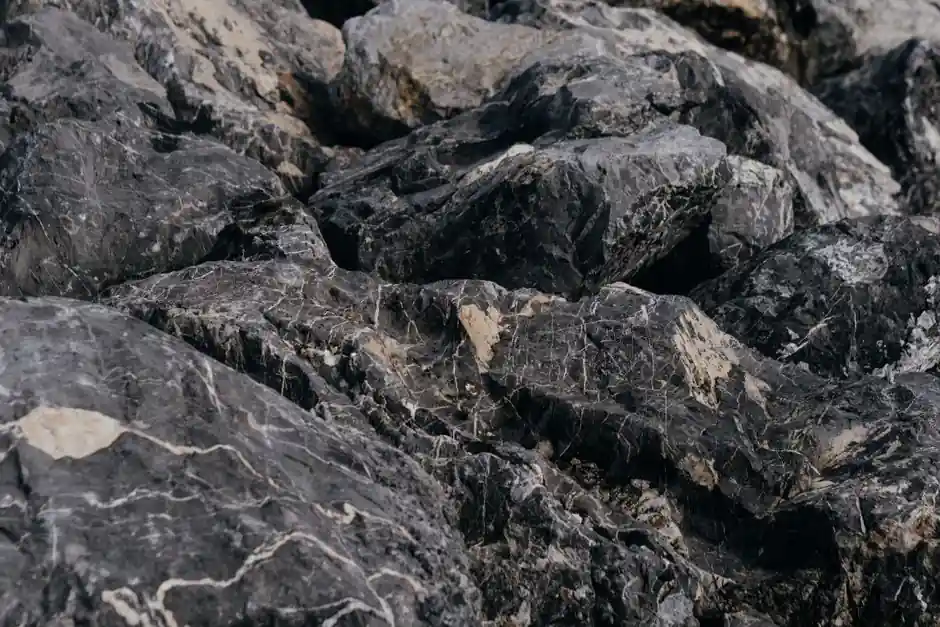
Chinese merchant phosphate rock is sold in five concrete spec tiers, with Guizhou Wengfu and Guizhou Kailin controlling the Kaiyang Yangshui reserve at an average 33.67% P2O5, the highest-grade sedimentary phosphate node in China and the backbone of the country's high-quality reserve base [S1][S3].
Procurement officers evaluating 2026 lots should anchor on five numbers: P2O5 grade (21–34% across rock SKUs, 32–46% across TSP), CaO/P2O5 ratio (1.55–1.65 for acidulation), MgO (typically <2.5% for mid-grade, <0.6% for export powder), Fe2O3+Al2O3 (R2O3 <3% to control sludge), and SiO2 (10–15% for siliceous ore feeding yellow phosphorus, >18% on flotation tailings) [S1][S3][S8].
Chinese grade taxonomy and the five SKU families
Domestic Chinese grade taxonomy splits merchant ore into three national classes: Grade 1 at P2O5 >30%, Grade 2 at 25–30%, and Grade 3 at 12–25%, with the older GB/T 1868–95 through GB/T 1881–95 series defining sampling, moisture, P2O5 (quinoline phosphomolybdate gravimetric/volumetric), Fe2O3, Al2O3, CaO, MgO (FAAS/volumetric), F (ion-selective electrode), SiO2, acid insolubles, loss on ignition, CO2, and SO3 methods [S2].
Guizhou Phosphate Chemical Group (GPC, RMB 6 billion registered capital, 17,000+ employees) commercialises five overlapping SKU families, each pinned to a downstream route: mid-grade carbonate-type ore (P2O5 >28%, MgO <2.5%, R2O3 <4%, SiO2 10–12%, arsenic <30 ppm, Pb/Hg/Cr <20 ppm) for fertilizer; siliceous ore (P2O5 >28%, MgO <2.0%, SiO2 10–15%, Fe2O3 elevated) for yellow phosphorus; carbonaceous B1-layer ore (P2O5 ≥28%, MgO 1.5–2.5%, R2O3 <2%, SiO2 <12%, arsenic <20 ppm, heavy metals <10 ppm) for MAP, MCP, and DCP; secondary concentrate from silicate flotation tailings (P2O5 ≥23%, MgO <1.5%, R2O3 >6%, SiO2 >18%) for calcium phosphate and yellow phosphorus feed; and A-layer fine-graded tailing pellets (P2O5 24–26%, MgO <1%, CaO ≥29%, SiO2 25–28%) again for yellow phosphorus [S1][S3].
Export-grade specification and Yunnan reference points
Yunnan export rock has run at P2O5 ≥32%, Fe2O3+Al2O3 <3%, MgO <0.6%, moisture <3%, with three particle-size windows (0–5 mm, 0–20 mm, 0–30 mm, each at >90% passing) and bulk shipment as the default pack format [S2].
Yunnan province hosts the Kunyang basin with a long-term geological survey estimate of 20 billion tonnes of in-situ phosphate reserves, including 4.6 billion tonnes within roughly 500 li of Dianchi Lake, ranking it alongside Florida, the Kola peninsula, and Morocco as one of the world's four large sedimentary phosphate districts; mining is open-pit with shallow overburden, cable-truck-belt combined haulage, and W-4 / WK-4 / 2–3 m³ hydraulic excavators paired with 988B front loaders [S2]. Yunnan product lines are split into run-of-mine (P2O5 ≥28%), three classes of crushed concentrate (Class 1 P2O5 ≥32% with MgO <0.5%, R2O3 <2.5%, CO2 <3.0%, moisture <8%, particle <30 mm), three classes of lump concentrate (Class 1 P2O5 ≥32% with Fe2O3 <1.2%, CO2 <4.0%, 30–50 mm fraction at >90%), powder (P2O5 ≥32% or 26–32% merchant band, 100-mesh pass >90%), and export powder (P2O5 ≥32%, moisture <2%, 100-mesh >90%, 50 kg PP+PE bags) [S2].
Decision-grade spec comparison across Chinese SKUs
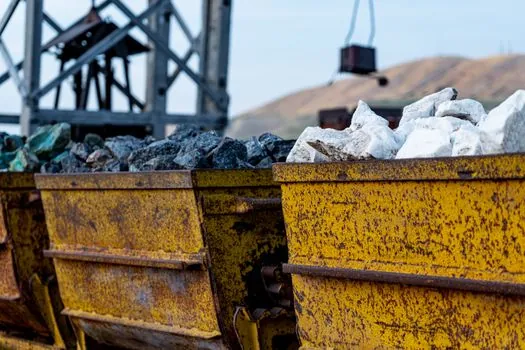
Side-by-side, the five Guizhou SKU families diverge on three decision axes: MgO (from <1.0% on yellow-phosphorus pellets up to 2.5% on mid-grade carbonate), SiO2 (from 10–12% on mid-grade carbonate to 25–28% on A-layer pellets), and downstream fit (fertilizer DAP/MAP versus yellow phosphorus versus feed-grade MCP/DCP) [S1][S3].
Buyers should read the matrix in three columns: (1) P2O5 grade band, where mid-grade carbonate and siliceous ore both clear >28% but secondary concentrate drops to ≥23% and A-layer pellets sit at 24–26%, so P2O5 alone is not a differentiator; (2) impurity ceiling, where carbonaceous B1-layer ore is the tightest (R2O3 <2%, arsenic <20 ppm, heavy metals <10 ppm) and secondary concentrate is the loosest (R2O3 >6%, SiO2 >18%); (3) end-use lock, where mid-grade and siliceous split between fertilizer and yellow phosphorus while B1-layer is locked to feed-grade MCP/DCP/MAP, and tailings-derived pellets are locked to yellow phosphorus only [S1][S3]. The same ore spec can therefore be priced against four different demand pools (fertilizer, feed, LFP, cement), which is why the Wind Product Chain Database, with 5,154 industries and 160,000+ upstream-downstream links, is the practical benchmarking tool for Chinese procurement teams [S4].
Supplier map and procurement gates for 2026
Verified Chinese state-owned and audited private suppliers in mid-2026 are concentrated in Guizhou, Hubei, Inner Mongolia, and Sichuan, with verified P2O5 grade bands of 21–34% across rock SKUs and 32–46% across TSP, and the top names are Guizhou Wengfu, Guizhou Kailin (the Kaiyang Yangshui operator), Guizhou Xifeng, Guizhou XinXin, Hubei Yihua Chemical, and Inner Mongolia Jingyichao Chemical [S8].
Procurement gates that should appear in any 2026 contract: (1) P2O5 by the GB/T 1871.1 quinoline phosphomolybdate method, with reject limits tied to the SKU class (≥32% for Class 1 export, ≥30% for Class 2, ≥28% for mid-grade); (2) MgO ceiling of 0.6% for export powder, 1.0% for Class 2 crushed concentrate, 2.0% for siliceous, 2.5% for mid-grade carbonate, with FAAS per GB/T 1871.5; (3) R2O3 (Fe2O3+Al2O3) ceiling of 3% combined for export lots, <2% for B1-layer feed-grade, <4% for fertilizer SKUs; (4) arsenic <30 ppm and Pb/Hg/Cr <20 ppm on standard carbonate, tightening to <20 ppm and <10 ppm on B1-layer feed-grade; (5) particle size windows per SKU (0–5/0–20/0–30 mm at >90% passing for export, 30–50 mm at >90% for lump, 100-mesh at >90% for powder), with 100-mesh powder packaged in 50 kg inner-PE / outer-PP bags; (6) moisture ≤3% on export powder, ≤2% on bagged powder, ≤8% on crushed concentrate; (7) sampling and sample preparation per GB/T 1868, with CO2 by gasometry (GB/T 1876), F by ion-selective electrode (GB/T 1872), and loss on ignition by gravimetry (GB/T 1875) [S1][S2][S3].
Downstream fit and what disqualifies a lot
A lot is disqualified from feed-grade MCP/DCP/MAP channels if fluorine is not driven below 0.1–0.2%, and disqualified from battery-grade LFP acid if CaO/P2O5 falls outside the 1.55–1.65 ratio band or if silica exceeds roughly 5%, both of which depress acid plant throughput [S4].
Phosphogypsum carry-off at 4.5–5.5 t per tonne of P2O5 (as CaSO4·2H2O) increasingly feeds cement retarder and soil conditioner lines where radionuclide and heavy-metal ceilings are met, while Mediterranean lots drifting to SiO2 6–8% and MgO 1.2–1.8% raise acid consumption 8–15% and choke filter presses in DAP plants, a useful benchmark for the Chinese buyer's QA/QC tolerance window [S4][S6]. For procurement officers comparing Chinese lots to Central Asian alternatives, the Uzbekistan-based Navoi Agrofos operation in Central Asia's Navoi basin sells premium-grade merchant phosphate rock with a stated low-cadmium impurity profile, useful as a second-source reference rather than a direct substitute, because the spec sheet is less granular than the GB/T-pinned Chinese SKU documentation [S5].
Standards, logistics, and traceability
The applicable Chinese national standard stack for rock and concentrate runs GB/T 1868 (sampling), GB/T 1870 (moisture), GB/T 1871.1–1871.5 (P2O5, Fe2O3, Al2O3, CaO, MgO), GB/T 1872 (F), GB/T 1873 (SiO2), GB/T 1874 (acid insolubles), GB/T 1875 (LOI), GB/T 1876 (CO2), GB/T 1877 (MnO), GB/T 1878 (K2O), GB/T 1879 (I), GB/T 1880 (SO3), and GB/T 1881 (SrO) [S2].
Logistics for export lots from Yunnan are rail-favourable because the deposits sit on rail lines, with bulk shipment as default and 50 kg PP+PE bags reserved for export powder; open-pit operations use W-4/WK-4 or 2–3 m³ hydraulic excavators and 988B front loaders with multi-size haul trucks, and 150–200 mm blasthole drills (YQ-150, KQ-200, KY-1) with millisecond blasting [S2]. GPC alone runs an annual import-export book above USD 1 billion, exports to 100+ countries, and has invested over RMB 3 billion in by-product gypsum utilisation since 2018, which is the auditable ESG datum a 2026 buyer should request at RFQ stage [S1].
Trackable signals for the next sourcing cycle: (1) whether GPC's RMB 90 billion asset base expands yellow-phosphorus pellet capacity past the current 24–26% P2O5 A-layer pellet SKU, which would tighten the low-P2O5 tail; (2) whether the GB/T 1868 series is superseded by a 2026-vintage revision, which would force contract re-papering on every assay method. The 2024–2026 LFP demand layer pulling high-purity acid remains the marginal pricing variable for any 28–34% P2O5 Chinese lot [S4].
For component-level specifications, see rock wool, linear guide, and crossed roller guide.
This topic is covered further in Wheel Loader vs Backhoe Loader: 2026 Spec Cut and Job-Site Match.