A modern rolling-element bearing is the sum of a roughly 200-station production chain: ring forging, turning, heat treatment, grinding, superfinishing, and assembly, each stage gated by dimensional and metallurgical checks tied to ISO 15:2017 boundary dimensions and ISO 492:2014 radial bearing accuracy classes (P0/P6/P5/P4/P2) [S1][S2].
Across Chinese Tier-2 suppliers, the high-volume mix is dominated by deep-groove ball, tapered roller, and slewing variants, while Tier-1 European and Japanese producers still own the P4/P2 super-precision and large-diameter slewing bearing niches [S2][S3].
Raw material selection: through-hardening chrome steel vs case-hardening case steel
Over 80% of commodity ball and roller bearing rings are machined from through-hardening chromium steel AISI 52100 (DIN 100Cr6), which combines ~1.0% C and ~1.5% Cr for a through-section hardness of 58-62 HRC after martensitic quench-and-temper [S1][S4].
For large-section parts, wind-turbine slewing rings, and railway axleboxes where case toughness matters more than full-section hardness, case-hardening steels 20CrNiMo and 20Cr2Ni4 are specified, with case hardness 58-62 HRC and a tough core of 30-45 HRC achieved by carburising or carbonitriding to a case depth of 1.5-6 mm depending on section size [S2][S4].
Ceramic and hybrid variants using silicon-nitride (Si3N4) rolling elements paired with steel rings are a separate material route covered under the ceramic bearing category, and they require grinding-diamond wheels and cleanroom assembly rather than the standard steel production line [S1].
Ring forging and pre-machining: turning, forging method, and grain flow
Hot forging in the 1100-1250 °C range followed by controlled cooling is the default route for tapered and roller bearing rings; the deformation step aligns the inclusion population with the ring geometry, raising rolling-contact fatigue life by typically a factor of 1.5-2× compared with bar-stock turned blanks [S1][S4].
Smaller deep-groove ball bearing rings under ~120 mm OD are often produced by cold heading or by tube-sawing from seamless-rolled tube, then CNC-turned on multi-spindle automatics holding ±0.05 mm on bore and OD before heat treatment [S1][S3].
Pre-grinding stock allowance on the raceway is typically 0.2-0.4 mm per side, set high enough to absorb heat-treatment distortion but low enough to keep the subsequent cylindrical grinding cycle under 60 s per part on a high-volume line [S1][S4].
Heat treatment: quench-and-temper, retained austenite, and dimensional control
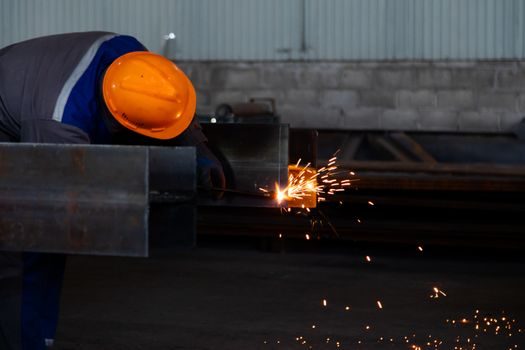
Bearing-grade steels are austenitised at 830-870 °C, oil- or salt-quenched, then tempered at 150-200 °C for 1-2 h; for 52100, this targets a tempered-martensite matrix of 58-62 HRC with retained austenite held below ~6% to avoid in-service dimensional drift [S1][S4].
Sub-zero treatment in liquid nitrogen at -196 °C is applied where premium dimensional stability is required (P4/P2 machine-tool bearings), pulling retained austenite below 1-2% and stabilising the bore size to within 1-2 µm after final grinding [S1].
Through-hardened rings are typically press-quenched in fixtures that constrain distortion to under 0.05-0.10 mm radial runout, but case-hardened slewing rings need press quenching dies matched to the gear-tooth and raceway geometry to keep the raceway circularity within 0.05 mm after carburising [S2][S4].
Grinding and superfinishing: raceway, superfinishing parameters, and ABEC class
Rough raceway grinding removes the heat-treatment stock on a cylindrical or angular-wheel grinder, finishing at a stock allowance of 0.02-0.05 mm before fine grinding on a higher-rigidity CNC grinder that holds bore and OD roundness to 1-3 µm at P6, and 0.5-1 µm at P4 [S1][S4].
Raceway superfinishing is the differentiator: a fine-grit (400-1000 mesh) stone oscillates at low amplitude while the ring rotates, dropping surface roughness Ra from ~0.4 µm post-grinding down to 0.05-0.10 µm, which directly raises L10 fatigue life by 2-4× and cuts NVH at high speed [S1][S4].
Ball and roller sorting classifies rolling elements into ABMA AFBMA grade classes 3-10 (G3, G5, G10, G20, G40) where G3 holds diameter variation under 0.08 µm for P2 spindles, and G10/G20 covers general P0-P6 service; matching-grade assembly is what lets a thrust bearing reach its rated speed limit without skidding [S1].
Assembly, cleanliness, and verification
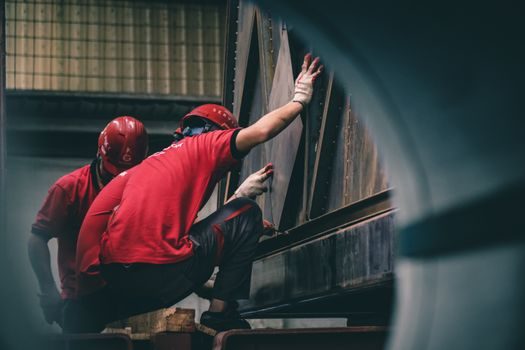
Cleanroom assembly is a process step, not a marketing line: rings are solvent-cleaned, oiled with a 0.5-2 µm filtered PFPE or mineral oil film, and assembled with rolling elements and a pressed steel, brass, or PEEK cage in an ISO 14644-1 Class 7 or better booth to hold particulate at <50 µg per bearing [S1].
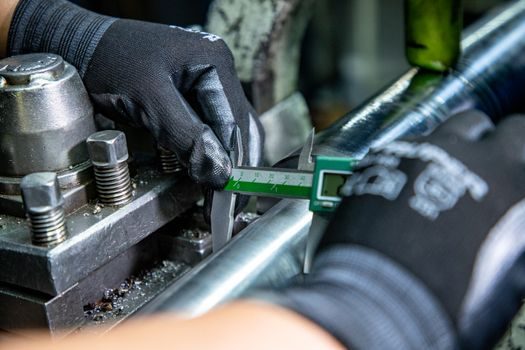
Final verification is run on a 100% basis for premium lines, with automatic measurement of bore, OD, width, radial runout, axial runout, and torque at the rated load, while ABMA-statisical lot inspection is used for commodity P0 output; certificates follow ISO 9001 plus, for automotive Tier-1 supply, IATF 16949 audits [S1][S3].
Packaging is typically VCI-film + vacuum-foil for export; a linear bearing line uses a parallel set of track-grinding and ball-retainer assembly cells, but the cleanliness and superfinishing logic is identical to a rolling-element bearing cell.
Comparison of main bearing families by production route
Deep-groove ball bearing: 52100 cold-headed ring → quench/temper → cylindrical grind → superfinish → ball sort G10-G20 → cage assemble; cheapest, fastest cycle, dominant in electric motors and pumps [S1].
Tapered roller bearing: forged 52100 ring → quench/temper → profile grind on Landis or Norton grinder → log-ground rollers → hand-assembled with matched clearance window of 0.020-0.060 mm; heavy-duty automotive and railway [S3].
Slewing slewing bearing: forged 42CrMo or 20CrNiMo ring in 1-4 m diameter → carburise 1.5-6 mm case → press-quench → raceway grind on vertical lathe → induction-hardened raceway; uses induction quench raceways and gear-tooth hobbing in the same fixture [S2].
Ceramic ceramic bearing: Si3N4 balls hot-isostatically pressed and sintered, then diamond-ground to G5; paired with 52100 or M50 rings; cleanroom-only assembly and high cost limit use to high-speed spindles and aerospace [S1].
Standards governing production and final inspection
ISO 15:2017 fixes the boundary dimensions (bore, OD, width) that all ring-forging and grinding fixtures must hold to; ISO 492:2014 defines the radial-bearing accuracy classes P0-P2, and ISO 199:2014 covers thrust-bearing tolerances, with ABEC 1/3/5/7 being the ABMA equivalent of P0/P6/P5/P4 [S1][S4].
Material specifications default to ASTM A295 for 52100 and ASTM A534 for case-hardening bearing steels, while aerospace-grade M50 (AMS 6491) and M50NiL (AMS 6278) require vacuum-arc or electroslag remelt to keep inclusion ratings inside ASTM E45 K0-class limits [S1].
For oil-and-gas service, sour-environment grades follow NACE MR0175 / ISO 15156, restricting alloy and hardness combinations in H2S exposure, and several Tier-1 Chinese mills hold sour-grade approvals for both ball and roller bearing lines [S4].
Signals to track in the next 6-12 months
Watch for ISO 492:2014 revisions under periodic review for tighter P2 dimensional gauges, more Si3N4 ball capacity coming online at Chinese suppliers, and IATF 16949 audit tightening on PFAS-free clean fluids in the assembly booth, all of which will reshape the standard production flow above [S1][S2].
Buyers comparing bearing lines against parallel capital-equipment sourcing can read Mining Equipment Production Technology 2026: Materials, Automation, Sourcing and Aerospace supply shortage and risk 2026: AS9100 scope, AIRTEC sourcing and tier-N exposure for adjacent spec and certification logic; petrochemical buyers can cross-check sour-grade application notes in Petrochemical Production Technology: Process Flow, Control and 2026 Spec Levers.