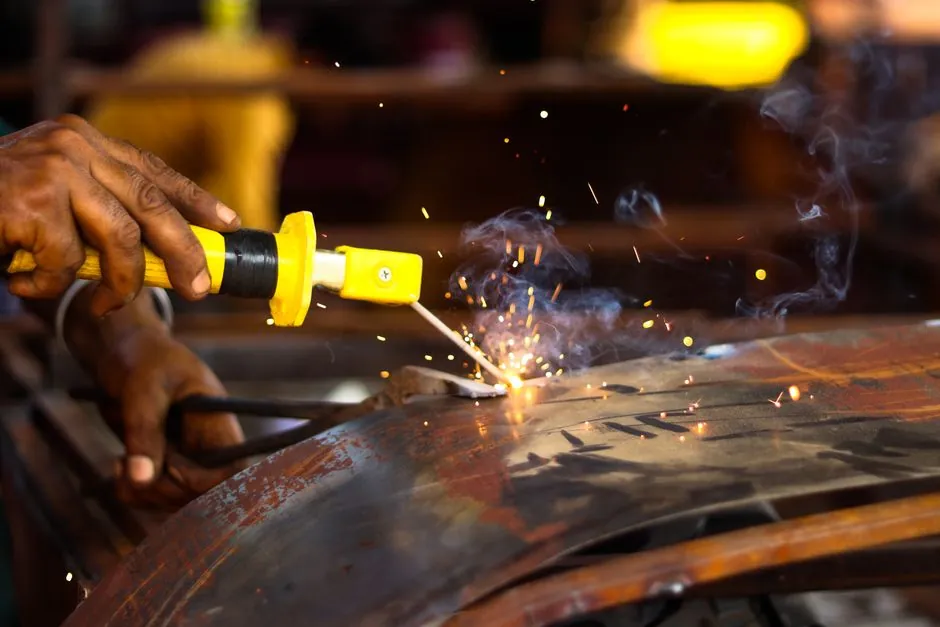
Electrical installation crews who cut steel strut, panel back-plates, transformer pads, and conduit hangers on site should spec a 40–60A dual-voltage inverter plasma cutter with 60% duty cycle, 5–6 CFM of clean oil-free air at 60–90 PSI, and 1/2 in recommended cut capacity on mild steel [S3][S4].
That envelope covers the materials an installer actually handles, 1/4 in to 1/2 in mild steel, stainless channel, and copper or aluminium bus bar up to about 1/4 in, while keeping the machine light enough (10–40 lb) to carry to a panel room or rooftop [S3][S5]. Anything below 40A is a sheet-metal toy; anything above 80A pulls more current than a typical jobsite distribution board will give up without a dedicated 50A branch [S1][S3].
Amperage and Cut Capacity: Why 40–60A Is the Sweet Spot
A 40–50A plasma cutter delivers a clean recommended cut of 1/4 in to 3/8 in mild steel and a maximum severance of 1/2 in; stepping to 60–80A raises the clean-cut range to 3/8 in to 1/2 in and severance to 3/4 in, which covers nearly every electrical fabrication task short of cutting thick transformer baseplates [S3][S5]. Westermans' tiering places the 40–80A bracket squarely in "general fabrication and garages, 10–32 mm" [S5].
The commonly cited rule of thumb from Welding Parts Blog is to buy 20–30% more amperage than your typical material so dross stays low and consumable life holds up: an installer who mostly cuts 1/4 in should be looking at a 40A-class machine, not a 25A unit, to keep travel speed and edge quality where the QA inspector will not flag it [S3]. For related sizing logic applied to demolition cuts and field repair, the plasma cutter spec map for demolition walks the same duty-cycle trade-offs from a different angle.
Input Power: 120V, 240V, or Dual-Voltage on a Jobsite
120V plasma cutters top out at about 40A output, deliver a 3/8 in recommended cut at best, and run off standard 15A/20A receptacles; 240V machines unlock 40–100A+ output, 1/2 in to 1 in recommended cuts, and need a dedicated 30–50A breaker with correctly sized conductors [S3][S4]. Dual-voltage units (120V/240V) drop performance on the lower rail, e.g. 50A on 240V becomes roughly 30A on 120V, which is the practical answer for installers who move between an energized shop and a rough-in jobsite [S1][S3][S4].
For crews running temporary power on a construction site, a 50A dual-voltage inverter on a 240V twist-lock receptacle is the realistic baseline: 60% duty cycle at full output, 6 minutes of cut time in any 10-minute window, and 4 minutes of cooldown, which is enough for repetitive strut, Unistrut, and panel-board bracket work without thermal trips [S3]. Indoor finishing and trim-out cuts follow a similar voltage trade-off, detailed in the plasma cutter spec map for interior finishing.
Duty Cycle and Thermal Headroom: The Hidden Cost of Cheap

Duty cycle is the share of a 10-minute window the torch can stay on at rated amperage before the machine thermal-stops: 20% gives 2 min cut / 8 min cool (hobbyist), 35% gives 3.5 min / 6.5 min (DIY), 60% gives 6 min / 4 min (production shop), and 100% is industrial continuous operation [S3]. A 50A cutter advertised at 35% duty cycle can therefore run 3.5 minutes at full power, then must sit idle for 6.5 minutes, which is unacceptable on a panel-rough job where the operator is making dozens of short cuts in a row [S3].
Two practical mitigations: (1) running a machine below its rated current raises its effective duty cycle, so a 50A unit at 30A typically delivers 60–80% duty cycle, which is often enough for short electrical-installation cuts [S3]; (2) buy headroom now, because the Express Weldcare guidance is that a plasma cutter should serve 5–10 years and that upgrading later costs more than buying correctly initially [S6]. For an installer planning 12 mm work today but expecting 20 mm bus-bar brackets next year, that translates into stepping from a 40A to a 60A class machine, not the other way around [S6].
Air Supply: CFM, Pressure, and the Moisture Problem
Plasma cutters need clean, dry, oil-free compressed air at 60–90 PSI (4–6 bar) and 4–8 CFM depending on amperage; a 40–50A unit wants a minimum 5 CFM @ 90 PSI and a 30-gallon tank, while a 60–80A machine wants 6 CFM and a 60-gallon tank [S3]. Moisture in the supply line causes premature consumable failure and slaggy cuts; oil contamination clogs the torch tip and ruins the nozzle within hours [S3][S4].
The correct field fix is a refrigerated or desiccant inline air dryer plus a particulate filter between the compressor and the plasma cutter, not a bigger compressor, because throwing more CFM at a wet-air problem just feeds contamination faster [S3]. On jobsites where the only available air is a portable gas-driven compressor, the same dryer/filter stack is non-negotiable; on a permanent shop, a hard-piped 60-gallon unit with a dedicated dryer covers the 40–60A range cleanly [S3][S4]. Reference coverage of consumables and the broader tool class lives at the plasma cutter encyclopedia entry.
Starting Method, Inverter Topology, and the 110V Edge Cases
Pilot arc (high-frequency start) initiates without touching the workpiece and will cut expanded metal, grating, and rusty or painted steel, at the cost of some electronic noise; contact (scratch) start is cheaper and electrically quieter but cannot start on an edge and refuses expanded metal [S3][S4]. For electrical-installation work, where strut and expanded-metal walkway panels are routine, a non-touch pilot arc is the practical default unless the budget forces a contact-start unit [S2][S3].
Inverter-based machines weigh 10–40 lb, run cooler, and typically post a 35–60% duty cycle; older transformer-based units are heavier, draw more input current for the same output, and are best avoided for portable work [S3]. The edge case is a strict 120V/15A site circuit: a dual-voltage machine in 120V mode typically delivers about 40A, which yields roughly 1/4 in clean cut and 3/8 in severance, enough for thin gauge work but not for repetitive 1/2 in plate [S1][S3][S4]. For control-side power and distribution behind the panel, the LV electrical encyclopedia entry covers the upstream spec gates the cutter is plugged into.
Selection Criteria Comparison for Electrical-Installation Use
Three machine classes map cleanly to electrical-installation work: a 30A 120V-only unit is portable and cheap but limited to 1/8 in to 3/16 in clean cuts, fits only sheet-metal and small brackets, and will not sustain 1/2 in plate; a 50A dual-voltage inverter is the practical default, covers 1/4 in to 3/8 in clean and 1/2 in severance on 240V, drops to about 30A on 120V, and pairs with a 30-gallon compressor at 5 CFM [S1][S3][S4]. An 80A 240V professional unit handles 1/2 in to 3/4 in clean and up to 1 in severance, needs a 50A breaker and an 8 CFM / 80-gallon compressor, and is justified only for crews regularly cutting thick baseplates or structural steel [S1][S3][S5].
Decision criteria to weigh against those classes: (1) maximum recommended cut on the material you actually run, not the marketing severance number; (2) duty cycle at your working amperage, not the headline 100%-at-light-load number; (3) input voltage and breaker compatibility with the site distribution; (4) air CFM and quality from the compressor you already own [S3][S4][S5]. Westermans' framing is direct: there is no single best plasma cutter, only the best match for material thickness, duty cycle, and budget, and any spec sheet that hides the cut chart or the CFM curve should be treated as marketing, not engineering [S5].
Safety, Standards, and Common Failure Modes to Plan Around
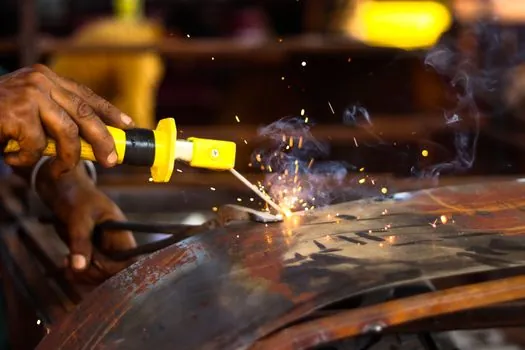
Plasma cutting is classified as hot work: it produces UV radiation, toxic metal fumes (galvanized zinc fumes in particular are a documented acute respiratory hazard), and sparks that travel several meters, so the work area must be cleared of combustibles, ventilated, and the operator must wear an auto-darkening helmet, flame-resistant clothing, and a respirator rated for metal fume [S4][S5]. Lincoln Electric's technical note adds that oxy-fuel still cuts thicker than 1 in steel faster than plasma, so installers cutting very thick plate for substation or switchgear bases should not assume a plasma cutter replaces an oxy-fuel rig [S10].
Common field failures follow a predictable pattern: torch tip burn-back from wet air, breaker trips from undersized 120V circuits, and dross-heavy cuts from running a 50A machine at 80% output on a 35% duty-cycle chassis [S3][S4]. The corrective actions are equally predictable: install a dryer/filter, upsize the branch circuit or drop to a 120V-rated output, and buy 20–30% more amperage than the typical job so you never run at the thermal limit [S3]. When the consumable stack cannot be kept cool and dry, or the electrical supply cannot be brought up to the machine's nameplate, replacement (a smaller, correctly-sized cutter) beats repair [S3][S4][S6]. For adjacent field-service specs, the plasma cutter spec map for road maintenance fleets covers the compressor and power trade-offs from a mobile-fleet angle.
Trackable signals to watch over the next buying cycle: whether manufacturers continue to bundle non-touch pilot arc as standard in the 50A dual-voltage tier (it was an upcharge in many 2025–2026 listings), and whether 60% duty cycle at full output becomes the entry-level claim rather than a premium feature [S2][S3][S6].
Component reference pages worth checking: electrical automation.