
ResearchAndMarkets puts the global pneumatic actuator market at USD 21.781B in 2025, expanding to USD 30.519B by 2030, a 6.98% CAGR, with growth anchored in process valve automation, water and wastewater retrofit, and food-grade packaging lines [S1]. Grand View Research frames the same category more aggressively: USD 51.71B in 2023, USD 60.2B in 2026, and USD 73.83B by 2030 [S4].
The 2-3x spread between publisher estimates is itself a fact, reflecting different scope definitions: ResearchAndMarkets counts core pneumatic actuators, while Grand View's universe bundles pneumatic cylinders, rotary vane units, grippers, and gripper-positioner accessories [S1][S4]. For a process engineer sizing a 2026-2030 capex, the realistic working number is the lower of the two for a like-for-like scope, and the higher for a fully-loaded pneumatic motion-control bill of materials.
Headline Forecasts Across Adjacent Pools
MarketsandMarkets sizes the entire actuator pool (electric, hydraulic, pneumatic) at USD 71.22B in 2025, growing to USD 100.41B by 2030 at a 7.1% CAGR, with pneumatic units identified as a structural slice of that base, not a niche [S2]. The Business Research Company reports a digital-actuator sub-pool at USD 20.46B in 2025, USD 22.23B in 2026, and USD 31.26B by 2030 at an 8.9% CAGR, where digital pneumatics (closed-loop positioners, IO-Link valve terminals, smart position sensing) is one of the listed product types alongside linear and rotary units [S3].
TechSci Research's combined Hydraulics, Pneumatics and Actuator envelope is valued at USD 45.62B in 2024 with a 3.53% CAGR to USD 56.68B by 2030, a more conservative trajectory that bundles hydraulics headwind against pneumatic growth [S5]. On a sub-segment basis, IndexBox projects world rotary pneumatic actuator demand growth of 4.0-5.5% CAGR between 2026 and 2035, driven by factory automation and 90/180-degree valve and damper duty [S7]. Taken together, the median process-engineer takeaway is mid-single-digit CAGR for pneumatic units, with smart/digital variants compounding at roughly 2 percentage points higher [S1][S3][S7].
Product-Type Comparison on Selection Criteria
For 2026-2030 spec work, pneumatic actuators split into four decision branches: spring-return quarter-turn rack-and-pinion, double-acting rack-and-pinion, scotch-yoke (high-torque quarter-turn), and linear pneumatic cylinder-and-spring assemblies. The reference pneumatic actuator class covers the first three, while pneumatic cylinder units dominate linear-thrust duty on damper and slide-valve service. [S3]
On torque density, scotch-yoke units out-deliver rack-and-pinion by roughly 20-30% at the same bore and stroke because the toggle geometry converts force near end-of-stroke into peak torque. On fail-safe behaviour, spring-return quarter-turn models default to a defined safe position on air-loss, while double-acting versions require a separate reserve air tank sized for 3-5 stroking cycles, a constraint that often pushes water and wastewater specifiers toward spring-return even at higher unit cost. On hazardous-area duty, the same aluminium-bronze or stainless rack-and-pinion bodies carry ATEX 2014/34/EU and IECEx certification for Zone 1 and Zone 2 group IIC T4-T6 service, while pneumatic-only housings avoid the heavier purge ratings that electric actuators carry.
On digital integration, a 2026-vintage positioner stack now ships with IO-Link, HART 7, FOUNDATION Fieldbus H1, and PROFINET in the same field-replaceable module, which is where the digital-actuator 8.9% CAGR attaches itself to the pneumatic base [S3]. For comparison against pneumatic valve actuator alternatives, the main trade-off is cleanroom and hygiene service: stainless 316L bodies with PTFE-coated internals command a 40-60% price premium over anodised aluminium at the same torque output, and are essentially mandatory for pharmaceutical and food-grade duty.
End-Use Pull: Process, Discrete, and Mobility
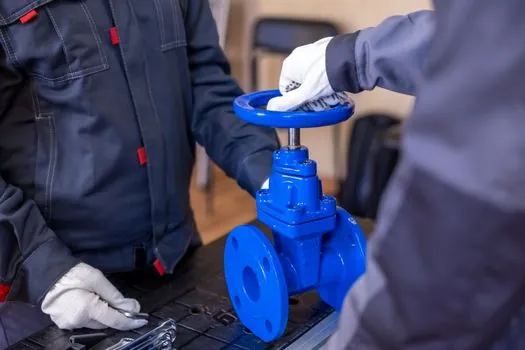
Process industries (oil and gas, chemicals, power, water) remain the largest single pull on pneumatic actuator volume because they pair with quarter-turn ball, butterfly, and plug valves on dead-man's-handle fail-safe logic. The automotive segment is a separate growth pocket: Claight's South Korea automotive pneumatic actuator forecast tracks 2026-2030 expansion driven by EV battery cell formation, paint-shop robotics, and HVAC blend-door duty [S6].
Discrete factory automation is the third leg, where rotary pneumatic actuators on end-of-arm tooling, conveyor diverters, and clamping fixtures run at 4-6 bar shop air and compete head-to-head with 48V servo electric units on cycle-time, not on unit cost. For a full plant-air foundation that supports any of these pneumatic loads, the upstream spec is covered under the broader pneumatic category, which spans compressors, dryers, FRLs, and distribution. On lower-purity utilities like bin aeration and dilute-phase conveying, pneumatic conveyor duty routinely specifies 1/4-turn dampers rather than full ball valves, which keeps the unit-price-per-actuator lower even as volume scales.
Who Should and Should Not Spec Pneumatic for 2026-2030
Pneumatic actuator specs fit cleanly when (a) the valve or damper duty is quarter-turn, (b) the plant already runs 4-7 bar clean dry instrument air, (c) fail-safe on loss of air is a code or insurance requirement, or (d) the environment is classified hazardous and the electric alternative would need a heavier Ex d or Ex e enclosure. They are a poor fit for continuous-modulation duty above 60 cycles/hour, for sub-zero service below roughly -40 degrees C without arctic-grade seal kits, and for any line where compressed air does not already exist and the cost of a dedicated compressor train is not justified. [S5]
The on-sky digital-actuator 8.9% CAGR is the proxy for how fast that hybrid topology is being specified, even on projects where the mechanical hardware behind it is still a 4-bar rack-and-pinion [S3]. On commodity rotary fittings and tubing that carry the supply air, the spec is covered under pneumatic fitting selection, where push-in versus compression versus flare choice has a bigger effect on skid build time than actuator brand.
Limitations, Failure Modes, and Sourcing Watchpoints

Three constraints deserve weight. First, the 6.98% headline CAGR assumes a benign macro, but pneumatic actuator demand is tightly coupled to global oil and gas capex, and the Grand View trajectory flattens noticeably in 2024-2025 because petrochemical project sanctioning slipped [S1][S4]. Second, raw-material exposure is real: ductile iron and aluminium-bronze bodies track steel and copper, which are sensitive to energy cost and trade policy. Third, the smart-positioner sub-segment is consolidating, with Siemens, Emerson, and a handful of European specialists holding the bulk of the field-replaceable positioner market, and OEM lock-in is a real risk for buyers who want multi-vendor sourcing [S3].
A practical failure-mode map for a 2026-spec unit: spring-pack fatigue typically begins at 250,000-500,000 full-stroke cycles and is the most common mid-life failure; O-ring and seal failure is the most common early-life failure on food and pharma duty where steam-in-place cycles hit 150 degrees C; positioner drift is the most common commissioning failure, often caused by dirty instrument air rather than a defective device, which is why the upstream FRL and dryer spec matters as much as the actuator itself. For capital planners, the dual-source discipline that EV charging station quality standards demand on suppliers is a reasonable template for actuator sourcing, since the failure-cost profile (a stuck valve at a refinery is a multi-million-dollar event) is in the same order of magnitude.
Trackable Signals for the Next 12-18 Months
Two signals to watch: the actual 2026 demand print from the four largest pneumatic actuator OEMs (Emerson, Rotork, Flowserve, IMI), which will validate or correct the 6.98% CAGR midpoint [S1]; and the rate at which water utility capex in North America and the EU converts into ball-valve-and-actuator purchase orders, because the wastewater retrofit cycle is the single largest non-process-industrial demand pool through 2030. For a broader industrial-machinery demand context, the industrial fasteners market 2026 sourcing map tracks similar mid-single-digit growth and similar steel-input sensitivity, and is a useful cross-check on whether the underlying industrial capex pulse is real or paper.