
Retail distribution of dry bulk goods (sugar, salt, starch, plastic pellets, dry milk, animal feed) is dominated by enclosed, dust-controlled transfer between railcar or truck, storage silo, and the packaging or batch line, and pneumatic conveying remains the default hardware class for that duty cycle [S1][S2].
Three flow regimes cover the practical envelope: dilute phase (high velocity, low solids-to-air ratio, typically 1.5–25 kg/kg), semi-dense phase, and dense phase (low velocity, higher ratio, often 30–80 kg/kg or higher with plug flow), and the right pick is set by particle size, friability, and abrasiveness, not by line length [S10][S1].
Material Properties Drive the Hardware Pick
Bulk density (apparent versus tapped), particle size distribution, moisture content, friability, abrasiveness, and angle of repose are the six inputs that decide flow regime, pipe diameter, and blower size before any catalog is opened [S4][S5]. The first decision is not the blower, it is the material profile, and engineering guides repeatedly put this step at the top of the selection list [S1][S6].
Apparent versus tapped density reveals how a powder compacts under vibration; a wide gap signals plugging risk and pushes the design toward assisted feeding or dense phase [S4]. Hygroscopic materials such as salt, sugar, and certain plastic resins absorb humidity in the line, so a dehumidification or pre-drying step may be required before conveying to prevent caking [S5].
Friable materials (premix powders, coated granules, certain food ingredients) need lower conveying velocities and dense phase routing to limit attrition; the IQS Directory guide specifies that dense phase or lower-velocity paths reduce breakage for fragile pellets and powders [S1][S9].
Dilute Phase vs Dense Phase vs Semi-Dense Phase
Dilute phase conveying operates at high air velocities with material carried largely in suspension; it suits free-flowing, non-friable, abrasive-tolerant materials such as plastic pellets, sand, and whole grains at low-to-moderate distances, and uses positive-displacement blowers or vacuum pumps as the air mover [S10][S2].
Dense phase conveying moves material as plugs, slugs, or a moving bed at low velocity and high solids loading; it is specified for friable, cohesive, or abrasive products where product integrity or line wear matters more than line length, and it typically relies on pressure vessels rather than rotary airlock feeders [S10][S1].
Semi-dense phase sits between the two, useful when full dense phase capital cost is hard to justify but dilute phase attrition or dust is unacceptable [S10]. For a comparison frame engineers can quote directly: dilute phase is the cheap, high-velocity default for robust granules; dense phase is the low-velocity, low-attrition, low-wear option for fragile or cohesive powders; semi-dense phase is the compromise when neither extreme fits the duty cycle [S10][S1].
Component Map: Blower, Feeder, Line, Receiver, Filter
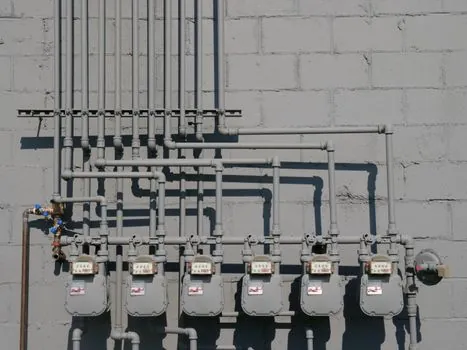
A pneumatic conveying line is a stack of discrete components: positive-displacement blower or vacuum pump, feeder (rotary airlock, flap valve, butterfly valve, or venturi eductor), conveying line (typically metal pipe with engineered elbows and ceramic-backed bends), receiver, and filter or cyclone separator [S2][S1]. Each component is selected against the same material profile, and mismatches between feeder and regime (a rotary airlock on a dense phase plug line) are a common source of failure [S4][S2].
Engineered elbows with replaceable ceramic or cast basalt liners are standard for abrasive service; a long-radius bend (commonly 5D to 10D radius) reduces particle impact velocity and extends elbow life in dilute phase plastic pellet service [S2][S4]. Filter receivers and bin vents on the receiving silo prevent dust emissions back into the packaging hall, which is a hard requirement in retail food and pharma-adjacent lines [S2][S9].
Instrumentation matters as much as the steelwork: differential pressure across the line, line temperature, and blower current are the minimum signals that let a control system catch a saltation drift before the line plugs, and the H&H design guide treats pressure and flow tracking as a stability requirement, not an option [S4].
Retail Distribution Use Cases: What Fits, What Does Not
For a packaging line receiving plastic pellets from a silo, dilute phase vacuum conveying at 15–25 m/s pickup velocity with a positive-displacement blower and a cyclone receiver is the typical configuration, giving clean transfer with low product damage and straightforward bag or box filling downstream [S2][S9].
For a sugar or salt repack operation handling friable crystalline material, dense phase pressure conveying at 5–10 m/s line velocity protects crystal integrity, reduces dust at the discharge, and is widely used for retail-grade sugar handling where fines generation degrives the customer-visible product [S1][S5].
For a dry milk or nutritional powder line feeding a retail carton erector and checkweigher, enclosed dilute phase with a high-efficiency filter receiver and gentle pickup is standard, and product quality guidance flags low-speed airflow as the lever that prevents compaction of fragile powders [S9]. The same hardware family is the foundation of food and beverage spec work, where sanitary piping, CIP capability, and filter hygiene override raw throughput concerns.
Where pneumatic conveying is the wrong pick: very high throughput (above roughly 50–100 t/h on a single line) and very long distances (several hundred metres) usually favor mechanical conveyors or a hybrid, because compressed-air energy cost scales with distance and solids ratio, and a mechanical belt or chain conveyor wins on energy per ton-kilometer at scale [S1][S2]. A different envelope, warehouse automation chain conveyors, is the right reference when the product is already cased or bagged and the conveying task is horizontal sortation rather than bulk transfer.
Selection Criteria Comparison for Retail-Duty Systems

Lining up the main options against four decision criteria that engineers actually quote in specs: dilute phase positive-pressure, dilute phase vacuum, dense phase pressure, and semi-dense phase, scored on friable-product suitability, abrasive-product wear, line length capability, and capital cost. [S1]
Dilute phase pressure: best for non-friable granules such as plastic pellets, salt, and whole grains; medium wear on bends because of high velocity; practical to roughly 300–500 m with intermediate blowers; lowest capital cost [S10][S2]. Dilute phase vacuum: best for clean-in-place retail food lines, dusty or hygienic duty, and short-to-medium runs from a truck or railcar to a silo; low leakage and good housekeeping; modest line length (commonly under 100–200 m) and limited by vacuum pump suction [S2][S1]. Dense phase pressure: best for friable powders, cohesive materials, and abrasive service where elbow life is the constraint; high solids-to-air ratio at low velocity (often below 10 m/s) reduces both attrition and bend wear; capital cost is higher due to pressure vessels and timers [S10][S1]. Semi-dense phase: a middle ground when full dense phase is over-spec but dilute phase attrition is unacceptable; medium capital cost, medium line length [S10].
For retail distribution the typical answer is dilute phase vacuum from receiving to silo, then dilute phase pressure or dense phase from silo to packaging depending on product friability, and that two-stage topology shows up across the engineering guides [S2][S9]. The same regime logic underpins pharma-grade dense versus dilute selection, where the criteria list is similar but the dominant constraint shifts to cleanability and validation.
Failure Modes, Limits, and Engineering Safeguards
The three dominant failure modes in pneumatic conveying are saltation (particles drop out of suspension and form a moving bed that can plug the line), slug collapse (a dense phase plug breaks apart and chokes the receiver), and bend wear (elbows erode first, often on the outside radius) [S4][S1]. Designing the operating point comfortably above the saltation velocity (or comfortably below it for dense phase) is the single most effective control, and running at the carrying peak guarantees turbulence and plugs over weeks, not years [S4].
Moisture-related caking in hygroscopic materials (sugar, salt, certain plastic resins) is a frequent retail-line failure; pre-drying, dehumidified conveying air, and insulated lines are documented countermeasures rather than optional extras [S5]. For cohesive powders, controlled pickup sections, air-assisted feeding, or mechanical vibrators on the feed hopper prevent the ratholing that causes surge events and downstream elbow damage [S4][S2].
Capital cost versus total cost of ownership is the recurring trade-off: a system with a higher upfront cost (dense phase, ceramic-lined elbows, PLC-controlled pressure regulation) generally has lower energy and maintenance cost over a 10–20 year life, and engineers are advised to evaluate running cost, not purchase price, when comparing bids [S5][S2]. For abrasive service, a defined wear inspection interval on the first elbow downstream of the feeder (commonly a 90-day visual and 12-month ultrasonic thickness check) is the routine that separates a reliable line from a chronically failing one [S4].
Trackable signals to watch on the 6–12 month horizon: revised ATEX and IEC 60079 zone classifications for new retail-packaging halls handling combustible dusts, and incremental adoption of PLC-integrated differential pressure and line temperature monitoring as a standard specification on new builds rather than an upgrade option [S4][S1].
For the relevant spec sheets and selection criteria, see conveying, distribution cabinet, and power distribution.