
A pneumatic nail gun for landscaping is, at minimum, an air-driven fastening tool that uses 1-3.5 inch collated nails in either 15, 16, or 18 gauge formats, paired with a portable air compressor in the 2.5-6 CFM range at 70-120 psi [S2][S3].
Landscaping work crosses heavy framing (raised beds, pergolas, fence pickets) and fine finish (trim, lattice, screen panels) on the same job, which is why most field pros settle on a two-gun kit rather than one tool: a 15 or 16 gauge framing nailer for structural members, plus an 18 gauge brad nailer for screen, trim, and detail work [S1][S6].
Matching Nail Gauge to the Landscape Substrate
Gauge is the controlling variable: 15 gauge nails are the standard for thick trim and heavier landscape carpentry, 16 gauge nails are the most versatile size for general fastening, and 18 gauge (and higher) nails are reserved for fine detail, thin trim, and furniture-grade work [S1][S2]. For 3/4 inch base trim over a wood sub-frame, 16 gauge is typically the lowest acceptable thickness to avoid pull-out, while 15 gauge is the conservative over-spec for exterior trim where stainless or hot-dip galvanized fasteners are required [S3].
Outside diameter translates directly to holding power and split risk: lower gauge means a thicker shank, a larger hole, and higher withdrawal resistance, but a higher chance of splitting thin trim if depth-of-drive is not adjusted [S2][S3]. On cedar, redwood, or pressure-treated lumber common in landscape builds, splitting risk on 3/8 inch trim with 15 gauge is real, and orienting the chisel point perpendicular to the wood grain reduces it [S3]. For screen panels, lattice, and other thin stock, drop to 18 gauge brads to keep the surface intact.
Magazine Type and Nail Length Window for Site Work
Coil nailers use flexible wire-welded strings forming a round magazine, hold more fasteners per load, and fit into tighter spaces than straight-strip designs; strip nailers use paper, plastic, or wire-bound straight cartridges that distribute weight evenly and are easier to handle on long runs [S2]. For landscaping, coil framing nailers driving 2-3.5 inch nails dominate deck, fence, and pergola framing, while strip finish nailers in 15 gauge angled or 16 gauge straight cover trim [S2][S6].
Typical length windows by gun class, all directly from the buying guides: framing nailers use 2-3.5 inch nails; finishing nailers use 1/2-2.5 inch strip finishing nails; roofing nailers use 1-2 inch coil roofing nails; brad nailers use 18 gauge brads up to about 2 inches [S2]. A landscape crew rarely needs a dedicated roofing nailer, but if composite or asphalt cap shingles are involved on a pergola roof, a roofing coil nailer is the correct tool rather than improvising with a framing nailer.
Air Supply Requirements and Compressor Sizing
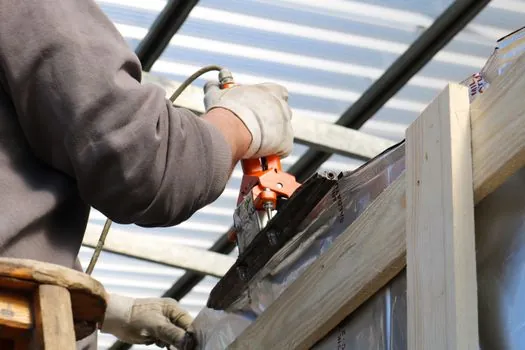
Pneumatic nail guns require a portable air compressor, an air hose, and the matching fittings, which is a different logistics chain from cordless nailers that trade air hose drag for battery swaps on power-intensive framing runs [S2][S4]. For a single framing nailer cycling 1 nail per second on a 2-3.5 inch fastener, plan on a compressor delivering at least 4-6 CFM at 90 psi with a tank large enough to recover between cycles; a pancake or hot-dog compressor in the 6-gallon class is the typical minimum, with a wheelbarrow-style 8-10 gallon unit preferred for fence runs where the compressor is moved hourly [S2].
Hose diameter matters more than most buyers expect: a 1/4 inch hose limits airflow and slows the recovery of the tool between shots, while a 3/8 inch hose preserves the CFM the nailer is rated for over runs of 25-50 feet. Quick-connect fittings, dry-fire lockout, adjustable depth-of-drive, and a directional exhaust are the four features that separate a jobsite-grade nailer from a homeowner unit [S2].
Comparison: Framing vs Finish vs Brad Nailer for Landscape Tasks
Side by side on the criteria a landscaper actually uses to choose, the three classes line up as follows. Framing nailer: 15-16 gauge, 2-3.5 inch coil or strip nails, heaviest in weight, correct for sleepers, joists, and fence framing. Finish nailer: 15-16 gauge, 1/2-2.5 inch strip nails, mid weight, correct for exterior trim, fascia, and stair risers where the head needs to set below the surface. Brad nailer: 18 gauge, 3/4-2 inch brads, lightest in the kit, correct for lattice, screen panels, thin trim, and picture-frame-style details around gate inserts [S2][S6].
The trade-off is always holding power versus surface damage. A 15 gauge finish nail has roughly 50% more shank cross-section than a 16 gauge and roughly twice that of an 18 gauge brad, which is why pros reach for the 16 gauge as the general-purpose compromise for interior and exterior trim and only drop to 18 gauge for material too thin to take the bigger fastener without splitting [S3].
Safety, Codes, and Fastener Specification Discipline

Each nailer has a manufacturer-specified fastener range, and substituting off-range nails is the single most common cause of jams, misfires, and dangerous double-fires [S2]. For exterior landscape work, fastener specification has to track the local building code and the treatment level of the lumber: hot-dip galvanized or stainless steel fasteners are required for pressure-treated lumber and cedar to prevent corrosion staining and fastener failure, and the nail packaging must be checked against the lumber treatment rating before the gun is loaded [S2].
Trigger discipline (sequential versus contact/bump) is the other variable that determines both speed and injury risk on a landscape site, where the operator is often working at odd angles, on uneven ground, or with one hand stabilizing a board. Most landscaping insurance carriers specify sequential-actuation tools for one-person operation, and the same tool often accepts both trigger modes with a swap of the trigger assembly.
When a Pneumatic Nailer is the Wrong Tool
Pneumatic nailers are wrong for sites without a compressor, wrong for fast-paced finish work where dragging a hose slows the crew below the cadence of a battery tool, and wrong for fastening into masonry, concrete, or steel landscape anchors [S2][S4]. For those edge cases, a cordless framing nailer using a fuel cell and battery, a rotary hammer with the right bit for concrete sleeper anchors, or a circular saw sized for landscaping timber is the correct tool pairing rather than a workaround with a pneumatic nailer.
The typical two-gun landscape kit (one 15 or 16 gauge framing nailer, one 18 gauge brad nailer, a 6-10 gallon compressor, a 3/8 inch hose at 50 feet, and a matched fastener stock in hot-dip galvanized or stainless) covers raised beds, pergolas, fences, screen panels, and trim without overlap. The next trackable decision point is matching the compressor CFM rating to the highest-demand tool on site (often a coil roofing nailer if the project includes a shingled pergola roof), and confirming the fastener spec against the local code for treated lumber contact.
For component-level specifications, see pneumatic nail gun, pneumatic, and pneumatic actuator.