
Stud welding on masonry and concrete-anchored plate jobs resolves to two process families per ISO 14555: drawn-arc stud welding (DAW) for M6-M24 structural anchors and capacitor-discharge (CD) for M3-M10 light-gauge attachments such as insulation pins and HVAC hangers [S2][S3].
Both families produce a full cross-section fusion bond in a single automatic arc cycle, but their heat input, equipment cost, and masonry fit differ sharply, and a wrong pick either burns through the thin sheet behind a furring channel or under-welds a 19 mm shear connector on a concrete embed plate [S2].
Masonry Anchor Classes and Which Stud Welder Band Fits
Masonry fastening divides into three working bands that line up with DAW current ratings and stud diameter [S3]. Light work covers insulation pins, lath attachments, and thin furring channel through M10, paired with 300-800 A DAW power or 500-2000 Ws CD banks. Mid-range covers M10-M16 anchors for CMU walls, brick-tie plates, and façade brackets at 800-1600 A and 200-500 ms weld time. Heavy work covers M16-M24 concrete anchors, bridge-rail posts, and structural embed plates at 1600-3000 A and 600-1000 ms weld time, where liquid-cooled torch cables become mandatory above 2000 A [S3]. The base-metal gauge controls which band is even admissible: CD on 0.6-1.5 mm sheet avoids burn-through, while DAW on plate under 1/4 in. tends to blow through or leave porosity.
For thin masonry-anchored sheet such as galvanized drip edge, duct hanger strap, or aluminium cladding clips, the stud welder entry confirms CD limits stud size to roughly M3-M10 and stores 500-2000 Ws for entry units, 2000-6000 Ws for mid-range, and above 10000 Ws for M12 gap-arc work [S2][S3].
Spec Sheet Numbers That Drive Masonry Selection
Four datasheet numbers decide whether a unit is honest or marketing [S3]. Welding current band (300-3000 A) must cover your stud diameter; open-circuit voltage on DAW sits at 70-110 V DC before the contactor closes and collapses to 18-30 V once the arc strikes. Duty cycle at rated current separates production-grade from benchtop units, and stored energy in watt-seconds (Ws) or joules replaces current on CD models. A datasheet without a current-vs-diameter table is a red flag for heavy masonry anchor work, because M20 weld parameters at 1500-2000 A and 600-1000 ms cannot be inferred from a peak-amp headline [S3].
Open-circuit voltage matters on masonry because field power is often a generator with a 5-10% voltage dip, and DAW at 70-110 V tolerates this while CD at lower trigger voltages can misfire on weak generators [S3]. For masonry site work where the operator runs off a portable genset, an inverter power source with a wide input voltage window outperforms a legacy transformer-rectifier stack.
Comparison of Process Options Against Four Masonry Criteria
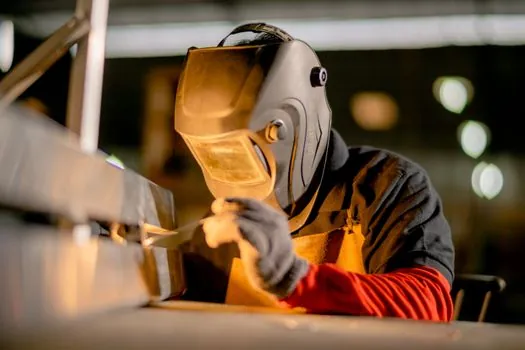
The four masonry criteria that actually move a decision are stud diameter, base-metal thickness, cosmetic back-side marking, and ambient site conditions. Drawn-arc with ceramic ferrule handles M6-M24 on 1/4 in. plate or thicker, leaves a ferrule ring residue that must be chipped off, runs at 100-1000+ ms arc time, and tolerates field dust with a gas shroud option. Capacitor-discharge handles M3-M10 on 0.6-3 mm sheet, leaves almost no back-side marking, fires in 1-6 ms, and tolerates coated or galvanized stock. Short-cycle drawn-arc sits between them and suits mid-range diameters on automotive and light structural brackets. Gap-arc (a CD sub-mode) reaches M12 on thicker stock when stored energy climbs above 10000 Ws [S2][S3][S4].
Weld time and current pair tightly with stud diameter. M6 drawn-arc typically runs 100-150 ms at 400-600 A; M12 jumps to 300-500 ms at 900-1300 A; M20 sits at 600-1000 ms and 1500-2000 A; M24 and beyond exceed 1000 ms and approach the upper current limit of the power source [S3]. Mild steel studs (ISO 13918 property class 4.8) are the easiest to weld; stainless A2-50 and A4-80 add a 10-15% current penalty and tighter time control to avoid porosity; aluminium requires DC-only supplies with a reverse-polarity option and a shielding gas adapter, and is rarely specified on masonry [S2][S3].
Who a Masonry-Grade Stud Welder Is For, and Who It Is Not
It is for refractory and furnace-lining installers welding high-temperature alloy studs inside furnace interiors, structural contractors fastening shear connectors and embed plates on concrete, marine yards attaching hatches and covers, and HVAC fab shops bonding insulation pins to thin aluminium panels [S1][S4]. The Delta Stud Weld product line and similar OEM ranges explicitly position ARC systems for structural fastening and high-temperature alloy applications, with rapid-fire CD units reserved for thin-gauge assemblies [S1].
It is not for a tile setter who needs three pins in a bathroom, a DIYer who wants to mount a shelf bracket, or any job where the base material is brick or block by itself: stud welding fuses the stud to a metal substrate, so the substrate must be steel or aluminium plate, not the masonry itself. For pure masonry drilling, a circular saw for masonry or a demolition hammer for plumbing chases is the right tool, because stud welding does not drill and does not bear on aggregate. The stud is welded to the steel embed plate that is in turn anchored into the masonry by mechanical expansion or chemical adhesive.
Real Use Cases Lined Up Against Equipment Class
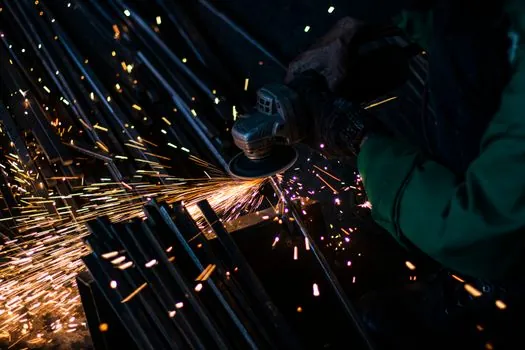
Insulation pin attachment on HVAC duct and boiler shell is the textbook CD application: M3-M6 pins on 0.6-1.2 mm galvanized or aluminium sheet, 500-2000 Ws stored energy, weld cycles under 10 ms, and no cosmetic concern on the air side [S4]. Brick-tie and CMU wall anchor plate fastening on thin galvanized plate is the textbook short-cycle DAW application, where heat input must stay low to avoid burning through the zinc coating. Heavy M20-M24 embed-plate anchor work on bridge piers and concrete columns is the textbook heavy DAW application, requiring 1600-3000 A power, liquid-cooled torch cables above 2000 A, and a documented current-vs-diameter table on the datasheet [S3].
WeldingMart stocks 22 stud welding gun models across DAW and CD, and same-day shipping is available for orders placed before 3 PM CT, with free freight above $99 [S4]. This kind of distributor depth matters for masonry contractors who need a replacement gun on site within 24 hours, because a single failed gun can shut down a shear-connector pour.
Limitations, Failure Modes, and What the Standards Demand
Stud welding has three recurring failure modes on masonry-adjacent work: porosity from zinc coating vaporizing on galvanized plate, under-penetration on dirty or painted base metal, and stud shear when weld time is set too short for the diameter. ISO 14555 and AWS D1.1 Clause 7 require that the actual stud-base-process combination be qualified by bend, torque, or tensile test before production, and the ceramic ferrule must match the stud diameter per ISO 13918 [S2]. The stud-base combination dictates the process: carbon and structural steel defaults to drawn-arc with class 4.8 studs; thin or galvanized steel wants short-cycle or CD with class 4.8 studs and a porosity caution; stainless uses drawn-arc or CD with A2/A4 grade studs matched to the parent metal and heat input limited; aluminium uses CD with aluminium studs and an oxide-film caution on narrow current windows [S2].
Duty-cycle derating is the silent killer on production masonry jobs. A 1500 A unit rated at 30% duty cycle drops to roughly 775 A continuous, which is below the M16 threshold and forces weld-time extension that itself risks porosity. Air-cooled DAW cabinets with finned transformer stacks are standard below roughly 1500 A; liquid-cooled secondary loops are mandatory on the heavy M20-M24 concrete-anchor class [S3]. The encyclopedia masonry insulation page covers how stud-welded pins tie into masonry insulation systems, where CD is the default for clean, low-heat attachment.
Sourcing, Standards, and One Verifiable Next Step

Selection for masonry is governed by ISO 14555 (the process standard), ISO 13918 (the stud and ferrule standard), AWS D1.1 Clause 7 (the structural welding code covering stud welding to structural steel), and IEC 60974-1 (the welding power-source safety standard) [S2]. Delta Stud Weld, Studfast, Jinda, and the WeldingMart distributor catalog all reference these standards directly, with Delta specializing in domestically sourced mild and stainless studs and rapid design-to-delivery cycles for refractory and field installation work [S1][S3][S4].
Trackable signal for the next buying cycle: confirm whether your shortlisted power source publishes a current-vs-diameter table for at least the M6, M12, M16, and M20 rows, and whether the gun is rated for the cable length your masonry site actually requires. Long cable runs on DAW need heavier conductors to hold arc voltage at the gun, and a 50 ft run on undersized cable can drop enough voltage to under-weld an M16 anchor on the top floor of an embed-plate pour [S3][S4]. If those two datasheet items check out and the duty cycle at your target current is at least 30%, the unit will hold up on masonry anchor production.
The underlying component specifications are covered under arc welder.