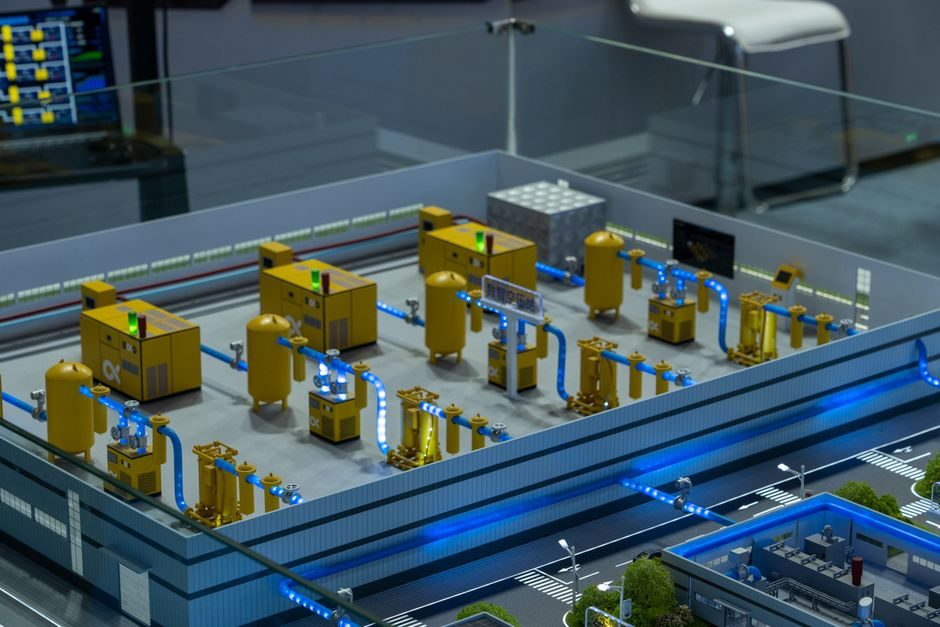
The pneumatic value chain runs from steel mills and aluminium smelters through forging and extrusion shops into cylinder, pneumatic actuator, pneumatic fitting and pneumatic silencer OEMs, before reaching end-users in automotive assembly, food/beverage packaging, pharmaceutical manufacturing and general factory automation [S2].
Compressed-air systems account for roughly 10% of industrial electricity consumption in manufacturing economies and about 25% of that energy is lost to leaks and pressure drop in the distribution network [S2]; the upstream supply map that feeds that network is now tracked in structured form across 5,154 industry nodes in the Wind dual-chain database [S4].
Upstream Tier 1: Carbon Steel, Aluminium and Stainless Billet Supply
Cylinder barrels, end caps and rod housings draw heavily on cold-drawn seamless carbon-steel tube to ISO 4394-1 and EN 10305-1 dimensional classes, with typical 20-100 mm bore, 2-5 mm wall and tolerances on OD of H8-H9; comparable cost-driven demand flows into carbon steel suppliers serving pneumatic fabricators [S2].
Aluminium alloy 6061-T6 and 6063-T5 dominate small-bore actuator bodies and pneumatic tubing where weight matters, with 6063 drawn tube supplied in the 6-25 mm OD range and 1-2 mm wall; stainless 304/316 is reserved for hygienic and offshore service classes [S2]. Forged brass C36000 and cast iron FG260 remain the standard body materials for pneumatic fitting bodies, with the global brass fittings segment running on thousands of CNC machining cells in coastal China and Vietnam [S2].
Upstream Tier 2: Seals, Coils, Springs and Sub-Components
Nitrile (NBR) and polyurethane (AU/EU) compounds hold 70-80% of the pneumatic rod-seal and piston-seal volume because they cover the -20 to +80 °C band most actuator duty cycles demand; FKM (Viton-class) fluoroelastomer is specified above 120 °C or where synthetic lubricants and aggressive fluids are present, while silicone and EPDM cover low-temperature and food-contact duties [S2].
Compressed-air filtration elements use borosilicate glass-fibre media to ISO 8573-1:2010 classes 1.-.1 to 6.-.6 (solid / humidity / oil), and a typical 0.01 µm coalescing element is paired with a 1 µm particulate pre-filter to extend element life; solenoid valve bodies use brass or 304 stainless, with coil insulation classes F (155 °C) and H (180 °C) dominating 24 VDC and 110/230 VAC control circuits [S2].
Midstream: Compressor, FRL and Valve Assembly Nodes

The midstream node converts the raw materials above into saleable systems: oil-injected screw compressors (7-13 bar, 5-500 kW) and oil-free tooth/scroll units (8-10 bar) feed refrigerated, desiccant and membrane dryers sized to the plant's ISO 8573-1 purity target, which then deliver to a filter-regulator-lubricator (FRL) train that typically drops line pressure 0.5-1.0 bar and filters to 5-40 µm before the work loop [S2].
Directional-control valves split into ISO 5599 (size 1-4, up to 1450 l/min) and ISO 15407-1 (size 02, 16 MPa) plate-mounted standards, with NAMUR mounting on 1/4-turn valve actuators; fieldbus protocols on valve manifolds have moved decisively toward IO-Link and PROFIBUS/PROFINET for new installations, while 4-20 mA plus HART remains the default for proximity sensor feedback on cylinder position [S2].
Downstream Demand: Automotive, F&B, Pharma, Electronics
Automotive welding and assembly lines are the single largest end-user, typically consuming 0.3-0.6 m³/min of compressed air per robot for clamping, ejector and pin-stroke duty, with tier-1 suppliers running ISO 8573-1 class 6.4.4 at the tool drop; food and beverage lines use 304/316 stainless cylinders to 3-A sanitary standards, with stroke counts commonly 5-10 million cycles per year on bottling and capping heads [S2].
Pharmaceutical clean rooms require oil-free compressors to ISO 8573-1 class 1.2.1 or better, with stainless contact surfaces electropolished to Ra ≤0.4 µm; electronics and semiconductor fabs run class 0 oil-free air for tool actuation and blow-off, and the broader factory-automation sector ties pneumatic actuators directly to PLC outputs via I/O blocks or, on premium lines, via pneumatic actuator bus terminals that share the same backplane as the proximity and photo-electric sensors [S2].
Material Comparison for Pneumatic Cylinder Barrels
Engineers selecting a barrel material on a 2026 build usually compare four candidates across three decision criteria: cost per kg of finished tube, maximum allowable working pressure at 25 °C, and corrosion resistance to common plant fluids (water, detergent, cutting fluid). The banded comparison is: cold-drawn seamless carbon steel (lowest cost, 10-16 bar MAWP at 25 mm bore, poor corrosion — needs plating or painting); aluminium 6063-T5 (2.5-3.5x steel cost per kg, 8-10 bar MAWP, good resistance to mild detergents); stainless 304 (5-7x steel cost, 8-12 bar MAWP, good resistance to water and weak acids); stainless 316L (6-9x steel cost, 8-12 bar MAWP, best resistance to chlorides and CIP chemicals) [S2].
For pneumatic cylinder rod ends, hard-chrome-plated carbon steel remains the cost default at 50-100 µm chrome and Ra 0.05-0.20 µm surface finish; 17-4PH and 316 stainless rods enter the spec where washdown or salt-spray exposure is routine, with cost multipliers of roughly 3-5x and 6-9x over plated carbon respectively [S2].
Limitations, Failure Modes and What Pneumatics is NOT For
Compressed-air systems are not the right tool where net energy efficiency dominates: at 6 bar and 100 l/min a pneumatic cylinder delivers roughly 5-25% of the input electrical energy as useful work, with the rest lost to heat of compression, leaks and aftercooling, so high-cycle motion-control axes on machine tools and EV battery lines have moved toward servo-electrical actuators [S2].
Standards, Sourcing Signals and Tracking Nodes

Design and procurement engineers should anchor specs to the following non-negotiable standards: ISO 6432 (10-25 mm bore mini cylinders), ISO 15552 (32-320 mm bore profile cylinders, replaces the withdrawn ISO 6431), ISO 21287 (compact short-stroke cylinders), VDMA 24563 (dimensional compatibility for FRL units), and ISO 8573-1:2010 (compressed-air purity classes); ATEX 2014/34/EU and IECEx govern pneumatic equipment in Zone 1/2 hazardous areas, with non-sparking brass and conductive hose assemblies required for Group IIB/IIC gas atmospheres [S2].
Trackable signals over the next two quarters: the Wind dual-chain database covers 5,154 industry nodes and 160,000+ upstream-downstream relationships and is updated continuously [S4]; cylindrical roller and tapered roller bearing demand (the adjacent motion-control supply chain mapped in the Bearing Upstream and Downstream Industries 2026 report) is a useful leading indicator for pneumatic actuator output because the two share the same steel, forging and CNC-machining subcontractor base.