Polycarbonate (PC) is the only general engineering thermoplastic that pairs >90% light transmittance with inherent UL-94 V-2 flame retardancy, and the only transparent marine-grade plastic that routinely achieves IEC 62262 IK08 to IK10 impact ratings (5 to 20 J) [S3][S2].
That same combination is what makes it the default lens and guard material on coastal luminaires, instrument windows, and machine enclosures, but the same resin family also fails predictably in alkaline wash-down, sand-laden air, and unvented high-humidity compartments [S2][S5].
What "marine-grade PC" actually means: the three variants that matter
Industrial PC is sold in three marine-relevant variants whose behaviour diverges sharply in service [S5]. Standard PC is a fully transparent, easy-to-machine thermoplastic suited to indoor enclosures, sight glasses, and prototype guards. UV-stabilized PC adds UV absorbers that suppress the yellowing and embrittlement that otherwise appear within 12-24 months of direct sunlight on standard grades. Hard-coated (scratch-resistant) PC carries a surface coating that raises abrasion resistance and improves chemical resistance to alkaline cleaners, with the trade-off that the coating can be damaged by mechanical abuse and is not field-repairable [S5].
For a vessel or offshore platform, the default specification should be UV-stabilized PC for any sun-exposed part, and hard-coated PC where cleaning crews use alkaline detergents or where wind-blown sand is chronic [S2][S5].
PC versus the other engineering plastics on a marine spec sheet
PC competes with nylon (PA), acetal (POM), PTFE, and acrylic (PMMA) for marine jobs, and the choice is rarely about a single property [S4][S2]. PC wins on impact and optical clarity, absorbs only 0.2-0.4% moisture by weight (versus nylon, which can move dimensions significantly with humidity), and holds rigidity up to about 140°C with toughness down to roughly -20°C [S7][S2]. Against acetal, PC loses on wear and chemical resistance; against PTFE, PC loses on continuous-use temperature and chemical resistance; against PMMA, PC wins on impact but loses on surface hardness and alkaline resistance [S4][S2].
For reference, the documented property spread for marine lens duty is: PC IK08 to IK10 (IEC 62262), Rockwell M 70-75, 0.2-0.4% moisture absorption, ~88-90% initial light transmission; PMMA IK02 to IK05, Rockwell M 85-105, 0.1-0.2% moisture absorption, ~92% initial light transmission [S2].
Selection criteria by marine application
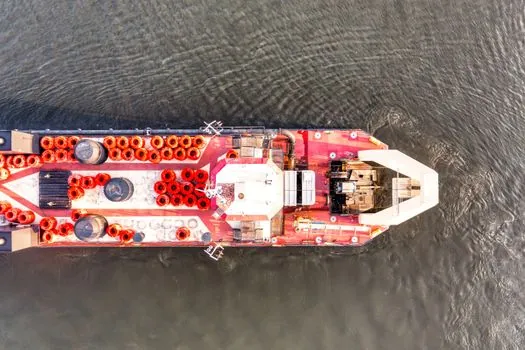
For marine instrument windows, port lights, and bridge enclosures, the controlling criteria are optical clarity, impact rating, and UV stability; specify UV-stabilized PC with at least IK08, and budget for visible micro-scratching within 6-12 months on sand-exposed decks unless a hard coat is applied [S2][S5].
For marine lighting lenses, the same impact-first logic applies, but pair the IK rating with a documented chemical-resistance note: standard PC fails in pH 10-12 alkaline cleaners, so a hard coat is mandatory on any fixture washed down with shipboard detergents [S2]. For internal valve and pump covers, marine valve assemblies on engine rooms, transparent PC is increasingly used for visual leak indication; here, the constraint shifts to flame retardancy, where the UL-94 V-2 base rating may need to be upgraded to V-0 via organic phosphorus, sulfonate, organosilicon, or nano-additive packages if the application sits inside a photoelectric safety enclosure [S3].
For HVAC plenums and marine HVAC housings, transparent PC is rarely the right pick because the surface is exposed to alkaline cleaning and continuous airflow dust; opaque, glass-filled PC or a coated variant is more typical, and the moisture-absorption figure (0.2-0.4%) is small enough not to distort housings if vents are designed in [S2].
Where PC is the wrong material
Standard PC is not a sliding or wear surface: continuous bearing or cam action belongs on acetal, nylon, or PTFE, not on PC, which will gall and generate fines [S4]. PC is also the wrong choice for unvented luminaires in 80-95% humidity compartments; the same 0.2-0.4% moisture absorption that keeps PC dimensionally stable in normal air will fog the inside of a sealed lens if no desiccant or breather path is provided [S2]. In pH 10-12 alkaline wash-down zones (engine room bilges, food-prep decks, car-wash-style cleaning bays), standard PC will stress-crack long before acrylic, so the design choice inverts in favour of PMMA or hard-coated PC [S2].
Finally, do not specify PC where the application is an industrial PC control cabinet on a hot engine room header; sustained temperatures above ~115-120°C approach the upper end of the resin's useful range, and a glass-reinforced polyamide or PSU is the safer call [S7].
Flame retardancy and the V-0 transparent problem
Because unmodified PC already carries a UL-94 V-2 rating, the next step up, UL-94 V-0 with retained >90% transmittance, is the active development frontier and is documented in the 2025 review by Xie et al. [S3]. Conventional brominated or high-loading phosphorus additives degrade optical clarity; the active research directions are organic phosphorus flame retardants, sulfonates, organosilicon systems, and nano-additives, all evaluated for interfacial compatibility with the PC matrix [S3].
For a marine specifier, the practical takeaway is: if the supply chain offers a "transparent V-0 PC," confirm the additive system on the datasheet, because the same flame-retardant package that pushes the resin to V-0 will determine its UV ageing, smoke density, and chemical resistance downstream [S3].
Processing and tolerance notes for marine fabricators
PC machines cleanly by sawing, drilling, milling, and thermoforming, and thin gauges can be cold-bent to give designers tolerance for hull curvature [S5]. The resin is recyclable by remelting, which matters for ship-recycling compliance, and its density is roughly half that of glass for the same optical function, so weight-driven marine retrofits (bridge windows, deck enclosures) often use PC as a direct glass replacement [S5][S7].
Standard machining best practice is to anneal thick sections before trimming to avoid internal stress, and to leave draft angles on molded parts because PC's coefficient of thermal expansion is higher than glass or metal inserts; this is a routine driver of engineering plastic design choices across marine and offshore work [S5].
Marine-relevant engineering plastics at a glance
On the four criteria that most often drive a marine material call, the practical comparison is: Polycarbonate (PC) - high impact (IK08-IK10), moderate hardness (Rockwell M 70-75), moderate moisture pickup (0.2-0.4%), good alkaline resistance only with hard coat; Acrylic (PMMA) - low impact (IK02-IK05), high hardness (Rockwell M 85-105), low moisture pickup (0.1-0.2%), good alkaline resistance to pH 9-12; Nylon (PA) - good toughness, high moisture absorption (can move dimensions), poor UV stability unless black-filled; Acetal (POM) - good wear and chemical resistance, opaque, limited impact vs PC; PTFE - best chemical and temperature resistance, low strength, expensive [S2][S4].
The intersection of impact + transparency is the PC niche; outside that box, the marine selector should default to the material that owns the limiting property (acetal for wear, PMMA for alkaline + clarity, PA for tough opaque parts, PTFE for chemical service) [S2][S4].
Trackable signals over the next reporting cycle: (a) new transparent V-0 PC grades reaching commercial datasheets, building on the additive chemistries catalogued in Xie et al. 2025 [S3]; (b) hard-coated PC lapping the IEC 62262 IK10 boundary while sustaining >88% transmittance after 2,000 h QUV exposure, a benchmark that the polycarbonate marine-lens supply chain has been chasing since 2025 [S2][S5].
Related analysis: Cast Iron Selection for Rail Castings: Ductile vs Gray vs Malleable vs Steel.