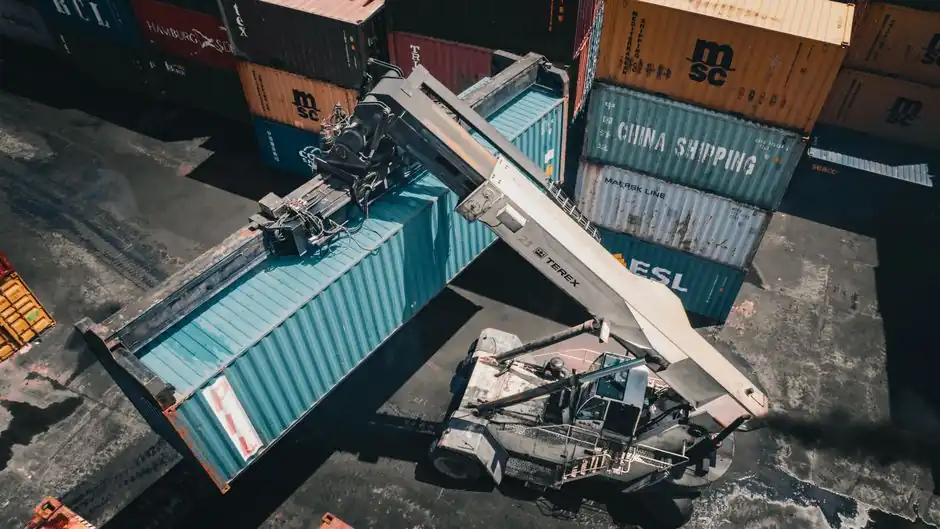
VLMs for ports and intermodal terminals are a distinct spec gate from automotive or general-warehouse builds because of salt-laden air, mixed SKU sizes, and 24/7 shift patterns that compress cycle budgets [S1].
The global VLM market reached US$950.19 Mn in 2024 and is forecast to grow at 9.7% CAGR to US$1,766.08 Mn by 2031, with the dual-level delivery segment holding 65.3% of that base [S1]. Dual delivery, not single, is the practical default for any port yard where one bay is dedicated to inbound and the other to outbound.
Scope and What Counts as a Port-Logistics VLM
A port-logistics VLM is an enclosed two-column vertical lift module used inside CFS (container freight station) sheds, bonded warehouses, or inland dry-port terminals to store spare parts, ship chandlery, PPE, tooling, and customs-sealed SKUs. The enclosure protects goods from dust, theft, and, critically, the salt-laden air that blows inland during container handling. [S1]
Top VLM OEMs in 2026 are Daifuku Co Ltd, Kardex Holding AG, Mecalux SA, Autocrib Inc, SSI SCHAEFER Group, Bastian Solutions LLC, Modula GROUP, Hänel GmbH & Co. KG, White Systems, and Weland Solutions AB, all offering scalable systems with WMS/ERP hooks [S1]. Modula alone claims 20,000+ clients worldwide and 25% YoY growth across the last five years [S4].
Selection Criteria Specific to Port Environments
Coastal and dockside air forces an IP54 minimum on the VLM cabinet, with IP65 preferred when the unit sits within 200 m of a quay or open container stack, because salt fog and sea mist routinely reach far past the wharf edge. Thomson linear motion components, which feed the extractor carriage on most OEM VLMs, are themselves REACH, RoHS, and ISO/AS certified for industrial material-handling duty [S2].
Tray payload, not bay count, is the constraint that drives sizing for ports: marine chandlery, life-jacket cartons, and mooring-line spools often hit 800–1,200 kg per tray, so a 1,000 kg/tray minimum rating is the practical floor. European builds dominate the 2024 market at a 37% share because of high space cost per m² and stricter indoor-air handling rules [S1].
Cycle time targets in port logistics should sit at 25–30 s per pick in single-extractor mode and 18–22 s in dual-extractor mode, the throughput envelope the dual-delivery segment is engineered around [S1]. For 60+ picks/hr, dual delivery plus an external WMS queue is the only realistic configuration.
Comparison of VLM Options by Decision Criteria
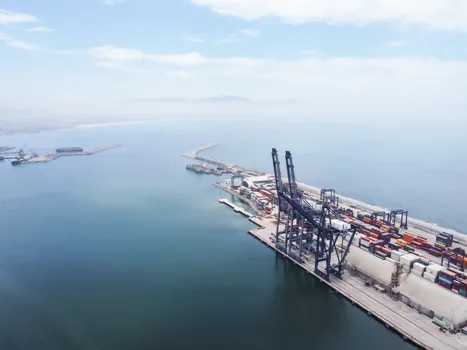
Three VLM configurations compete for port-logistics spend: single-level delivery, dual-level delivery, and VLM-plus-AGV hand-off. The decision criteria that matter are salt-air protection, peak picks/hr, and footprint recovery, all of which intersect with the linear module drive train the OEM selects. [S1]
Single-level delivery VLMs are the lowest-cost option, with throughput capped near 35–40 picks/hr, which fails most 24/7 CFS windows. Dual-level delivery, the 65.3% market-share configuration in 2024, doubles the bay count and pushes throughput to 70–90 picks/hr while keeping footprint flat, which is why it is the de-facto port spec [S1]. VLM-plus-AGV hand-off adds an autonomous trolley to extend picking beyond the cabinet but introduces extra PLC and wireless module integration work, suiting only large bonded-warehouse operations with stable tote SKUs.
On cost-to-throughput, dual delivery wins per pick when pick rates exceed 60/hr; below that, single delivery returns better capex per pick. On salt-fog endurance, all three inherit the OEM cabinet rating, so a 316L stainless or marine-epoxy column is what actually moves the needle, not the delivery architecture.
Integration Constraints: WMS, ERP, and Customs Seals
Port VLMs must hand off pick events to a bonded-warehouse WMS, a terminal operating system (TOS), or a customs declaration system, because every pick can affect a customs seal. Most OEMs expose a REST or OPC UA interface that the WMS polls on pick completion, with a fallback to discrete I/O wired through a remote IO module for legacy TOS stacks. [S1]
Inventory accuracy on dual-delivery VLMs typically exceeds 99.95% in published case data, and Modula customer feedback cites a 5-minute operator learning curve for a fresh hire on a dual-extractor bay [S4]. That accuracy figure is the same window customs auditors need for SKU-level reconciliation, which is why dual delivery, not just bay count, is the spec gate.
Failure Modes, Limitations, and When a VLM Is the Wrong Tool
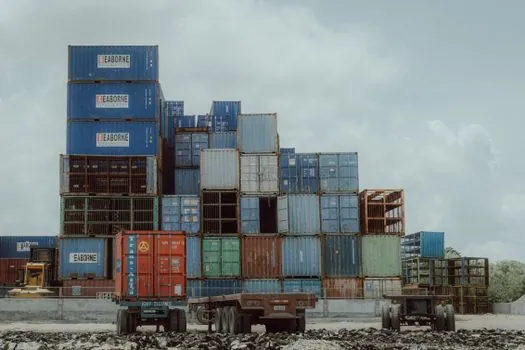
VLMs fail port duty when three conditions collide: outdoor mounting, sub-zero temperature swings, and humidity above 85% RH, because the extractor carriage, encoder, and load cell module on the lift platform drift outside their compensation curve. A VLM is also the wrong tool for bulk pallet storage; for full pallets, a yard crane or AS/RS crane is the correct answer, and a VLM is only justified when SKU count is high and footprint is the binding constraint [S1].
High preliminary capex and integration complexity are the two market-cited barriers to VLM expansion, and both bite hardest at smaller terminals [S1]. For sub-100 m² sheds, a horizontal carousels or mobile shelving will return better capex per pick than a VLM.
Standards, Sourcing, and Sizing Checklist
Spec sheets for port VLMs should anchor on IEC 60068-2-52 (salt-fog test methods) for enclosure validation, with the cabinet rating printed on the data plate. Lift-mechanism linear guides and ball screws typically carry ISO/AS certification and RoHS/REACH compliance, which Thomson documents for its own product line feeding VLM OEMs [S2].
A dual-delivery VLM with two 1,000 kg trays per column typically draws 8–12 kW peak, so a dedicated 32 A three-phase circuit is the right floor for a port-yard install.
Track the VLM selection spec map for automotive parts for an adjacent automotive-parts VLM baseline, and the broader vertical lift module buyer's map for non-port sector cross-checks. For a wider industrial material-handling context, the spec-driven buyer's map lays out the full decision tree.