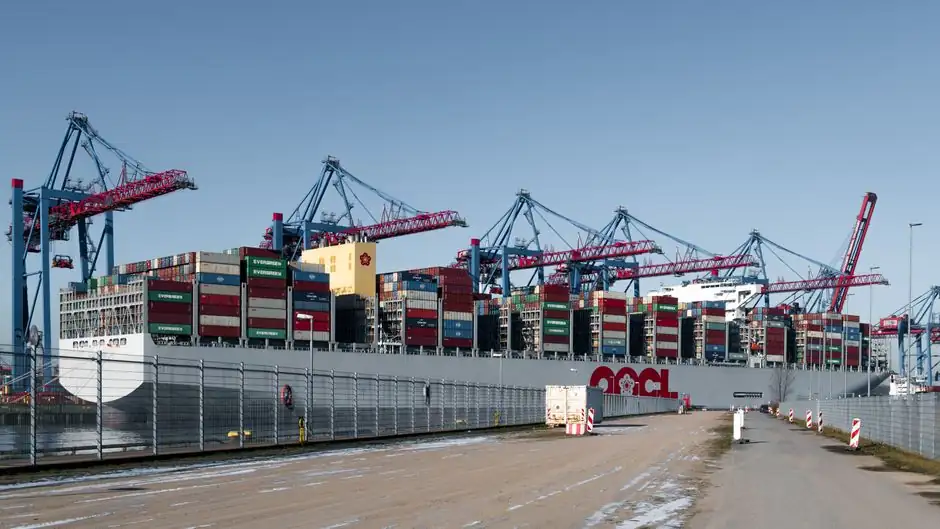
Port and terminal applications push a tower crane into a different envelope than a high-rise jobsite: low-to-medium lifts, wide-radius container or break-bulk work, and continuous cyclic duty under salt-laden coastal air.
Specifying the right unit starts with three concrete gates: max load and radius envelope, freestanding height versus tie-in capacity to a quay structure, and corrosion/duty class. A typical CMAX TC4808-class flat-top delivers 4 t max load, 0.8 t tip load at 48 m, 31.5 m independent height, and up to 110 m with wall attachments, with working ranges selectable at 38/43/48 m [S2].
Defining the Port Terminal Envelope: Quay, Yard, and Container Yard
Port terminal duty cycles cluster into three layouts, and the crane envelope must be sized to the worst case. Quay-side ship-to-shore towers typically need 30–50 m radius and 25–40 m under-hook height to clear hatch coamings and reach the apron. Yard container handling towers run shorter radius (20–35 m) but higher cycle counts, often 80–120 lifts per shift. Bulk or break-bulk terminals sit between the two, with 40–60 m radius, mid-range hook height, and frequent radius changes that demand stable trolleying performance. [S2]
For all three, the working range is set by the minimum and maximum radius, not just the headline jib length. The TC4808 spec lists adjustable working ranges of 38/43/48 m and a minimum working radius of 2.25 m, which lets the operator trim capacity loss at long radius when only a short reach is needed [S2]. A 4 t max / 0.8 t tip-load envelope fits most container yard and small quay work; heavier lift categories (8–12 t at shorter radius) are common where project cargo or steel coils dominate.
Selection Criteria: Capacity Curve, Height, and Cycle Time
Three numbers decide almost every port-tower purchase: the load-radius curve, the freestanding-to-tied height ratio, and the hoist/trolley cycle time. Capacity at the jib tip governs the maximum reach a container spreader or clamshell bucket can be served, and it falls off roughly linearly beyond the 2/3-radius point on most flat-tops. The TC4808 ships a three-speed hoist motor paired with a single-speed ratio reducer, giving heavy-load low-speed and light-load high-speed, which is the right architecture for mixed container/bulk cycles [S2].
Independent height matters because quays rarely accept wall ties above deck level. The TC4808 lists 31.5 m independent (freestanding) height before any wall attachment, with maximum attached height of 110 m using hydraulic jacking of standard sections [S2]. Standard mast sections in the 2.0–2.4 m module range let the tower climb section-by-section and keep transport on standard 40HQ containers, which simplifies spares logistics for multi-unit terminal fleets [S2].
Cycle time depends on hoist motor kw, trolley speed, and slewing rate. A typical 4 t-class port tower runs hoist line speeds of 60–100 m/min and slewing speeds near 0.6–0.8 rpm. Higher values shorten shift throughput but raise dynamic loads on the tie structure, so coastal terminals often derate to 0.5 rpm to limit fatigue in salt-air conditions.
Safety Stack: Limiters, Brakes, and Operator Cab Configuration
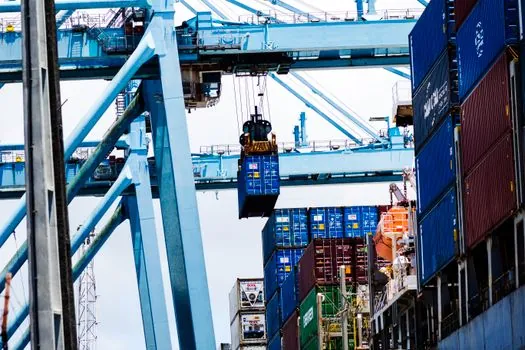
Mandatory limiters on a port-rated tower crane are non-negotiable, and the spec set is consistent across major OEMs. The TC4808 ships with five interlocks: lifting height limiter, trolley range-change limiter, moment (load moment) limiter, weight limiter, and slewing (circumgyrating) limiter [S2]. On port sites, the moment limiter and the anti-two-block on the hook block do most of the real work, because the worst failure mode is a two-blocked hoist on a container spreader at full radius.
Operator cab placement is part of the safety case, not a comfort item. The TC4808 sets the cab independently on one side of the tower for clear sightlines to the jib, trolley, and ground riggers [S2]. For unmanned or semi-automated yard work, cabs are replaced by camera-based man-machine interaction with PLC-driven control via WLAN, as documented in ICIRA 2017 work on wireless multi-controller operation [S5]. That path is gaining traction in greenfield automated container terminals where a remote operator can run 3–4 cranes from one console.
Duty Class, Wind, and Corrosion Considerations
Port cranes live in C3–C5 corrosion environments (ISO 12944 family) and in wind regimes that routinely exceed 20 m/s operating limit. Selection should anchor on hot-dip galvanised mast sections, 316L stainless on exposed fasteners, and epoxy-polyurethane topcoat systems rather than standard paint. Cab glass should be rated to the same wind load as the structure, and the anemometer must feed the moment limiter, not just an alarm. [S2]
Duty class drives structural sizing. A terminal running two-shift container cycles sits in FEM 1Am or higher, while intermittent bulk work can be specified at FEM 1Bm. Under-rating the duty class is the most common cause of premature slewing-ring wear, and it shows up as bolt looseness and pitch errors after 10,000 hours rather than as a single dramatic failure. For comparison, crawler crane selection on adjacent yard duties uses ground-pressure and travel-cycle logic that port towers avoid by being stationary.
Comparison: Port Tower vs Crawler Crane vs Mobile Harbour Crane
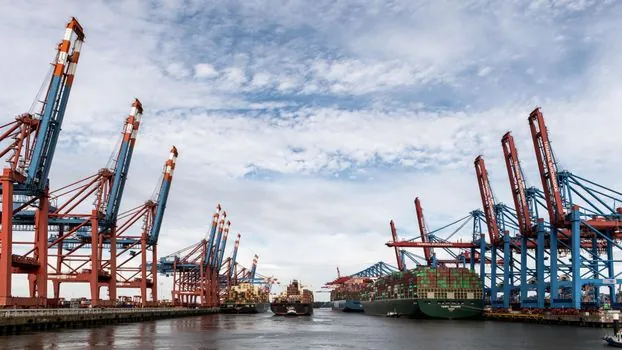
The right machine depends on radius, mobility, and cycle count, not on a single spec number. A port-tower crane wins on long radius at low-to-medium lift height, with the lowest installed cost per metre of reach. A crawler crane is the right pick when the load travels across a yard, the ground is firm, and the radius envelope shifts between bays. A mobile harbour crane (MHC) wins on ship-to-shore work with heavy lift, where telescopic boom and travel under load matter more than reach. [S2]
Three concrete decision criteria sharpen that choice. First, cycle count: above roughly 80 lifts per shift, fixed tower automation pays back faster than a mobile crane. Second, radius: above 45 m, tower crane tip-load economics beat MHC hourly rates. Third, footprint: a tower on a 4.5 m square base sits inside one container slot, leaving more stacking rows than a mobile unit. For a deeper look at how these gates map onto mining and heavy-civil sites, see the port and terminal spec map for tower cranes in 2026.
Vendor and Sourcing Reality (2026-08-12 snapshot)
Dealer footprints in North America in 2026 are anchored by regional specialists rather than OEM-direct sales. Forteza Equipo LLC operates as a tower crane, elevator, and generator dealer in Puerto Rico, partnered with Forteza Crane Rental, ATS, and Manitowoc/Potain for new Potain units such as the MC 310 K16 deployed on a San Juan jobsite [S1]. On the Canadian West Coast, Tall Crane Equipment runs roughly 140 operating cranes and hoists with 30 years of service history and 24/7 field response across BC [S3]. For Chinese-sourced flat-top units in the 4 t / 48 m class, the CMAX TC4808 from CNBM ships in 40HQ containers with 20–25 day lead time after deposit and T/T or L/C terms on the Okorder platform [S2][S4].
Lead times, payment terms, and minimum order quantity all feed the sourcing decision. Okorder lists a 1-unit MOQ and 5 unit/month supply capability for the TC4808, which is a useful gauge of single-unit availability versus fleet replacement runs [S4]. Buyers running multi-unit terminal upgrades should pin pricing on volume brackets before locking the spec, because the headline "ref price" on B2B portals is a starting point, not a contracted rate.
Who It Is For, and Who It Is Not For
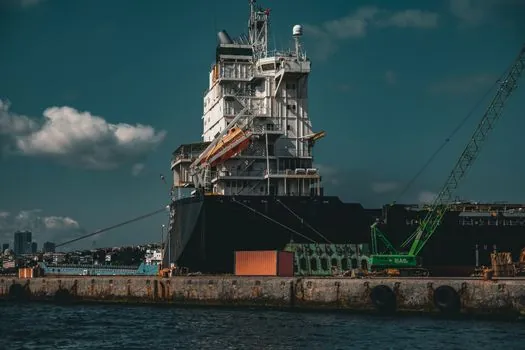
Port and terminal operators with fixed quay or yard geometry, two-shift container cycles, and a 25–50 m reach envelope are the natural fit. Specifying a 4 t / 48 m flat-top with 31.5 m freestanding and tie-attachment to 110 m covers most greenfield container yards and small break-bulk terminals [S2]. Operators with heavy-lift project cargo above 8 t at full radius, or with frequent re-positioning between berths, should look at mobile harbour cranes or crawler units instead.
Buyers chasing fully automated unmanned operation should treat the cab-less wireless architecture as a known research path rather than a standard catalog option, since most port sites still run a certified operator in the cab for fault response and shift handover [S5].
Track three signals over the next 12 months: the FEM duty class and ISO 12944 corrosion class stamped on new tender drawings, the proportion of new port-tower orders specifying wireless or remote operation, and any revision to the freestanding-height standard sections used by CNBM-class flat-tops. These three will mark whether the 2026 port-tower spec set is shifting toward higher cycles, longer autonomous runs, or simply more reach at the same 4 t class.
Detailed specification references: terminal block.