
Tower cranes sized 6-12 t at 45-70 m jib are the workhorses on 2026 highway and bridge-pier jobs, with topless flat-top and luffing-jib configurations replacing the older cat-head designs because they cut head height by roughly 3-5 m and remove the tie-cables that interfere with overhead rebar lifts [S1][S4].
Luffing-jib models such as the D2520 3 t and the D4522 in the 6-8 t, 45 m class are explicitly marketed for civil and infrastructure work, where the variable-angle boom lets multiple cranes work in overlapping radii without jib-to-jib collision [S1]. For heavier precast-girder or steel-truss erection on interchanges, the QTZ250 (PT6013) platform with L68B or L46 mast sections gives 12 t at 70 m and remains the most-cited Chinese OEM configuration in export catalogues [S1].
Topless flat-top vs. luffing-jib vs. cat-head: when each earns the spec
Topless flat-top cranes are characterised by not having a protruding horizontal head and not needing straps or jib ties, which lets a single crew swing over live traffic, suspended cable trays, and rebar stacks that would foul a cat-head's pendant lines [S4].
Luffing-jib cranes (D2520 / D4522 class) carry less load at full reach but allow tighter cluster layouts; on a constrained urban interchange with three cranes inside a 60 m radius, contractors usually mix one topless and two luffers to keep hoist ropes vertical [S1].
Older cat-head (hammerhead) cranes like the Potain MC200A on L68 mast sections remain common on long, linear road stretches where the project layout is a single straight track, because their higher trolley speed and lower purchase cost outweigh the head-clearance penalty [S1].
Self-erecting cranes and truck-mounted telescopic cranes (see truck-mounted crane selection for landfill operations for a contrasting duty cycle) are the right answer only when the road job is under 8 weeks or below 50 t peak lift; beyond that, the tower crane's lower cost per lift on rebar, formwork panels, and pier caps wins on total installed cost.
Four selection gates: ground pressure, free-standing height, jib reach, hoist speed
Ground-bearing pressure is the first gate on any road job, because the base slab or rail mat is rarely a structural foundation. A 12 t class tower crane with 70 m jib can impose 80-120 kPa under the chassis; on a 200 mm lean-concrete mat this means either a 1.2 m thick reinforced spread footing or a tied-down rail mat on engineered fill [S4][S6].
Free-standing height governs whether the crane needs tie-in collars to the pier shaft or to a gantry. Typical topless units in the 6-10 t class free-stand 40-55 m above the base before the first tie, which covers most elevated-expressway piers; once the pier height exceeds that, plan a tie at every 25-30 m of climb, anchored through the cantilever formwork system that the tower crane itself hoists into place [S2].
Jib reach is the third gate. For a 4-lane elevated road on a 28 m cross-section, the outer pier is roughly 14 m off centreline, so a 45 m jib clears the deck with margin; for a 6-lane or curved interchange, jump to 60-70 m so the hook can service the full deck without re-spotting the crane [S1][S8].
Hoist speed and dual-hoist capability matter for rebar cycles. A 2-fall main hoist at 80-100 m/min plus a 4-fall auxiliary hoist at 40 m/min is the common 2026 OEM split; for rebar-cage work, the auxiliary hoist's lower speed is actually preferred because it cuts swing on the 12 m vertical lift [S1].
Foundation, mast, and tie-in: the engineering that decides go/no-go
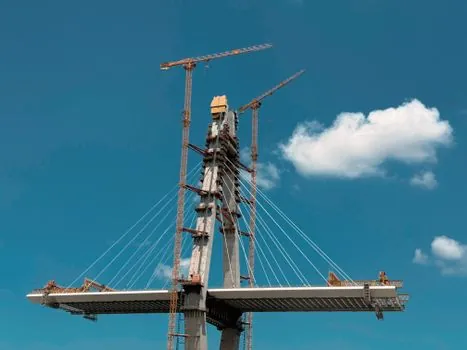
Foundation design follows either EN 13001 for European-built units or the OEM's own anchor-bolt template; the mast is normally L46 (1.6 x 1.6 m, 46B designation) for the 6 t class and L68 (2 x 2 m) for the 12 t class, with bolted flange connections rated for 600-800 kN vertical per corner [S1][S6].
For pier work, the crane often sits on a cross-rail mat that lets it be "walked" between pier positions by hydraulic jacks; FOIN and other Chinese OEMs confirm that their 6-12 t range can be supplied with internal climbing frames and base frames matched to jacking-stroke rails, which avoids a 200 t mobile-crane assist on every reposition [S8].
The tie-in collar is the link the spec writer most often under-engineers: it has to transfer both the horizontal shear from jib slewing and the moment from out-of-service wind loads on the 70 m boom, so it must be designed with the structural team, not handed off to the crane supplier as a generic "one tie per 25 m" rule [S2][S3].
Standards, certification, and the ISO 9001 / CE baseline
All major Chinese OEMs in the 2026 export catalogues (HYCM, Potential Industries / Anka, FOIN) ship with ISO 9001 quality system certification and CE marking on the machinery directive, and the tower-crane model line is built to FEM 1.001 / EN 13001 load combinations for hoisting appliances [S5][S8].
For the structural interaction between a tower crane mounted through a building slab (relevant when a road project includes a toll plaza or admin building), the KSCE 2020 study on temporary openings in RC slabs is the most-cited reference, and it quantifies the strength-reduction factors that a structural engineer has to apply when the crane sits on a partially completed deck [S3].
Slewing and travel drives are increasingly variable-frequency with soft-start limits, and the 2026 OEM literature highlights anti-collision zoning as a standard option when two or more cranes overlap, which is the normal case on an elevated-road site [S1][S8].
Cost and lead-time reality for 2026 procurement

Lead time from a Chinese OEM in the 2026 summer window is one month in the off-season and one month in peak season for catalogue models, with a 2002-established manufacturer reporting 500+ employees and 150,000+ annual unit sales across its tower-crane, hoist, and platform lines [S1][S5].
FOB pricing for a CE-marked 6-8 t luffing tower crane in 45-50 m jib configuration sits in the US $80,000-150,000 range per catalogue, while 12 t QTZ250-class units on L68 masts land in the US $180,000-260,000 range before spares and shipping; a used Potain MC200A on L68 masts is a common cost-down path for contractors who can accept 2019-vintage electronics [S1].
On the rental side, Spanish OEM channels (JASO, Comansa, SAEZ, Liebherr) are routinely supplied through dealers such as Redcrane's international network covering 40+ countries, with the Spain manufacturing division now producing spare parts and mast sections to shorten the spare-parts tail for European and North-African road jobs [S4].
For a deeper look at how mobile crane duty cycles compare on short-run bridge work, the 50 t dual-drive 48 m reach pipeline crane spec map and the urban-infrastructure truck-mounted crane selection 2026 spec cuts lay out the mobile-crane side of the same decision; for the lifting-class toolbox and hoist platforms that share the site with the tower crane, the construction tools and lifting accessories reference covers the rigging end.
Decision matrix: which configuration matches the road job
For a linear elevated expressway with pier spacings of 30-40 m and no overhead obstructions, the topless flat-top on L68 masts, 12 t at 70 m, with a 25 m first-tie spacing is the lowest-risk spec and the most rented configuration in the 2026 export book [S1][S4].
For a constrained urban interchange with 3-5 cranes on overlapping radii, the luffing-jib D4522 (6-8 t at 45 m) repeated across the footprint beats a single big hammerhead because the luffers' vertical hoisting ropes do not swing into adjacent jibs [S1].
For a short-run bridge job under 8 weeks, or where the crane must relocate every 3-4 days between pier lines, a self-erecting crane or a truck-mounted 50 t class unit (see the landfill truck-crane spec map) is the correct call, because the cost of foundation works and tie-ins would otherwise consume the schedule gain.
For an elevated road that crosses a building (toll plaza, station box), the structural team must quantify slab-opening effects using the KSCE 2020 methodology before sign-off, and the crane supplier must supply the climbing-frame reaction loads as a data set, not as a generic table [S3].
Trackable next nodes: whether the OEM catalogues shift from L68 to a wider L70B mast section in the 12 t class for higher free-standing height, and whether the European FEM 1.001 / EN 13001 load-case updates for combined slewing + out-of-service wind appear in the 2026-2027 revision cycle. For lifting-class peripherals on the same site, the tower crane encyclopedia entry and the crawler crane reference cover the adjacent heavy-lift choices when a single pick exceeds the tower crane's 12 t envelope.