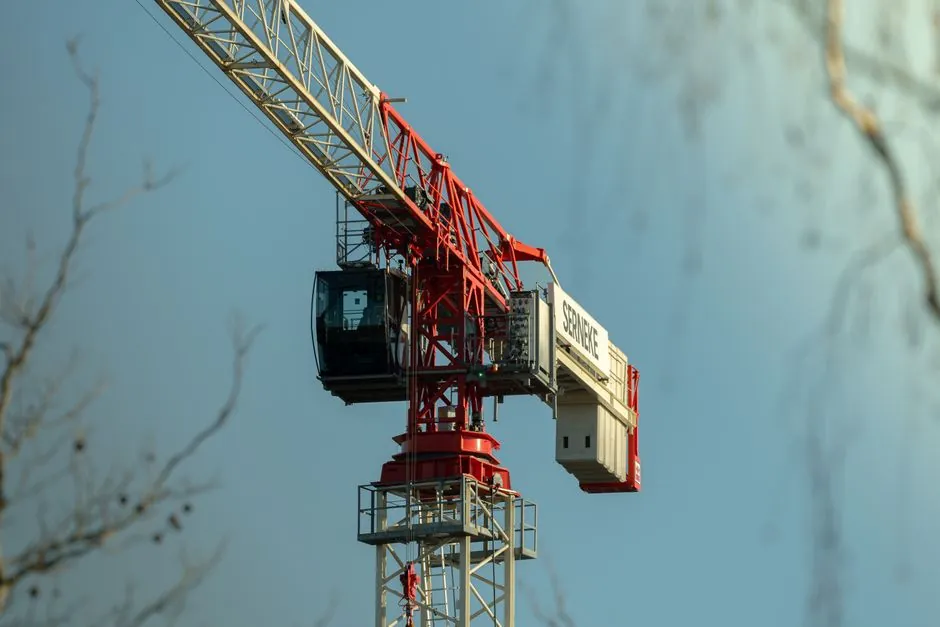
Quarry duty is not high-rise duty. Operating envelopes of 10-220 t, luffing and topless configurations, and DIN 15018 / FEM 1.001 structural baselines define the spec window, per Chinese OEM product disclosures published 2026-07-20 to 2026-08-11 [S1][S2][S3][S4].
Quarry operators evaluating tower cranes must reconcile four divergent constraints simultaneously: irregular high-load lifts (drill stems, jaw-crusher change-outs, block stone), wind exposure on open benches, mobile crane substitution economics, and the structural certification track record of the OEM. The 8 t PT6016 flat-top reference unit sits at US$123,000-123,437 FOB with a 5-set MOQ, while a 220 t wind-powered class crane has been delivered as a one-off engineered package [S2][S5].
Quarry Operating Envelope: Why Standard High-Rise Models Fall Short
Quarry sites impose a unique duty cycle that the standard high-rise tower crane catalogue is not sized for, and the structural certification stack required is correspondingly heavier, per OEM documentation issued 2026-08-11 [S1]. Luffing jib tower cranes for quarry duty offer maximum loads of 3-6 t on small-format models (D2520-3t, PT6016-8t class) and scale to 200-220 t on heavy-construction variants explicitly positioned for industrial and energy sites rather than buildings [S2][S4][S5].
Wind exposure on open quarry benches routinely exceeds 20 m/s operating limits set for urban tower cranes, and the OEM response is the wind-powered heavy class: DaHan's DHL3300-220 ton unit, described in the 2026-08-08 corporate disclosure as the world's first ultra-high and ultra-large wind-powered tower crane, pairs 220 t capacity with a wind-turbine installation duty profile [S2]. For sites where the air-rights of a tall lattice tower are restricted by adjacent blasting zones, the luffing configuration reduces the jib-footprint radius versus a horizontal-jib topless unit [S1][S4]. A quarry should not specify a construction hoist and tower crane as interchangeable, despite some shared OEM parent branding: the structural chassis, slewing bearing, and load-moment indicator (LMI) calibration on a quarry-rated luffing or topless crane differ from the rack-and-pinion hoist class used for personnel/material on vertical building cores [S3][S4].
Selection Criteria: Capacity, Jib Type, Certification Stack, and Wind Class
Four decision criteria govern quarry tower crane selection in 2026: nameplate capacity, jib geometry, certification set, and wind class, with the OEM disclosure window 2026-07-20 to 2026-08-11 offering comparable reference data points [S1][S2][S4][S5]. USETER's product disclosure (2026-08-11) lists three jib families: L-Series topless, M-Series luffing, and S-Series luffing, all manufactured to German DIN standards with certification from TÜV Germany, Singapore MOM-WSH, Australia AS, South Korea KOSA, Malaysia DOSH, and Russia EAC [S1].
Capacity bracket by application: 3-6 t (small quarry loader duty, D2520 luffing, export-configured for confined bench sites), 8-12 t (mid-range block-stone and drill-stem lifting, PT6016 / QTZ250(7020) class), 200-220 t (large quarry / industrial heavy-lift, DHL3300 class) [S2][S4][S5]. The PT6016-8t flat-top reference sits in the mid-range with US$123,000-123,437 unit pricing, 1-year warranty, and customization available, with a 5-set MOQ enforcing fleet-style procurement rather than single-unit spot buys [S5]. Certification depth separates OEM tiers: TÜV + DIN (German-track), EAC (Russia/CIS), AS (Australia), and KOSA / DOSH / MOM-WSH (Asia-Pacific) collectively indicate a manufacturer prepared for cross-border quarry deployment, which is the default for multinational aggregate operators [S1].
Who a Quarry Tower Crane Is For, and Who It Is Not For

A quarry tower crane is sized for sites with sustained heavy-lift tonnage, fixed bench geometry, and long project horizons, and is not the right tool for short-cycle mobile lifts or truck-mounted pick-and-carry duty, per OEM product positioning disclosed 2026-08 [S1][S2]. Operators with a fixed primary crusher, a static block-stone saw line, or a wind-turbine erection pad inside the quarry footprint benefit from the luffing or topless tower configuration because the crane's working radius covers the whole bench from one foundation pad.
Operators with predominantly mobile load patterns (short-haul aggregate truck loading, drill-pattern recharging) gain more flexibility from a crawler crane or mobile crane class machine, which relocates with the face. The 200-220 t heavy-construction tower crane class is a multi-month deployment decision with foundation engineering; specifying it for a 6-month quarry is poor capital allocation [S2]. Conversely, the 3-8 t luffing / topless class assumes the quarry has at minimum a reinforced concrete pad, anchor cage, and 380 V / 50 Hz three-phase supply at the tower base, which is not always present on greenfield exploration sites [S4][S5]. HYCM's HGY17 mobile hydraulic concrete placing boom (16.5 m horizontal reach, 380 V / 50 Hz) is the same power-supply envelope the smaller tower cranes require, which is why many quarries pair the two [S4].
Jib Geometry Comparison: Topless vs Luffing vs Derrick for Quarry Duty
Three jib geometries compete in the quarry tower crane class as of 2026-08: topless (flat-top), luffing jib, and derrick, each with a distinct radius / lift / airspace trade-off, per OEM catalogues issued 2026-08-09 to 2026-08-11 [S1][S2][S3].
Topless (flat-top) cranes offer the lowest crown profile, which reduces the wind sail area and lets multiple cranes overlap on congested bench sites; the PT6016-8t flat-top reference unit ships with this geometry and is widely used in 6-12 t road-and-bridge pier work, which transfers well to quarry bench duty [S5]. Luffing jib cranes raise the jib angle to reduce the radius envelope, which is the defining requirement for quarry sites adjacent to highwalls, blast patterns, or restricted air-rights; the M-Series and S-Series from USETER, plus Dahan's luffing-jib line, target this geometry [S1][S2]. Derrick cranes (also called roof cranes in some OEM catalogues) trade horizontal reach for high vertical lift, and are typically deployed for crusher head and mill reline duty rather than general bench service [S2][S3]. For quarries with a gantry crane already handling shop-floor block saws, the tower crane complements rather than replaces the indoor fixed-rail unit, and the two should be specified as a lifting system rather than independent purchases. A 2026 OEM comparison on this geometry stack is laid out in the related spec map for topless and luffing tower cranes 6-12t for road and bridge piers, where the same 6-12 t bracket is analysed for horizontal infrastructure; quarry bench duty shares the lift envelope but adds wind-exposure severity.
Use Cases and Field Deployment Notes from 2026 OEM Activity

Three field-deployment archetypes dominate quarry tower crane activity in 2026, drawn from OEM case disclosures in the 2026-07 to 2026-08 window, and they map directly to the capacity brackets above [S1][S2][S3][S4]. Small- to mid-quarry bench duty (3-12 t) uses topless PT-class and luffing D2520-class machines, often with 380 V / 50 Hz site power and a re-locatable foundation cage; USETER's L-Series topless and SYM's distributor programme for YONGMAO / SANYO / SCM / Zoomlion / GJJ / BAODA-branded chassis both serve this segment [S1][S3][S5].
Large-construction and energy-site quarry duty (200-220 t) uses Dahan's DHL3300 wind-powered class, designed for wind-farm erection inside or adjacent to the quarry footprint, and the unit has already been delivered and is in field service as of 2026-08-08 [S2]. Cross-border quarry contractors servicing Africa, Southeast Asia, and the CIS typically specify the multi-cert chassis (TÜV + EAC + AS + KOSA / DOSH / MOM-WSH) to clear customs and site-inspection regimes in a single procurement, and USETER's 20-year DIN-aligned manufacturing experience directly addresses that requirement [S1]. The OEM ecosystem also provides a deep spares channel: SYM Hoist & Tower Crane Equipment, based in Shenyang, distributes OEM-branded tower crane and hoist spares for the major Chinese chassis brands, which is the practical way a multi-site quarry operator maintains LMI calibration, slewing bearing spares, and hoist rope replacement without holding a dedicated warehouse [S3]. For quarry operators already running a tower crane fleet on a sister construction site, the quarry can be added to the same spares contract without a new vendor qualification cycle.
Limitations, Failure Modes, and Sourcing Discipline
Quarry tower cranes fail in three predictable modes, all of which the 2026 OEM documentation helps the buyer pre-empt, but only if the spec writer is disciplined about the boundary between OEM marketing language and verifiable specification, per disclosures dated 2026-07-20 to 2026-08-11 [S1][S2][S3][S4][S5]. Structural overrating (a chassis certified for high-rise urban duty but undersized for quarry shock-load cycles from crusher relines and block-stone tipping) is the dominant failure mode, and is mitigated only by purchasing to DIN 15018 / FEM 1.001 with an OEM that publishes a certification list, not a single certificate image [S1].
Wind-class underrating is the second failure mode: a quarry on an exposed bench can see gusts that exceed the operating envelope of a 20 m/s-rated chassis, and the 220 t wind-powered class exists precisely because the standard high-rise envelope is not the quarry envelope [S2]. LMI / load-moment indicator drift after a shock event is the third mode, and the maintenance response is to keep the indicator on the OEM calibration cycle, using OEM-branded spares, not aftermarket [S3]. Sourcing discipline: when the OEM sheet lists a price, treat the FOB price as the start of negotiation (US$123,000-123,437 for the PT6016-8t flat-top is a tight US$437 spread, which signals a list price rather than a project-engineered quote) [S5]. When the OEM sheet lists only product categories without a price (USETER, SYM, Dahan, HYCM, Jinan Jihong, VEGA), request a full RFQ with bench location, lift schedule, and wind-class data, and verify certification numbers directly with the issuing body (TÜV, EAC, AS, KOSA, DOSH, MOM-WSH), not the OEM self-declaration [S1][S2][S3][S4][S6][S7].
For buyers comparing tower crane procurement against crawler or mobile crane rental for the same quarry, the related spec map on crawler crane selection: 2026 spec gates, duty classes, and ground-pressure logic lays out the ground-pressure and duty-class math that drives the make-or-buy decision on quarry lift equipment, and is the most direct cross-reference for quarry capital planners weighing a tower crane pad against a crawler fleet.