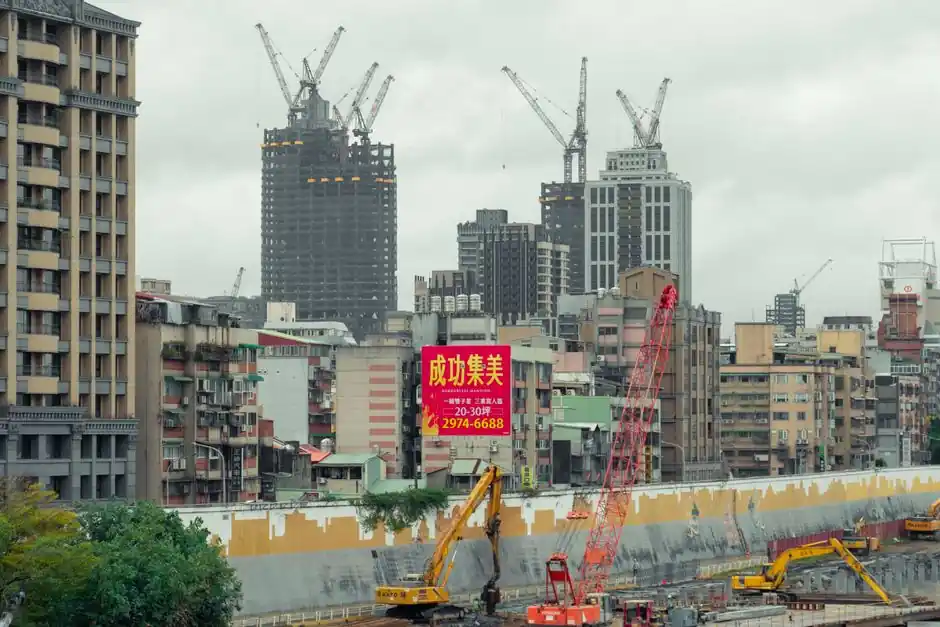
On tunneling jobs, a tower crane is rarely chosen the way it is on a high-rise deck: the radius-load envelope, free-standing height, and power source are dictated by the shaft collar, the portal mouth, and the muck-handling cycle, not by floor count [S2][S5].
For Southeast Queensland tunneling and shaft work, hire fleets concentrate on self-erecting and luffing jib units in the 6 to 20 tonne class, supplied with operator and dogger, because the radius-jib geometry of a flat-top or hammerhead machine rarely clears a tunnel portal [S2]. Boland Cranes and Aspire Tower Cranes both publish 6-20 tonne working envelopes for tunnel-adjacent shaft and station builds across Australia, with electric power dominant on the 18-storey-capable Potain units [S2][S7].
Why tunneling rejects a standard high-rise tower crane
Tunneling sites impose three physical constraints that a deck-erected hammerhead or flat-top tower crane cannot satisfy without re-engineering: a low clearance envelope at the portal, a narrow working corridor alongside the launch adit or shaft collar, and a duty cycle dominated by short-radius, high-frequency lifts of muck skips, segments, and formwork [S5].
The Quick Pick Crane fleet note is explicit: a self-erecting tower crane is the right answer for tight city job sites and campuses where footprint and headroom are binding constraints, and bare-rental coverage is only feasible because the units are self-deploying, with no separate erection crane needed on the bench [S5]. For a tunnel portal, this same logic applies: a single self-erecting unit can be positioned on a 6-8 m wide bench and start working before the bench is widened for the next pass [S5]. A full-size hammerhead flat-top, by contrast, typically needs a 10-12 m wide erection pad, a 200+ tonne assist crane for the first jib lift, and a 40-60 m free-standing height before the first tie, none of which a tunnel bench can offer in the early months of the drive [S2].
Spec gates that actually decide the model
Four specification gates filter the candidate list down to two or three viable machines, and the order matters because a unit that fails gate 1 is dropped before gates 2-4 are even checked. [S6]
Gate 1, radius-load at the portal face: the crane must lift the heaviest tunnel segment or muck skip at the maximum radius dictated by the shaft collar, with at least a 20% margin on the chart value. Boland's published 6-20 tonne class with lifting capacities between 6 t and 20 t typically maps to a 2.5-3.5 t working load at 12-18 m radius, which covers segmental lining erectors and 4-6 m³ muck skips used on metro and rail tunnels [S2]. Gate 2, free-standing height: the crane must clear the highest obstruction (shaft headframe, gantry, or spoil-handling conveyor) without the first tie, because the first tie position in a tunnel is rarely accessible before the bench is built out. Gate 3, power source: electric supply is dominant on city tunneling, with Aspire specifying electrically powered Potain units up to 18 storeys as standard for Southeast Queensland work, and diesel or hybrid only where site power is unavailable [S7]. Gate 4, transport and erection footprint: the unit must be deliverable on standard low-loaders without road escort permits and self-erect on a bench with no assist crane, or the schedule gains no value from the crane at all [S5].
Self-erecting vs luffing vs flat-top: a side-by-side decision
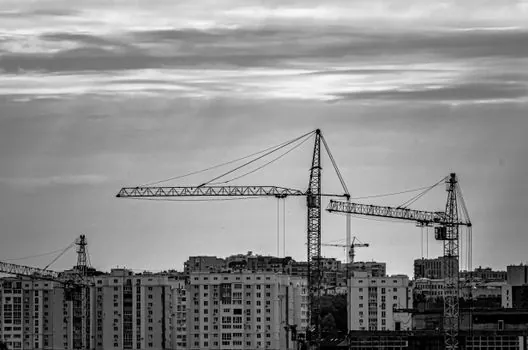
For tunneling, the comparison collapses to three real options, and the tiebreaker is almost always portal headroom, not lift capacity.
Self-erecting (Potain Igo, Liebherr L1, Comedil CTT-style compact units): radius 18-32 m, tip load 1.0-2.5 t, max load 4-8 t, free-standing height 20-30 m, single-axle trailer transport, erect in 1-2 hours with no assist crane. Best fit for short shafts, narrow portal benches, and metro station boxes where headroom is below 25 m [S2][S5]. Luffing jib (Potain MR, Liebherr EC-H, Wolff luffers): radius 35-55 m, tip load 2-5 t, max load 6-20 t, jib angle variable, free-standing height 40-60 m, multiple trailer loads plus 1-2 day erection. Best fit for deep shaft work where the crane sits outside the shaft collar and the jib has to reach over the headframe into the shaft [S2]. Flat-top / hammerhead (Potain MC, Manitowoc MC 310 K16, the unit Forteza Equipo deploys in San Juan): radius 50-80 m, tip load 3-8 t, max load 12-32 t, free-standing height 50-80 m before first tie, multi-day erection with assist crane. Only viable on large-diameter cavern or cut-and-cover station work where the bench is wide and high enough to take the erection footprint [S1].
The decision rule a process engineer should write into the spec: if portal headroom is below 25 m, default to self-erecting; if shaft depth is above 30 m and the collar is offset from the shaft, default to luffing; only specify flat-top when the work is a cavern or a cut-and-cover box with a 50+ m free-standing requirement [S1][S2][S5].
Power, controls, and the unmanned-crane question
Electric supply at 400-690 V is now the default for city tunneling because diesel exhaust cannot be vented through the same shaft that crews are using, and the rental market has followed: Aspire's Potain fleet is described as "modern, electrically powered" with both wet and dry hire available, and Boland's Queensland fleet pairs the same Potain equipment with trained operators and dogmen rather than remote-control packages [S2][S7].
The technical literature on unmanned tower crane operation, dating to the 2017 ICIRA work on wireless multi-controller man-machine interaction, identifies the two persistent problems as low efficiency and high labor cost because of the need for a ground observer in addition to the cab operator, which is precisely the constraint a tunnel site removes by giving the cab operator direct line of sight down the shaft [S6]. For tunneling, the practical interpretation is that radio-remote or cab-less operation adds little value when the operator can see the hook from the shaft collar, and rental providers continue to staff wet-hire contracts with operator + dogger as standard [S2][S7].
Standards, sourcing, and what the rental contract must include
Three contractual points separate a tunneling tower crane hire that finishes on programme from one that loses a month to re-engineering. [S2]
First, the radius-load chart at the actual jib configuration for the project, not the brochure maximum, must be appended to the contract; Boland's published envelope of 6-20 t at 6 m radius down to 2-3 t at the jib tip is the kind of working chart that should be cross-checked against the segment erector's pick weight plus the lifting beam [S2]. Second, the tie schedule must be agreed before mobilization, because in tunneling the first tie is usually to a temporary collar beam and not to a permanent floor slab, and the supplier needs to confirm tie reaction loads against that beam. Third, the power and control package: electric supply voltage, gland type for the tunnel environment (typically IP55 minimum), and whether the operator cabin is heated and filtered for the shaft microclimate, which on a deep metro shaft can be 5-10 °C below ambient and 100% RH [S7].
Who this is for, and who it is not for
This selection map fits project engineers, site managers, and procurement leads specifying cranes for shaft, portal, station-box, and cavern-adjacent work on metro, rail, road, and utility tunnels in the 6-20 tonne class, with self-erecting, luffing, and flat-top variants all on the table [S2][S5][S7]. It does not fit TBM-only drives where segment supply is via underground logistics and no surface crane is needed, and it does not fit immersed-tube or cut-and-cover work where crawler or mobile crane alternatives are more cost-effective [S5].
For a related heavy-lift selection map covering quarry and aggregate sites with different duty-cycle drivers, the Tower Crane Selection for Quarrying: Spec Map for Heavy-Duty Stone Sites piece is a useful adjacent reference, and the broader variant overview in Tower Crane Selection Guide: Variants, Spec Gates, and Site Fit covers hammerhead, flat-top, luffing, and self-erecting classes in more general terms.
Two signals worth tracking over the next 12 months: whether rental fleets in Queensland and the US Northeast add electric self-erecting models above the 8 t class, since the current 6-20 t envelope is anchored at the lower end for tunneling work [S2][S7]; and whether unmanned or remote-control operation moves from research papers into commercial tunneling contracts, given the persistent labor-cost driver flagged in the ICIRA work and the clear line-of-sight advantage that tunnel sites offer over open-deck high-rise sites [S6].
For component-level specifications, see signal tower light.