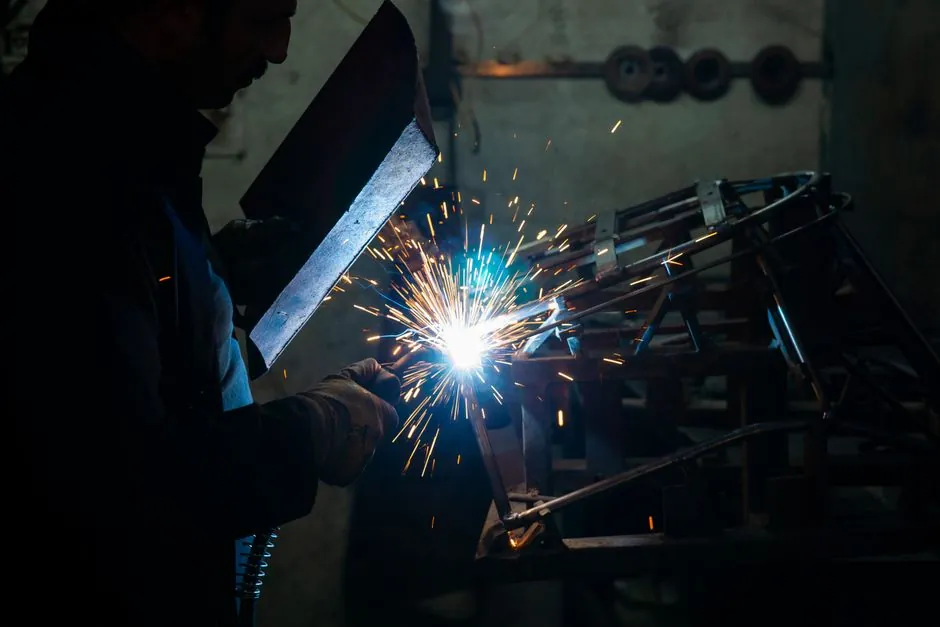
Portable stud welder power units, defined as single-phase inverter or battery systems weighing under ~40 lb and running from 110 V wall outlets, can now perform drawn-arc welding of 3/8" diameter studs to structural steel, a job that historically required 3-phase shop power [S1]. Bench-mounted transformer and inverter systems still dominate production cells, delivering 17–45 V at 55–590 A continuously from facility mains [S3].
Selection is driven by stud diameter, base material, duty cycle, available supply, and weld process: capacitor discharge (CD) for thin-gauge sheet, short-cycle for mid-range fasteners, and drawn-arc for heavy structural and high-strength coated steel [S1][S2]. Process definitions and component terminology are covered in the stud welder reference page, and portable power conditioning overlaps with general hydraulic power unit sizing logic on duty cycle and heat dissipation.
Power Supply Classes: Transformer, Generator, Inverter
Stud welding power supplies fall into three topologies with distinct weight, output, and field-deployability profiles [S3]. Transformers step 110–240 V mains down to 17–45 V at 55–590 A, are the lowest cost, but are physically large and restricted to fixed installations [S3]. Generators (also called alternators) convert mechanical energy from an electric or internal-combustion motor to electrical output at the same voltage step-down, and are the conventional choice for job-site portable welders [S3]. Inverters are a newer class that rectify mains AC to DC, then invert and step down via high-power semiconductors; the semiconductor front end lets the operator tune voltage and current in software, which is why modern portable units can squeeze a 3/8" drawn-arc weld out of a 110 V outlet [S1][S3].
For OEM and shipyard buyers, the practical split is: transformer-based bench units for high-volume, repeatable production; inverter-based portable units for field work, low-voltage outlets, or sites without 3-phase; and engine-driven generators for the heaviest drawn-arc work where no utility power exists [S3]. Bench scale calibration practice uses the same duty-cycle versus heat-run logic when sizing a fixed shop power unit for a stud welding cell.
Portable Class: 110 V Inverter, Battery, and Generator Options
The HBS Visar 650 is the canonical 110 V portable drawn-arc platform: roughly 40 lb, single-phase 110 V input, paired with the HBS A-12 gun, and rated to weld 3/8" diameter studs to compatible steel structures from a standard US wall outlet [S1]. The unit accepts 4-pole R&S connectors, so legacy arc-welding guns can be adapted without a dedicated stud gun [S1]. The lower mass and single-phase input remove the two historical barriers (3-phase availability and trolley-mounted transformer weight) that pushed stud welding off the job site and into a fixed bay.
Battery-powered systems target a different niche, low-power fastening on coated or treated steel rather than full drawn-arc stud welding. The Hilti BX3 BT cordless system drives 800, 500, or 400 fasteners per B22 battery charge (5.2, 3.0, and 2.6 Ah packs respectively), on coated or high-strength steel 8 mm (5/16") and thicker, with no powder cartridges, no combustion, and no disposal stream [S1]. Generator-driven portable welders remain the workhorse for heavier drawn-arc work and remote sites, sized so the engine's kVA rating covers the inrush current of the stud welding cycle [S3].
Bench-Mounted Class: Production Transformers and Inverters
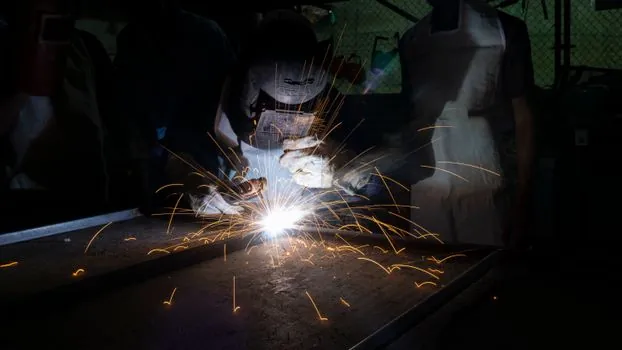
Bench-mounted stud welding power units are the default for OEM production lines, automated cells, and any application requiring repeatable, calibrated output across thousands of welds per shift. The Stanley Engineered Fastening portfolio, sold under the Nelson and Tucker brands, supplies drawn-arc and CD systems purpose-built for these cells, with integration into automotive, construction, shipbuilding, and industrial fabrication lines [S2]. Output range typically spans 55–590 A at 17–45 V from a transformer front end, or a tighter, software-tuned range from an inverter front end [S3].
The bench form factor buys three things a portable cannot match: thermal headroom for continuous duty, three-phase input for higher steady-state current, and integration paths for CNC or robotic stud feeders [S2][S5]. For automation cells the IWT stud welder line at WeldingMart illustrates the bench/inverter pairing, with handheld and bench-top models differentiated explicitly by output and shop versus on-site use [S5]. Choosing between a portable and a bench unit is therefore rarely a feature comparison; it is a duty-cycle and infrastructure decision.
Selection Criteria: Stud Diameter, Base Material, Supply, Duty
Four criteria cover almost every portable-versus-bench decision. Stud diameter and base material: 3/8" structural studs on bare or primed mild steel are the breakpoint where 110 V portable inverters now compete with legacy 3-phase shops [S1]. Coated, galvanized, or high-strength steel 8 mm and above is the Hilti BX3 BT domain, not the drawn-arc portable's [S1]. Power supply: 110 V single-phase rules in the portable class; 3-phase or high-kVA single-phase remains the bench default [S1][S3]. Duty cycle: bench transformers and inverters run continuous at 55–590 A; portable units are rated for intermittent drawn-arc cycles and shorter shifts [S3]. Process: capacitor discharge welders are simpler in construction (a charged capacitor bank, lower cost) and dominate thin-gauge CD work; short-cycle and drawn-arc cover progressively heavier fasteners [S7].
For comparison: a 110 V portable inverter at ~40 lb delivers 3/8" drawn-arc capability from a wall outlet but trades continuous-duty headroom for mobility [S1]. A bench transformer delivers 55–590 A continuously but is bolted to a facility and tied to 3-phase [S3]. A battery fastening system delivers 400–800 cycles per charge on coated steel but does not perform drawn-arc stud welding at all [S1]. A generator-driven portable welder bridges the gap where no utility power exists, sized by engine kVA versus welding inrush [S3]. The user's answer is determined by which two of {mobility, duty cycle, stud diameter, supply type} dominate the job.
Limitations, Failure Modes, and Standards Anchors
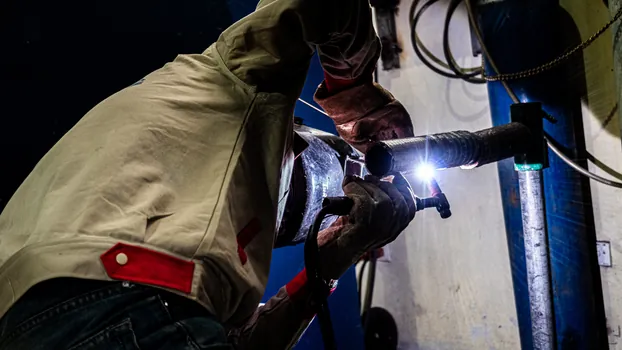
Portable inverter units are limited by single-phase input current draw, so 3/8" is the practical drawn-arc ceiling on 110 V; larger diameters push the operator back to 3-phase or a generator [S1]. Capacitor discharge welders, while cheap and simple, are limited to thin-gauge sheet and small-diameter studs, and are sensitive to stud-to-base alignment and surface contamination [S7]. Bench transformer welders are large, heavy, and tied to facility mains; they cannot be redeployed to a field site without rigging and a generator [S3]. Connecting a stud welder to sensitive electronics on the same bus (an ECU, a control panel) is a known noise and transients problem and is generally avoided [S6].
The relevant industry standard for stud specification is ISO 13918, which defines the metric and imperial stud dimensions and welding end geometry for arc-welded studs; compliance with ISO 13918 is the baseline for both portable and bench systems that supply studs to automotive, construction, and shipbuilding OEMs [S4]. For shipbuilding and offshore, fastening to fire-coated (PFP) beams, functional bonding, protective bonding, and earthing/grounding applications with X-BT-ER threaded studs are explicitly within the Hilti BX3 BT use case set [S1].
Use Cases: Who a Portable Suits, Who a Bench Unit Suits
A portable 110 V inverter suits a steel fabricator or shipyard fitter who needs to weld 3/8" cable-hanger, tube-support, T-SEP, or tray-support studs on a structure that is too large to bring to a shop and has no 3-phase service; the Visar 650 plus A-12 gun is the canonical kit [S1]. A battery fastening system suits a mechanical, electrical, or instrumentation contractor fastening to coated or PFP-coated steel 8 mm and up, where combustion-free operation and no powder-cartridge disposal matter, for example grating discs, cable trays, light-duty junction boxes, and lightning-protection bonding [S1]. A bench-mounted transformer or inverter suits an OEM production cell running thousands of identical studs per shift, with a CNC stud feeder or robotic gun and stable 3-phase mains [S2][S5].
Buyers who should not specify a portable include any cell that needs continuous-duty output above ~200 A, any application above 3/8" drawn-arc diameter, and any line tied to a documented weld procedure specification that mandates 3-phase input. Buyers who should not specify a bench unit include one-off field jobs, retrofit work on in-service structures, and any site where 3-phase is unavailable and the structural fastener does not justify a generator. The decision matrix reduces to: stud diameter + base material + supply availability + duty cycle.
Trackable signals to watch: further 110 V inverter releases extending portable drawn-arc diameter beyond 3/8"; battery-platform standardization across stud welding accessories (today the BX3 BT is a proprietary 22 V B22 platform with 400–800 cycles per charge) [S1]; and inverter-front-end penetration into legacy transformer-based bench cells as software-tunable weld profiles displace fixed-tap transformer settings [S3]. On the standards side, ISO 13918 remains the reference for stud geometry, while site electrical practice still drives the portable-versus-bench split more than any change in welding process technology [S3][S4].
Related analysis: Push-Back vs Pallet Flow Rack: A Spec-Based Selection Guide for Warehouses.