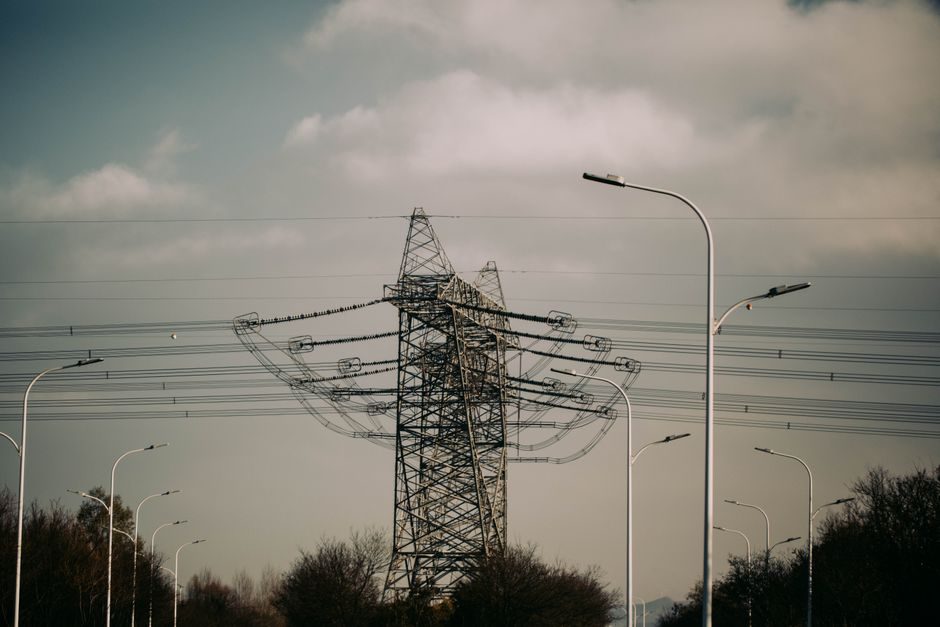
The global power grid market is on track to expand from USD 326.52 Billion in 2025 to USD 487.55 Billion by 2031, compounding at 6.91% CAGR over 2027–2031, per TechSci Research published 2026-05-21 [S2]. Four drivers anchor that growth: aging T&D infrastructure replacement, rising electricity demand, grid-modernization technology investment, and accelerating integration of utility-scale renewables [S2].
Hardware tells the same story at the line item level. Made-in-China listings active in May 2026 show a 1,000,000 Wh air-cooled energy-storage system quoted at US$ 0.135–0.145 per Wh (MOQ 1,000,000 Wh) and grid-tied / off-grid / charging hybrid PCS inverters spanning US$ 4,699–11,599 per piece [S1]. Substation-class oil-filled transformers (1,600 kVA / 35 kV) and SCB14-series grid-connected units continue to surface as the high-spec stock items behind those volumes [S3].
Market sizing: where the 6.91% CAGR comes from
TechSci Research frames 2025 as the base year at USD 326.52 Billion, with 2031 as the terminal year at USD 487.55 Billion — an absolute add of roughly USD 161 Billion over six years, or about USD 27 Billion per year of incremental spend that must land on conductors, transformers, switchgear, protection, and software-defined controls [S2]. The 6.91% CAGR sits well above typical OECD grid capex growth of the prior decade, which is consistent with a one-time catch-up in replacement plus a structural lift from renewables interconnection [S2].
Spec-engineers should treat the 6.91% headline as an envelope number, not a single product-line forecast — the deviation between HV transformer demand and LV distribution demand is widening as data-center loads cluster.
What is actually being bought: ESS, PCS, and substation-class transformers
Three product families dominate the 2026 procurement mix visible on Chinese B2B channels. First, air-cooled battery energy-storage systems (BESS) for power management — the Dagong Huiyao unit at 1,000,000 Wh with a 5-year warranty is representative of the 0.5–2 MWh class used behind-the-meter and at small C&I sites [S1]. Second, power-conversion system (PCS) inverters that combine off-grid, grid-tied, and grid-charging modes in one chassis, listing at US$ 4,699–11,599 per piece depending on power rating and grid-forming firmware [S1].
Third, substation transformers: 1,600 kVA / 35 kV oil-filled units for distribution substations, and SCB14-series dry-type grid-connected transformers (typically 10 kV / 0.4 kV class) for renewable interconnection [S3]. The SCB14 designation refers to the GB 20052 efficiency tier — the 14 series sits one notch below the GB 20052-2024 SCB18/19 reference, which is the current efficiency ceiling for Chinese dry-type units. Procurement teams mapping Chinese dry-type to European or US equivalents should expect 1–2 efficiency-tier offsets rather than drop-in interchangeability.
Selection criteria: matching hardware to the four growth drivers
Specifying into a 6.91% CAGR market still means picking per-site. Four decision axes carry most of the weight. (1) Voltage class: 35 kV oil-filled for substation step-down; 10/0.4 kV SCB14 dry-type for renewable plant-side step-up. (2) Power-conversion topology: grid-following vs grid-forming — grid-forming firmware is required when BESS must black-start a feeder, and not all PCS in the US$ 4,699–11,599 band carry it [S1]. (3) Energy-storage duration: 1,000,000 Wh = 1 MWh class; utility-scale projects typically stack 2–4 hour duration, so 2–4 MWh nameplate per skid. (4) Cooling architecture: air-cooled for siting simplicity and lower balance-of-plant cost; liquid-cooled preferred where energy density per square meter is the binding constraint.
A direct comparison for spec boards:
Air-cooled BESS (1 MWh class) — low $/kWh installed, low site complexity, limited continuous C-rate, suited to C&I and small utility [S1].
Liquid-cooled BESS (2–4 MWh skid) — higher density, higher C-rate, higher BoP cost, preferred for utility-scale and data-center-adjacent sites.
Oil-filled substation transformer (1,600 kVA / 35 kV) — proven insulation, lower upfront cost per MVA, requires oil containment and periodic dissolved-gas analysis [S3].
SCB14 dry-type grid transformer (10/0.4 kV) — no oil hazard, indoor-rated, higher $ per kVA, sits one tier below SCB18/19 efficiency ceiling under GB 20052-2024 [S3].
Who this market is for — and who it is not for
For utility procurement, IPP developers, and large C&I behind-the-meter buyers, the 2026 mix offers the deepest equipment choice in a decade. For small residential buyers, the same channels are largely irrelevant — the 1 MWh air-cooled BESS at US$ 0.135–0.145/Wh and 1,600 kVA transformers are sized for commercial and utility buyers, not households [S1][S3]. Residential demand is being met by separate SKUs (for example, the small off-grid solar systems listed on the same Made-in-China grid-channel page) [S3].
It is also not a market for buyers who need turnkey EPC under a single contract from a Chinese supplier. Most Made-in-China listings on this category are bare equipment; system integration, protection-relay commissioning, and grid-code compliance typically require a separate integrator stack, especially for North American and European utility interconnect where IEEE 1547 series and IEC 61727 / IEC 62116 inverter anti-islanding rules govern acceptance testing.
Standards, sourcing gates, and what to verify before PO
Three verifications block most 2026 POs. First, efficiency tier: confirm whether the Chinese supplier quotes SCB14, SCB18, or SCB19, and map to the destination market's premium-efficiency regime (DOE 10 CFR 431 in the US, EU 548/2014 Tier 2 in Europe). Second, PCS firmware: confirm whether the inverter carries grid-forming control, low-voltage ride-through settings per IEEE 1547-2018, and anti-islanding per IEC 62116 — do not assume grid-tied implies grid-forming [S1]. Third, BESS safety: confirm the cell format (LFP vs NMC), the BMS protocol (CAN-bus vs Modbus TCP), and listing to UL 9540A / IEC 62933 thermal-runoff test data, which is increasingly demanded by AHJs in North America.
For transformer-heavy projects, our 2026 Transformer Industry: US Capacity Build, Grid Load Shift and Eco-Fluid Spec Pivots write-up covers the US capacity bottleneck and the shift to natural-ester dielectric fluids, which is the single biggest spec pivot on the substation side. On the broader upstream supply picture, the Copper Upstream-Downstream Chain 2026: Mining, Smelting and End-Use Demand reference tracks the conductor-side cost inputs that ultimately flow into every transformer and cable on this list.
Limitations and failure modes buyers should price in
Three failure modes dominate 2026 grid-equipment claim-vs-reality disputes. (1) Quoted MOQ vs shipped MOQ: the air-cooled BESS at US$ 0.135–0.145/Wh is conditional on a 1,000,000 Wh MOQ — smaller draws are priced higher per Wh and may shift to a different SKU entirely [S1]. (2) PCS warranty scope: the 5-year warranty on the BESS unit does not extend to the PCS inverter unless explicitly contracted; PCS field-failure rates in this class run materially higher than battery degradation rates, and the inverter is the more likely warranty event. (3) Standards drift: SCB14 vs SCB18/19 tiers, UL 9540A revisions, and IEEE 1547-2018 interconnection updates mean a quote written against a 2024 standards baseline may be non-compliant against a 2026 AHJ interpretation — re-verify at PO, not at commissioning.
A tracking signal worth wiring into 2026 sourcing dashboards: the spread between SCB14 and SCB18/SCB19 dry-type transformer pricing. If that spread compresses below roughly 8–10%, expect SCB14 to exit the catalog as SCB18 takes the volume tier. The signal to watch on the BESS side is the air-cooled vs liquid-cooled $/kWh crossover — at current listings, air-cooled is winning on installed $/kWh for sub-2 MWh projects, but liquid-cooled is closing the gap as cell prices normalize [S1].
Track the next data point on 2026-08: TechSci's H1 2026 update to the Power Grid Market forecast, and the first US DOE 10 CFR 431 distribution-transformer efficiency rule compliance reports due from US manufacturers. Both will reset the baseline against which current Chinese SCB14 and SCB18 quotes are evaluated.
For component-level specifications, see power cable, power meter, and power mixer.