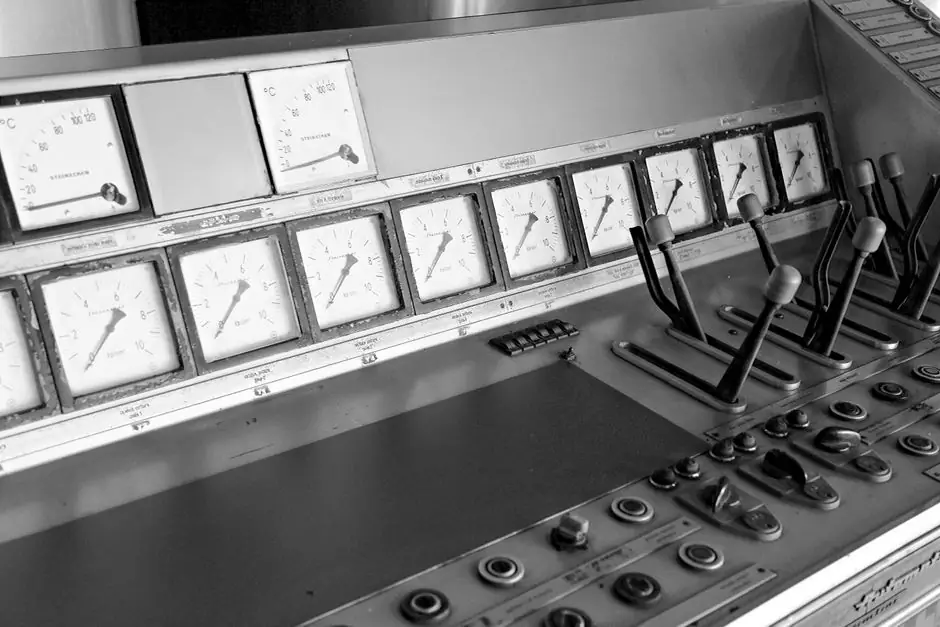
Power grid process control and instrumentation in 2026 is built around three hard requirements: functional safety per IEC 61511 for protection loops, IEC 61850-based substation interoperability, and embedded cybersecurity per IEC 62443 and NIST 800-82 for any controller connected to operational technology networks [S3][S2].
Engineers specifying substation I&C, generation plant SIS, or behind-the-meter microgrid assets must treat the tag-letter ISA-5.1 convention (ESL for voltage switch low, FFI for flow ratio indicator, FIC for flow indicating controller) as a non-negotiable documentation baseline before any loop is wired [S1]. For a wider primer on how motor-driven loops fit into the same control hierarchy, see the electric motor process control spec map.
Functional Safety Backbone: IEC 61511 and SIS Loop Sizing
IEC 61511 is the functional safety standard for safety instrumented systems in the process industries, covering hazard and risk assessment through HAZOP, LOPA, and the safety lifecycle from concept to decommissioning [S3]. It applies directly to oil and gas, petrochemical, and power-generation sites where a Safety Integrity Level (SIL 1 to SIL 3) target is set per protection loop and verified by calculated Probability of Failure on Demand (PFDavg).
For a utility-scale combined-cycle plant, the typical SIS architecture is a 2oo3 or 1oo2D voted transmitter cluster feeding a SIL 3-certified safety PLC, with separate logic solver hardware from the basic process control system (BPCS) to satisfy IEC 61511 clause on independence. Proof-test intervals usually fall in the 1-5 year range, and every transmitter, control valve, and solenoid must carry an FMEDA or equivalent failure-rate data sheet that the SIL calculation can be re-run against after any field replacement.
Substation Communications: IEC 61850, GOOSE, and Process Bus
IEC 61850 is the interoperability backbone for substation automation, defining object models for protection relays, bay controllers, and merging units, plus the GOOSE (Generic Object Oriented Substation Event) messaging layer for peer-to-peer trip signalling over the process bus [S3]. It is paired with IEEE 802.x Ethernet at the physical layer, and modern IEDs routinely support 100/1000 Base-T, PRP, and HSR redundancy profiles.
Where the spec extends to time-synchronised measurements, IEEE 1588 grandmaster clocks with sub-microsecond accuracy are now common on the same process bus.
Microgrid Controllers: 12-36 Vdc, Distributed IPCs, and ATO-Grade Cybersecurity
The S&C Electric GridMaster Microgrid Control System is documented as a combined software/hardware platform drawing 12 to 36 Vdc at under 20 W, communicating over 1000/100/10 Base-T Ethernet with IPv6 default and IPv4 compatibility [S2]. Its distributed architecture runs the control software on multiple Intelligent Power Controllers (IPCs) that talk peer-to-peer over an encrypted proprietary protocol, with automatic lead-IPC failover if a node drops off the network due to physical damage, loss of enclosure power, or a network failure [S2].
Cybersecurity is a hard sell-in rather than an add-on: the GridMaster documentation lists compliance with NIST 800-82, NIST 800-53, and DoDI 8500, and the system is reported to hold an Authorization to Operate (ATO) at mission-critical U.S. Department of Defense facilities [S2]. For specifiers who need access governance around the same control room, the access control catalog entry covers the physical-layer side, while this S&C bulletin gives the OT cyber-framework side. For a broader view of how instrumented loops tie back into supervisory SCADA, the related electric motor process control write-up covers loop sourcing and signal levels.
Tagging, Loop Drawings, and ISA-5.1 Discipline
ISA-5.1 instrument tag letters are the lowest-cost risk-reduction tool a power grid I&C engineer has, and they are not optional. ESL identifies a voltage switch low (for under-voltage detection on a bus), FFI flags a flow ratio indicator (for example air-to-fuel on a large industrial engine), FIC denotes a flow indicating controller, and AIT labels an analytical indicating transmitter such as an in-line oxygen analyzer with built-in display [S1].
The first-pass rule on any loop drawing review is to reject any tag that is not ISA-5.1 compliant, because the tag drives the P&ID, the cable schedule, the I/O list, the HMI screen, and the maintenance work order. A second pass should verify that every protection loop in a SIS is marked with the SIL target and proof-test interval directly on the loop sheet, so the operations team cannot accidentally bypass a transmitter in service.
Selection Criteria: Generation, T&D, and Microgrid Compared

Three decision criteria cleanly separate the three main grid I&C categories. First, safety standard: generation plant protection loops live under IEC 61511 with formal SIL targets, transmission and distribution bays live under IEC 61850 plus IEEE C37.2 device numbering, and microgrid controllers are governed by IEC 62443 plus NIST 800-82/800-53 cybersecurity controls [S3][S2]. Second, logic solver class: generation uses SIL-certified safety PLCs, T&D uses protection relays with IEC 61850 GOOSE, and microgrids use peer-to-peer IPCs on distributed Ethernet. Third, cybersecurity posture: generation plants treat OT cyber as a project-specific scope, T&D follows NERC CIP (North American Electric Reliability Corporation Critical Infrastructure Protection) where applicable, and microgrid controllers with documented ATO accreditation ship pre-hardened for high-assurance sites [S2].
In terms of physical I/O the control cable selection, signal levels, and shielding all track the same 4-20 mA plus HART convention that is still common at the field-device edge, while IEC 61850 and microgrid Ethernet ride the LAN/PROCESS BUS side. Two-handed control and dedicated safety hardware belong on the SIS side, not the supervisory side, and the two-hand control reference describes the discrete-safety approach for operator stations that is occasionally adapted to switchgear local controls.
Limits, Failure Modes, and Common Mis-Specs
The first common failure mode is treating a HART-enabled smart transmitter as if it were a digital fieldbus device: HART is FSK-modulated on top of the 4-20 mA analog loop, and it does not replace the analog current value, so any safety function reading the loop must continue to work on the 4-20 mA current alone [S3]. A second failure mode is running GOOSE traffic on a non-deterministic LAN shared with business traffic, which violates the IEC 61850 timing budget and can stall protection signalling under load. A third is specifying a microgrid controller without verifying its cybersecurity framework alignment, since the OT/IT convergence in 2026 means the cyber spec is as important as the loop spec [S2].
A fourth common mis-spec is the assumption that any IEC 61508 SIL 2 component is automatically acceptable under IEC 61511; the process-sector standard adds sector-specific requirements on competence, documentation, and the safety lifecycle that the generic IEC 61508 does not impose on its own [S3].
Documentation, Standards Map, and What to Track Next
Working standards to anchor a power grid I&C spec package include IEC 61511 for SIS lifecycles and functional safety, IEC 61850 for substation interoperability, IEC 62443 for industrial automation cybersecurity, IEEE 1588 for clock synchronisation, and ISA-5.1 for tag-letter discipline across P&IDs, loop drawings, and I/O lists [S3]. Where hazardous-area equipment is in scope, ATEX 2014/34/EU (European explosive atmospheres equipment directive) and the IEC 60079 series apply, and on the North American side NFPA 70 (National Electrical Code) and IEEE C2 (National Electrical Safety Code) are the typical references; specific NERC CIP version applicability should be confirmed against the registered entity's current reliability standards.