
Power mixers and cut-off machines share a misleading name, but they solve completely different problems: a power mixer is PC audio utility software (PowerMixer v4.1 is a 70.02 MB Windows editor that handles noise cleanup and per-band volume control), while a cut-off machine is a corded abrasive saw that spins a 355 mm blade at 3700 rpm from a 2000 W motor [S7][S8].
The comparison most buyers actually want is between a cut-off machine and similar metal-cutting tools, so this guide also lines a 14-inch hand-held cut-off machine (Milwaukee 6185-20) against industrial swing-frame and precision cut-off variants, and flags where a power mixer reference is even relevant [S5][S3].
What "Power Mixer" Usually Means on an Industrial Buy Sheet
In process plants, a power mixer is a driven agitator mounted on a tank, not a sound file; buyers searching for "power mixer" in industrial catalogs get gearboxes, shaft seals, and impellers, not software. [S1]
The PowerMixer v4.1 entry is a 70.02 MB Chinese-language audio editor that removes noise from recordings and lets the user fine-tune per-band volume with scroll-wheel shortcuts; it does not run on Windows XP or older, and it ships as v4.13 in the package data, even though the page is titled v4.1 [S7].
For anyone comparing like with like, the industrial "power mixer" path leads to agitator selection (impeller type, shaft power, seal class), not to PC utilities. If a buyer's actual problem is moving slurry in a vessel, the right reference is mixing equipment, not audio software [S7].
Cut-Off Machine Anatomy: Motor, Blade, No-Load Speed
The MT-CM35504 cut-off machine ships with a 355 mm saw blade, a no-load speed of 3700 r/min, a 2000 W rated input, a 56 x 32 x 43 cm carton, and a 15 / 16.5 kg net / gross weight per unit, packed 1 pc per carton and 350 pcs per 20' FCL [S8].
The MT240 variant is also rated 2000 W, copies the Maktec 240 form factor, has a 30–45 day delivery time, and carries a 300-piece minimum order from an Ouderli / OUDERLI brand out of Zhejiang, China [S2].
A 14-inch (≈355 mm) hand-held Milwaukee 6185-20 cut-off machine runs on 120 V corded power, uses a brushless motor, positions the blade on the right, and is sold as a single bare tool with no battery — it is a 120 V mains unit, not an 18 V or 20 V MAX cordless platform like the cross-referenced Milwaukee miter saws on the same listing [S5].
Selection Criteria: Cut-Off Machine vs Other Cutting Tools
Selection for a cut-off machine comes down to four numbers: blade diameter (mm), no-load rpm, rated input power (W), and weight (kg). The MT-CM35504 hits 355 mm / 3700 rpm / 2000 W / 15 kg in one package, which lines up with the most common 14-inch portable abrasive-saw class worldwide [S8].
For heavy-section steel and iron foundry work, a swing-frame cut-off machine is the right tool: the Fox 2-C swings 90° clockwise and 75° counter-clockwise, and is purpose-built to knock gates and risers off castings, including cuts close to flat surfaces on the casting itself [S3].
A precision cut-off machine (Ø25 mm capacity, "high speed precision") is a different machine class — small-diameter abrasive or metallographic cutting, not handheld steelwork — and the CENS listing under "HIGH SPEED PRECISION CUTTING-OFF MACHINE Ø25" sits next to sand-belt grinders and finishing machines rather than handheld saws [S4].
Buyers also cross-shop cut-off saws against circular saws; the CENS "Optimizing Cut-Off Saw" entry is filed under "Circular Sawing Machines" / "Woodworking Machinery", so its optimization scope is blade geometry and feed for wood, not abrasive cutting of steel [S9].
Option Comparison: Three Cut-Off Machine Classes on 4 Criteria
Side by side, the three main classes separate cleanly on diameter, mass, power, and primary use: the MT-CM35504 handheld abrasive saw (355 mm, 15 kg, 2000 W, steel / rebar / pipe), the Fox 2-C swing-frame cut-off machine (heavy-section castings, swing-frame foundry duty, plus 90° / 75° swing), and the Ø25 mm high-speed precision cut-off machine (small-diameter metallographic or fine-parts cutting, sand-belt-grinder family) [S8][S3][S4].
For 14-inch handheld work the Milwaukee 6185-20 confirms 14 in (~355 mm) blade diameter, 120 V corded supply, brushless motor, and bare-tool packaging, which is the same envelope as the Chinese MT-CM35504; the difference is motor brand, supply voltage (US 120 V vs China 220 V typical), and dealer network, not blade size or class [S5][S8].
Volume buyers should also note packaging: the MT-CM35504 fits 350 pcs into a 20' FCL with 1 pc per carton at 15 / 16.5 kg, while the MT240 carries a 300-piece MOQ and 30–45 day delivery — those two numbers set the floor for any container-load quote from Zhejiang Ouderli [S8][S2].
Who a Cut-Off Machine Is For (and Who It Is Not)
A 14-inch / 355 mm cut-off machine at 2000 W is built for steel plate, rebar, pipe, and metal stud work on a jobsite or in a fab shop, not for sheet-rock or finish wood; the 3700 rpm no-load speed and abrasive wheel design cut hard metal fast but leave a rough edge that needs deburr [S8].
A swing-frame cut-off machine like the Fox 2-C is for foundry gate and riser removal on castings, where full 90° / 75° swing lets the operator position a large abrasive wheel close to the casting surface — handheld saws cannot do this safely at the same diameter [S3].
A precision Ø25 mm cut-off machine is for laboratory, toolroom, or electronics work where cut quality and small kerf matter more than throughput; it is not a substitute for a 14-inch saw and cannot accept a 355 mm wheel [S4].
For powdery, dusty, or noise-sensitive sites, the MT240's "low sound" and "new structure design" are the marketing claims to verify in person; the spec sheet does not publish a dB(A) number, so buyers should ask for a sound-power figure on the nameplate before signing a 300-piece MOQ [S2].
Sourcing, Standards, and Commercial Signals
Volume cut-off machine sourcing in mid-2026 still routes through Zhejiang and Shandong manufacturers; the MT-CM35504 comes from Yongkang Bowei Tools Co. with a Yonkang (0579-87153456) phone, the MT240 ships from Ouderli in Zhejiang (0579-7712176), and the Moyi MY2051 cut-off machine is sold by Moyi Tools Co., Ltd., a power-tools maker that has been operating since 1995 and moved into cut-off saws, band saws, and wet grinders from 2002 [S1][S2][S8].
Moyi explicitly covers the DIY to professional buyer range, so a spec sheet at that level will not carry the same CE / EMC / abrasive-wheel documentation as a Milwaukee 6185-20; OEM buyers should request the test report for EN 60745-2-5 (hand-held cut-off saws) on top of the carton data, even though the spec page does not list a standard number [S1][S5].
For pricing context, the corrugated-mill "Non Cut Off" OEM / ODM factory on Made-in-China lists an automatic double cutoff at US $257,000 per piece MOQ 1, plus single-face corrugator lines at US $100,000–200,000 — a useful sanity check that the term "cut-off" also covers packaging-line cutoff saws, not just handheld abrasive tools [S6].
Limits, Failure Modes, and Buyer Watch-Outs
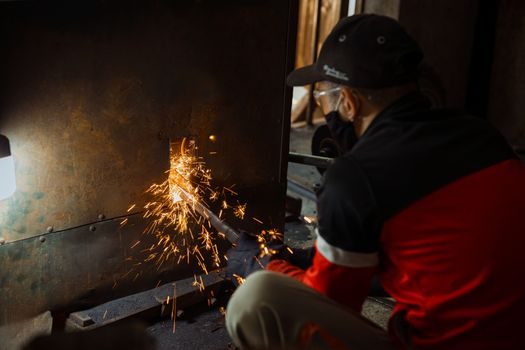
Every 2000 W handheld cut-off saw in the MT-CM35504 / MT240 / Moyi MY2051 class shares the same duty-cycle limit: continuous abrasive cutting of heavy steel will overheat the motor and wear the wheel, so the published 3700 rpm no-load speed drops fast under load and the operator must feed conservatively [S1][S2][S8].
Packaging numbers tell a story: 15 kg net per unit and 350 pcs / 20' FCL is the volume-buyer's whole cost stack — freight, duty, and palletization are all driven by the 15 / 16.5 kg and 56 x 32 x 43 cm per-carton footprint, not by the catalog motor wattage [S8].
Confusion risk: "cut-off" also describes corrugated-packaging cutoffs, woodworking optimizing saws, and metallographic precision saws, so a 14-inch Milwaukee 6185-20 (handheld, abrasive, 120 V) and a CENS Ø25 mm high-speed precision cut-off (small benchtop, fine cut) should never be benchmarked against each other on price or blade diameter [S5][S4][S9].
Closer cost guidance for handheld cut-off saws — blade, power, automation levers — is in the Cut-Off Machine 2026 Price & Cost Guide, and a thermal-cutting cross-shop is laid out in the Plasma Cutter vs Oxy-Fuel Torch spec cut for buyers deciding between abrasive and thermal separation.
Track three signals over the next quarter: (1) Zhejiang and Shandong OEM price lists for 2000 W / 355 mm cut-off saws, especially MOQ shifts on the Ouderli MT240 (300 pcs, 30–45 day lead time) and Yongkang Bowei MT-CM35504 (350 pcs / 20' FCL); (2) revised EN 60745-2-5 test reports on handheld cut-off machines from Moyi, Ouderli, and Bowei; (3) a published dB(A) figure on the MT240 or its successor, which the current spec sheet still omits [S1][S2][S8].
For component-level specifications, see sand mixer, and concrete mixer truck.