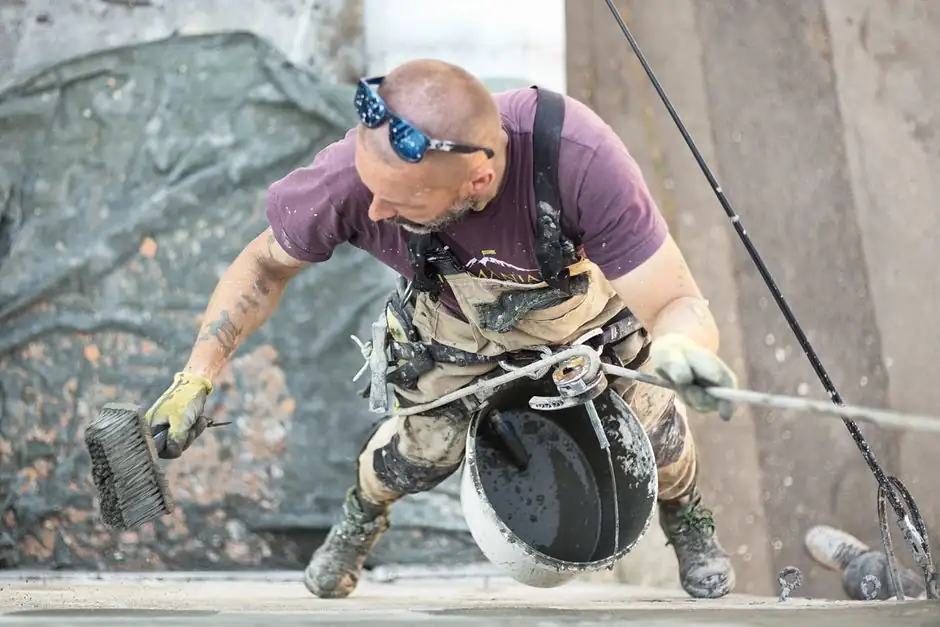
Walk-behind power trowels use 1 rotor, weigh 100 to 200 lb, and finish 200 to 800 sq ft/hr; ride-on power trowels use 2 rotors, weigh 740 to 2,400+ lb, and finish 3,000 to 10,000+ sq ft/hr [S2]. That productivity gap is the first gate on any spec: under 3,000 sq ft a walk-behind is the right answer, over 3,000 sq ft a ride-on almost always wins on schedule and FF/FL flatness consistency [S2].
Power is the next axis. Small residential and enclosed-area pours take 3 HP walk-behinds with 12- or 17-inch blades running at 120 rpm [S1]; mid-size walk-behinds sit at 7 HP (5.2 kW) gasoline with 24-inch (610 mm) blade diameters; heavy ride-ons span 24 to 65+ HP, with rotor diameters from 24 to 48 inches [S2][S3]. Selecting the wrong class is the single most common cause of burnisher marks, re-pours, and operator fatigue on pours longer than 2 hours [S2].
Walk-Behind vs Ride-On: Decision Criteria Compared
Walk-behind machines pair a single rotor with 4 to 6 steel blades on arms driven by a centrifugal clutch and gearbox, and they are sized for slab edges, doorways, and small commercial pours under 3,000 sq ft [S2][S4]. Ride-on machines mount twin rotors (each 24 to 48 inches in diameter) on a seated frame with joystick or dual-lever steering, and they become standard equipment once a slab crosses 3,000 to 5,000 sq ft because the same two operators per shift can finish 10x the area [S2]. A compact mid-size ride-on can finish a 40-by-60 ft pole barn slab in under 1 hour [S2].
The four criteria that decide the class: slab area, FF/FL floor flatness requirement, site access, and budget. Warehouse and distribution center slabs above 50,000 sq ft, manufacturing plant floors with strict FF/FL numbers, and airport apron pours all sit firmly in ride-on territory [S2]. Within ride-on, hydraulic drive delivers smoother blade-pitch control on finish passes than mechanical (gear-driven) systems and costs 20% to 40% more; buyers chasing high FF/FL numbers on commercial work usually pay that premium [S2]. For slab prep, a walk-behind is also the right hand-off companion to a concrete groove cutter on the same pour, since both work in the same plastic-to-set window.
Engine, Power, and Fuel: Matching the Drive to the Site
Walk-behind power sources cluster around two options: a 3 HP 3-phase electric motor (ELGI or HAVELL'S are common OEM pairings) for indoor or enclosed pours where fume control matters, or a 3 HP Honda petrol-start kerosene-run engine for sites without electricity, which burns 0.75 to 1.0 litre per hour [S1]. Electric walk-behinds run at 120 rpm blade speed on a 34- or 46-inch base with 12- or 17-inch blades, and the smaller 34-inch base is the right pick for college buildings, apartment slabs, and any lift-into-floor situation [S1].
Ride-on powerplants scale from 7 HP (5.2 kW) gasoline on entry-level machines up to 26 kW (35 HP) diesel on heavy hydraulic units like the CONGLORY CRP-2390H, which carries a 2,390 mm working width and hydraulic steering for large industrial pours [S5]. Battery-electric and LPG options exist on premium ride-ons to meet indoor air-quality rules, but petrol remains the default for outdoor commercial work. Fuel tank size, throttle placement, and a safety kill switch are non-negotiable features on any ride-on; the 9-component checklist (engine, twin rotors, blades, guard rings, seat and controls, pitch mechanism, fuel system, safety switch) is the minimum a spec should call out [S2].
Blade Selection: Float, Combination, and Finish
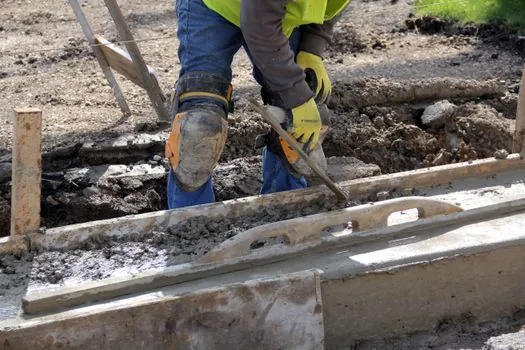
Three blade types cover the three finishing stages, and mis-sequencing them is the second most common field error after wrong timing [S5]. Float blades (or a float pan clamped over the rotor) run flat or at very low pitch during the early floating pass, embedding coarse aggregate, closing the surface, and bringing mortar up while bleed water is still leaving the slab [S4][S5]. Combination blades are pitched flat for floating and progressively steepened as the slab firms, which lets a small crew carry one blade set through both stages and skip a blade change [S5]. Finish blades go on last, at progressively higher pitch through successive passes, to close, smooth, and burnish the surface to a hard sheen [S5].
On a power trowel rotor, blade pitch is the variable that drives surface pressure: more pitch means less blade area in contact, which raises local pressure and burnishes the paste. A pan is the right attachment for very fresh concrete where a bare steel blade would dig in, and most contractors switch from pan to combination to finish in two or three passes on a typical 4,000 to 6,000 sq ft slab. Float pan diameter usually matches the rotor guard ring, while finish blades come in 12-, 17-, 24-inch (walk-behind) and 24- to 48-inch (ride-on) sizes [S1][S2][S4].
Timing, Standards, and the Footprint Test
Timing controls the outcome more than any spec sheet variable. The accepted field test, described in ACI 302.1R, is the footprint test: once bleed water has evaporated and a worker standing on the slab leaves a footprint no deeper than about 3 mm (1/8 inch), the slab is ready for the first float pass [S4]. Starting too early tears the surface and traps bleed water, which causes delamination weeks later; starting too late means the slab has gone plastic and no amount of blade pressure will close it [S4]. Mix design, ambient temperature, wind, and humidity all shift that window, so the clock is the wrong reference.
Floor flatness and levelness on commercial pours are measured under ASTM E1155, which produces the FF (flatness) and FL (levelness) numbers that ride-on trowels with hydraulic pitch control are typically specified to hit [S4]. Curing then falls under ACI 308, and the whole floor section is read against ACI 302.1R [S4]. On burnisher-quality finishes, the final pass is taken with finish blades at high pitch once the slab is firm enough to walk on without marking; under that condition, a 100 to 200 lb walk-behind still gives the best edge control for the perimeter 6 to 12 inches, even on a ride-on-dominant pour [S2][S4].
Who Should Pick a Walk-Behind, and Who Needs a Ride-On
Walk-behinds fit residential slabs, garage floors, small commercial pours under 3,000 sq ft, edge work, and any site with limited access or no three-phase power; the 34-inch-base 3 HP electric and the 46-inch-base 3 HP electric or 3 HP Honda variants cover that range at 120 rpm with 12- or 17-inch blades [S1]. They also fit indoor enclosed-area pours where fume control rules out a petrol engine. A walk-behind is wrong for a slab over 3,000 sq ft on a tight schedule, and it is wrong for any pour where the spec calls out FF/FL numbers that require consistent hydraulic pitch control [S2][S3].
Ride-ons fit warehouse and distribution center slabs above 50,000 sq ft, manufacturing plant floors with high FF/FL ratings, retail big-box foundations, parking decks, airport apron pours, bridge decks, and large agricultural slabs from 2,000 to 20,000 sq ft [S2]. They are also the right call when labor is scarce: a single ride-on operator replaces 2 to 3 walk-behind operators and produces a flatter, harder finish in less time [S2]. For site prep on the same pour, a ride-on finishing crew is often paired with a shotcrete machine for vertical elements and an air pick for demo or trimming.
Selection Checklist and Common Failure Modes
The selection decision sequence is: confirm slab area, confirm FF/FL requirement, confirm site access and power, then pick the rotor class, then pick the engine, then pick the blade sequence [S4]. Spec values to lock in writing: rotor diameter (24 to 48 inches ride-on; 24 inches typical walk-behind), blade RPM (120 rpm small electric walk-behind; up to 160 rpm mid-size ride-on), engine power (3 to 7 HP walk-behind; 24 to 65+ HP ride-on), operating weight (100 to 200 lb walk-behind; 740 to 2,400+ lb ride-on), and the blade types in the planned sequence (float pan, combination, finish) [S1][S2][S5].
Failure modes to spec against: starting too early (delamination from trapped bleed water), wrong blade for the pass (tears on float pass, chatter on finish pass), under-powered machine on a stiff mix (stalls and surface tearing), and no safety kill switch on the ride-on (operator pinch risk at the guard ring) [S2][S4]. On concrete specs, a quality finish is the cheapest insurance a contractor can buy, since re-profiling a slab that fails FF/FL is a 5 to 10x cost versus getting the trowel choice right the first time. Trackable signals into Q4 2026: OEM rollout of battery-electric ride-ons in the 24 to 35 HP class for indoor air-quality sites, and wider adoption of automatic blade-pitch systems that hold a target FF number across a pour.
The underlying component specifications are covered under aerial work platform, and aerial work truck.