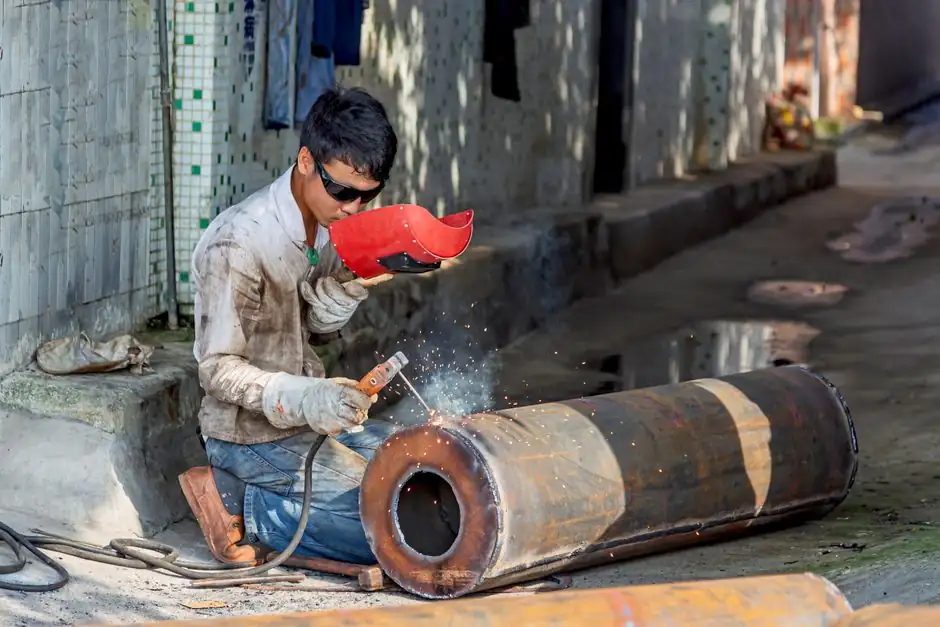
Electroslag pressure welders sit in a narrow but well-defined niche for landscaping jobs that involve vertical reinforcing bars, specifically retaining walls, planters, garden pillars, and small cast-in-place piers in the 16-32 mm bar range, where the lightweight clamp-and-head package (7-16 kg gross weight for entry-level vertical units) lets a one- or two-person crew run joint after joint without a crane lift [S1].
The process shares its molten-slag heating principle with the plate version (ESW) but adds axial upset pressure to forge a bar-to-bar joint inside a flux-filled mold, which is the feature that lets a small head rated for bars up to 32 mm replace lap splices or mechanical couplers on landscaping structures [S2][S3]. Procurement for 2026 landscape projects therefore hinges on a few hard numbers, not on brand familiarity, and this guide lines those numbers up against the work the crew actually does on site.
Why a Welder, Not a Coupler, on a Landscape Site
Landscape retaining walls and pier cages are mostly vertical rebar cages with bars that run true and rarely exceed 32 mm in residential and small commercial work, which is the exact operating envelope of a portable electroslag pressure welder: vertical or inclined bars within roughly a 4:1 gradient, joining diameters from 16 mm up to 40 mm without a separate filler wire, producing a visible weld collar that is later ground flush before concrete placement [S2][S3].
Above 32 mm a 1,000 A source is required, and most landscape jobs never need that, so a 600-750 A AC transformer paired with a manual clamp head covers the bulk of retaining wall and pillar work at the lowest entry cost [S3]. For crews that already rent a portable arc welder for tack work, the EPW head and a separate power source can share the same single-phase supply if the head weighs under 16 kg, which keeps total carry weight manageable on a garden site with no crane access [S1][S3].
Spec Lock: Four Numbers That Drive the Purchase Decision
For landscaping rebar EPW, four specifications must be locked before quoting: maximum bar diameter the head accepts (16, 20, 25, 32 mm are the common stops), welding current rating and duty cycle of the power source, the upset (forging) force the head can deliver, and the control sequencing of arc stage, electroslag stage, and upset stage [S2][S3].
No-load voltage must be high enough to strike the arc through the flux, typically 70 to 90 V, well above a general arc welder, and these two numbers together decide whether the machine can heat the largest joint quickly enough to avoid lack of fusion [S3]. The weld-collar quality limits in JGJ 18-2012 set axial offset, bar diameter mismatch, and visible defect thresholds that the equipment must be able to hit under production rate, not just in the lab, and the comparable US framework for welding reinforcing steel is AWS D1.4/D1.4M [S3]. A direct head-to-head comparison of the three landscape-scale options:
Manual clamp, AC transformer welder, 16-32 mm bar range, 7-16 kg head: lowest first cost, light head, suited to small pier columns and short retaining wall lifts, but operator skill drives weld-collar quality and the arc-to-upset timing is hand-judged [S1][S2].
Manual clamp, inverter DC welder, 16-40 mm range with programmable arc-to-upset timer, 12-18 kg head: higher first cost, more repeatable collars, preferred on tall piers where the worker climbs with the head and needs consistent timing between welds [S2].
Semi-automatic dual-operator rig, 25-50 mm range with hydraulic upset, 25-35 kg head plus separate power source: best collar consistency on large-diameter bars, heavier, needs a small hoist or two workers to lift, overkill for typical 16-25 mm landscape work but worth the spend on a 30+ pier estate job [S2][S3].
Who Should Use a Landscape EPW, and Who Should Walk Away
EPW is the right tool for vertical column rebar in cast-in-place concrete piers, abutment stems, and retaining walls where bars run true and the crew can stage the head on a ladder or scaffold, because the slag bath and upset force both depend on gravity and coaxial alignment [S2][S3]. For landscape projects that pair rebar cages with site-fabricated embed plates or stainless handrail anchors, an EPW can splice the cage while a separate TIG welder handles the stainless trim, which is the standard split on high-end garden work [S3].
It is the wrong tool for horizontal or overhead rebar, where out-of-position work is mechanically impractical with a standard ESW rig, and for any plate work below roughly 25 mm where the slag bath cannot be reliably established and held, so thin-gauge fabrication stays on conventional arc welder processes [S4]. Plate under 25 mm, stainless, aluminum, and quenched-and-tempered rebar grades are outside the documented EPW window, and crews that try to push the head into those applications will see lack-of-fusion defects, off-center collars, and rejected welds on the first inspection [S2][S4].
Process Footprint: Heat, Grain, and Inspection Reality
ESW and EPW both deliver a deposit rate reported up to 20 kg/h with flux consumption held low versus multi-pass submerged-arc routines, and the kWh-per-kg-of-deposited-metal figure is correspondingly favorable, which is why a single EPW station can replace multiple lap-splice bays on a long retaining wall [S4]. On landscape rebar the heat input is bounded by the small bar section, so coarse prior-austenite grain and a wide heat-affected zone that trouble thick-plate ESW are not usually a problem on 16-25 mm HRB400 or Grade 60 bars [S2][S4].
The JGJ 18-2012 table 4.6.6 schedule for HJ431 flux sets the per-diameter current and time that the control box must deliver, and current and time both rise with bar diameter, so a head rated only to 25 mm cannot be pushed to 32 mm by extending the timer without overheating the smaller bar and burning through the collar [S3]. Inspection on landscape work typically requires a visible collar profile, axial offset under roughly 0.1 times the bar diameter, and a bend test on a sample joint, all of which a properly clamped EPW head hits on a 16-25 mm bar without special operator training beyond the standard arc-welder ticket [S2][S3].
Buying and Sourcing Signals to Track into Late 2026
Two signals are worth watching on the sourcing side: the published JGJ 18-2012 schedule is the binding current-time table for HJ431 flux in China, and AWS D1.4/D1.4M is the comparable US framework for welding reinforcing steel, so any new landscape EPW purchase should be cross-checked against the schedule table in the control box, not just the head diameter rating [S3]. For a closely related spec-driven comparison on the steel-construction side, see the Electroslag Pressure Welder Selection for Steel Construction breakdown, which covers the same head classes at the heavier 25-50 mm end of the range.
For landscape projects that need accurate vertical alignment of pier cages before the EPW head is clamped, the Theodolite Selection for Landscaping: Magnification, Accuracy, and Match Rules guide covers the instrument side of the same workflow, and the Power Mixer Selection for Concrete Work: Capacity, Power, and Drum Specs piece covers the pour that follows. Watch the entry-level 7-16 kg AC transformer head pricing through Q4 2026, and confirm the inverter DC head's programmable timer carries the JGJ 18-2012 schedule table preloaded, since a generic timer without the per-diameter current-time map will fall back on operator judgment and drive the reject rate up on the first long retaining wall.
The underlying component specifications are covered under electroslag pressure welder.